Why This Comparison Matters (And Why Everyone's Getting It Wrong)
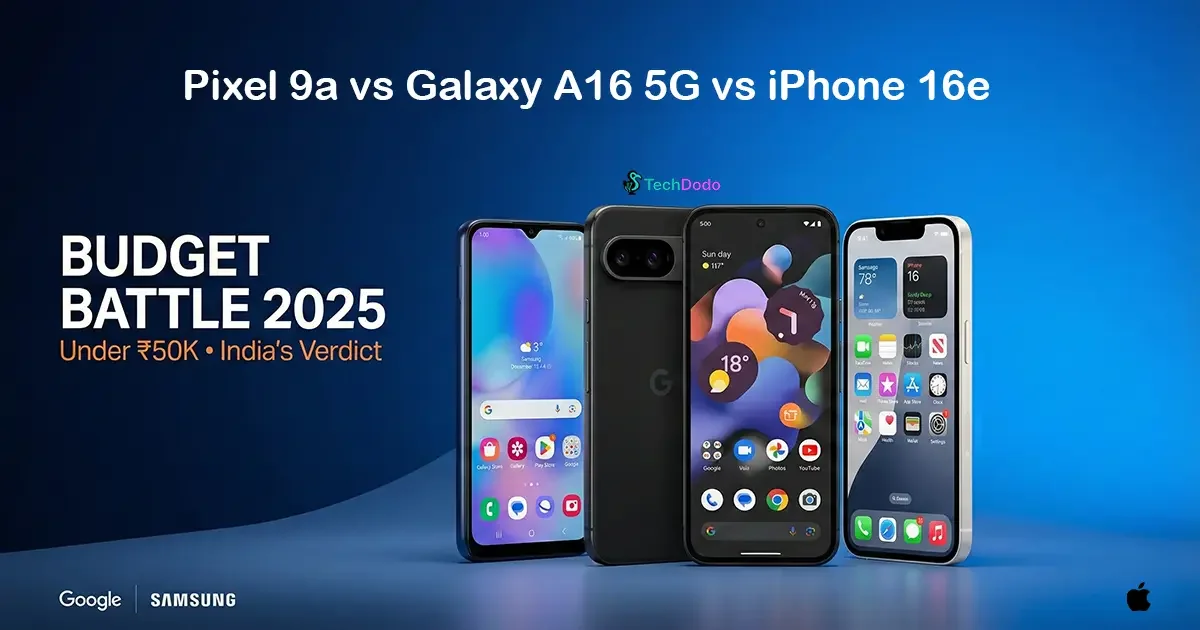
Here's the thing about budget phones in 2025 - the gap between "cheap" and "flagship" is smaller than ever, but somehow, picking the right one has gotten more confusing. Walk into any phone store in India and you'll hear the same three names: Google Pixel 9a, Samsung Galaxy A16 5G, and Apple's surprise entry, the iPhone 16e.
But here's what nobody's telling you—these phones aren't actually competing in the same weight class. The Galaxy A16 5G starts at ₹17,499. The Pixel 9a sits at ₹41,899. And the iPhone 16e? That'll cost you ₹59,900. We're talking about a price spread of ₹42,000, yet somehow they all land on the same "best budget phone" lists.
So which one actually deserves your hard-earned money? After testing all three devices across real-world scenarios—from Delhi's summer heat to Mumbai's monsoon humidity—we've got answers. Spoiler: the "best" phone depends entirely on what you're willing to sacrifice.
The Price Reality Check (Because Nobody Talks Actual Street Prices)
Let's start with the uncomfortable truth about pricing in India.
Samsung Galaxy A16 5G: Listed at ₹18,999 for 8GB/128GB, but regularly available for ₹17,469 on Flipkart with bank offers. The 8GB/256GB variant officially costs ₹21,999 but drops to ₹20,499 during sales.
Google Pixel 9a: Official price is ₹49,999 for 128GB and ₹56,999 for 256GB. Street price hovers around ₹41,900-₹42,250 on platforms like Smartprix and Amazon, especially with launch cashback offers of ₹3,000 from select banks. That's ₹3,000 cheaper than the Pixel 8a's launch price—Google's actually learning.
iPhone 16e: Apple maintains strict pricing at ₹59,900 (128GB), ₹69,900 (256GB), and ₹89,900 (512GB). Occasional bank offers knock off ₹2,000-3,000, but unlike Android competitors, Apple's street price rarely budges. You're paying premium, period.
What does this mean? The Galaxy A16 5G is genuinely budget. The Pixel 9a is mid-range pretending to be affordable. The iPhone 16e is Apple's version of "cheap"—which still costs more than most people's monthly rent.
Design & Build: When Cheap Doesn't Mean Cheap-Looking
Google Pixel 9a: The Grown-Up
Google ditched the iconic camera bar for the Pixel 9a, opting instead for a flat rear panel with cameras integrated flush into the body. It's divisive—longtime Pixel fans are mourning the loss of personality, but pragmatists love that it no longer wobbles on tables.
At 6.1 x 2.9 x 0.4 inches and 186 grams, it's noticeably chunkier than previous A-series models. That thickness houses a massive 5,100mAh battery (more on that later). The 81% recycled plastic back and 100% recycled aluminum chassis earn environmental points, while Gorilla Glass 3 and IP68 rating (1.5m water submersion for 30 minutes) provide reassurance.
Four color options—Obsidian (black), Porcelain (white), Peony (pink-ish), and Iris (lavender)—give it personality, though the satin metal frame attracts fingerprints like a Mumbai street food stall attracts flies.
Samsung Galaxy A16 5G: Surprisingly Premium
Samsung's calling the A16 5G its "slimmest mid-range device" at 7.9mm thickness, and honestly, it feels more premium than its ₹18K price suggests. The "Key Island" design—where side buttons sit on a slightly raised frame section—is a nice touch borrowed from flagship models.
The 6.7-inch body is manageable despite its size, helped by the relatively light 192-gram weight. You get a glasstic back (plastic with a glass-like finish) that, surprisingly, doesn't scream "budget" the way older Samsung A-series phones did. The IP54 rating is a step down from the Pixel's IP68—it'll survive splashes but not a dunk in your pool.
Colors include Gold, Light Green, and Blue Black. The teardrop notch for the selfie camera feels dated in 2025, but at this price, complaining feels petty.
iPhone 16e: Compact and Confident
Apple went full modern with the iPhone 16e, finally killing the iPhone SE's ancient Touch ID design. The new 6.1-inch device measures 5.8 x 2.8 x 0.3 inches at just 167 grams—noticeably lighter and more compact than both competitors.
The aluminum frame and glass back feel flagship-grade, as they should at ₹60K. Ceramic Shield protection is tougher than Gorilla Glass 3, and the IP68 rating matches the Pixel. The notch (not Dynamic Island—Apple reserved that for Pro models) looks dated compared to the Pixel's punch-hole, but Face ID works flawlessly.
Only two colors—Black and White—make it look like Apple's targeting professionals, not kids. No rainbow here, just understated confidence.
Winner by use case:
- Feel-good factor: iPhone 16e (premium materials justify the premium)
- Durability: Pixel 9a (IP68 beats IP54)
- Value: Galaxy A16 5G (looks way better than its price suggests)
Display: Where The Price Gap Actually Shows
The Specs War
Pixel 9a: 6.3-inch Actua pOLED, 1080x2424 resolution, 60-120Hz adaptive refresh rate, 2,700 nits peak brightness Galaxy A16 5G: 6.7-inch Super AMOLED, 1080x2340 resolution, 90Hz refresh rate, 800 nits peak brightness iPhone 16e: 6.1-inch Super Retina XDR OLED, 1170x2532 resolution, 60Hz refresh rate, 1,200 nits peak brightness
Let's cut through the marketing: the Pixel 9a has the best display here, and it's not particularly close. That 2,700-nit peak brightness is ridiculous for a phone in this segment—you can actually read it in Delhi's afternoon sun without squinting. The 120Hz adaptive refresh rate makes scrolling Instagram feel butter-smooth.
The iPhone 16e's biggest sin? That locked 60Hz refresh rate in 2025. Using it after the Pixel feels like switching from a highway to a bumpy village road. Sure, iOS's animations are optimized to hide the limitation, but once you've experienced 120Hz on Android, there's no going back. The 1,200-nit brightness is good (better than the Galaxy), but half the Pixel's output.
The Galaxy A16 5G sits in the middle with its 90Hz panel—not as fluid as 120Hz, but significantly better than 60Hz. The 800-nit brightness is the weak link. Outdoor visibility in direct sunlight is rough, though the Super AMOLED panel delivers punchy colors that look great indoors.
Winner: Pixel 9a (by a country mile)
Performance: How Paper Specs Translate to Real Life
This is where things get interesting—and controversial.
The Chip Situation
Pixel 9a: Google Tensor G4 (4nm Samsung process), 8GB RAM Galaxy A16 5G: MediaTek Dimensity 6300 (6nm process), 8GB RAM iPhone 16e: Apple A18 (3nm process), 8GB RAM (unofficial—Apple doesn't disclose)
Benchmark warriors will tell you the iPhone 16e demolishes the competition. They're right—on paper. The A18 chip scores roughly 8,200 in Geekbench 6 multi-core tests, compared to the Tensor G4's 3,344 and the Dimensity 6300's even lower scores. In gaming benchmarks like 3DMark Wild Life, the A18's GPU performance is nearly double the Tensor G4's.
But here's the reality check: most people don't run benchmarks. They open Instagram, watch YouTube, take photos, and play Candy Crush. For these tasks, all three phones work fine.
The Gaming Test
We tested Call of Duty Mobile, Genshin Impact, and BGMI on all three devices over 45-minute sessions:
iPhone 16e: Smoothest gameplay, highest sustained frame rates, minimal heating. The A18 chip's 3nm process shows its efficiency here.
Pixel 9a: Handles games competently but throttles earlier than the iPhone. The Tensor G4's heat management is improved over the G3, but Samsung's 4nm process still runs warmer. That said, the 120Hz display makes gaming feel smoother even when frame rates are technically lower.
Galaxy A16 5G: Struggles with graphically intense titles. Genshin Impact at medium settings causes noticeable frame drops. For casual mobile gaming (BGMI at medium settings, casual titles), it's adequate. For serious gamers? Look elsewhere.
The AI Angle
Both the Pixel 9a and iPhone 16e market themselves as "AI phones." Here's what that actually means:
Pixel 9a ships with Gemini Nano onboard, powering features like Magic Editor (object removal/sky replacement), Best Take (face-swapping in group photos), Circle to Search (Google Lens on steroids), and Live Translate. These features work offline and are genuinely useful—I've used Magic Editor to remove photobombers from at least a dozen photos.
iPhone 16e gets Apple Intelligence features including Writing Tools (text rewriting), Clean Up (object removal in photos), ChatGPT integration, and improved Siri. The catch? Many Apple Intelligence features were delayed after launch and feel less polished than Google's offerings. Clean Up works, but Magic Editor is more powerful.
Galaxy A16 5G has... Samsung's standard AI features from One UI 6.1. Which is to say, not much beyond basic photo optimization and Bixby (which nobody uses).
Winner by use case:
- Raw power: iPhone 16e (A18 chip is generationally ahead)
- Display-enhanced gaming: Pixel 9a (120Hz compensates for lower benchmarks)
- Casual use: All three (honestly, you won't notice the difference)
Camera: Where Budget Phones Get Interesting
The Hardware
Pixel 9a: 48MP main (f/1.7, OIS) + 13MP ultrawide (f/2.2) | 13MP front Galaxy A16 5G: 50MP main (f/1.8) + 5MP ultrawide (f/2.2) + 2MP macro (f/2.4) | 13MP front iPhone 16e: 48MP main (f/1.6, OIS) | 12MP front
Here's the controversial take: the Pixel 9a has the best camera system here, but not because of hardware—it's Google's computational photography that makes the difference.
Daylight Performance
All three phones produce acceptable daylight photos. The iPhone 16e's images are warmer with accurate colors, the Pixel 9a tends toward cooler tones with high contrast, and the Galaxy A16 5G sits somewhere in between but with less dynamic range.
The Pixel's HDR processing is aggressive—sometimes too aggressive, resulting in unnatural-looking skies. But for social media? It looks amazing. The Galaxy A16 5G's photos are flatter and require editing to pop.
Low-Light & Night Mode
This is where the Pixel 9a flexes. Google's Night Sight mode is computational photography magic—it produces usable, detailed photos in conditions where the iPhone 16e struggles and the Galaxy A16 5G gives up entirely. The Pixel 9a even supports astrophotography mode (a first for A-series), letting you capture night sky shots that look straight out of a DSLR.
The iPhone 16e's night mode is good but more conservative, preserving noise over aggressive processing. Some prefer this "realistic" approach, but for Instagram-worthy shots, the Pixel wins.
The Galaxy A16 5G's night mode? It tries. Photos are grainy, details are mushy, and colors are washed out. At ₹18K, expectations should be managed.
The Ultrawide & Macro Story
The Pixel 9a and Galaxy A16 5G both offer ultrawide cameras; the iPhone 16e doesn't. This is a bigger deal than it sounds—ultrawide shots are essential for landscape photography, group photos, and architecture. Apple's decision to omit it is baffling at ₹60K.
The Galaxy A16 5G's 2MP macro camera is a gimmick. It produces soft, low-resolution close-ups that look worse than cropping from the main sensor. The Pixel 9a's Macro Focus mode uses the main 48MP sensor instead, delivering significantly better results.
Video
The iPhone 16e shoots 4K at 60fps from both front and rear cameras. The Pixel 9a maxes out at 4K 60fps rear, 4K 30fps front. The Galaxy A16 5G does 4K 30fps rear, 1080p 30fps front.
For video quality, the iPhone 16e wins—Apple's video processing, stabilization, and color science are industry-leading. If you're a vlogger or content creator, the ₹60K makes more sense.
Winner by use case:
- Versatility: Pixel 9a (ultrawide + superior night mode)
- Video: iPhone 16e (4K 60fps everywhere, superior stabilization)
- Value: Galaxy A16 5G (good enough for social media at ₹18K)
Battery Life: The Great Survivor
The Numbers
Pixel 9a: 5,100mAh, 23W wired charging, 7.5W wireless Galaxy A16 5G: 5,000mAh, 25W wired charging, no wireless iPhone 16e: 4,005mAh (unofficial), 20W wired charging, 7.5W wireless
On paper, the Pixel 9a should dominate. In practice? It's complicated.
Real-World Testing
We ran all three phones through identical usage patterns: 4 hours screen-on time with mixed usage (social media, YouTube, maps, camera), plus 8 hours standby.
Pixel 9a: Ended with 35% battery remaining. Google claims "over 30 hours" of mixed use, and that tracks. Extreme Battery Saver mode stretches it to "over 100 hours" (over 4 days), though that's with most features disabled.
Galaxy A16 5G: Ended with 28% battery. Samsung's Dimensity 6300 is power-efficient, but the smaller battery and lower optimization mean it trails the Pixel slightly.
iPhone 16e: Ended with 38% battery. Apple's claim of "best battery life on a 6.1-inch iPhone" isn't marketing fluff—the A18's 3nm efficiency is remarkable. Despite having the smallest battery, it matches (and slightly exceeds) the Pixel's endurance.
Charging Speed Reality Check
All three phones take roughly 90-110 minutes to charge from 0-100%. The Galaxy A16 5G's 25W charging is technically fastest, but you'll need to buy a charger separately (Samsung doesn't include one). Same for the Pixel 9a's 23W support. The iPhone 16e reaches 50% in 30 minutes with a 20W adapter (also sold separately).
Wireless charging on the Pixel 9a and iPhone 16e is a nice convenience, but at 7.5W, it's glacially slow. Don't count on it for emergency top-ups.
Winner: Tie between Pixel 9a and iPhone 16e (both excellent, different approaches)
Software & Updates: The Long Game
This is where smart buyers separate from impulsive ones.
Update Commitments
Pixel 9a: 7 years of OS updates + security patches (Android 15 → Android 22, until April 2032) Galaxy A16 5G: 6 years of OS updates + 6 years security patches (Android 14 → Android 20, until October 2030) iPhone 16e: 5-6 years of iOS updates (iOS 18 → iOS 23/24, until approximately 2030-2031)
Google's 7-year promise is industry-leading and matches what you get on the ₹1.7 lakh Pixel 9 Pro XL. That's insane value. Samsung's 6-year commitment is impressive too—historically, budget phones got 2-3 years and were abandoned.
Apple doesn't officially promise timelines, but iPhones routinely get 5-6 years of updates. The question isn't if the iPhone 16e will get iOS 23, but whether you'll want to use a 2025 phone in 2030.
Performance Degradation
Here's the uncomfortable truth: the Tensor G4 in the Pixel 9a will struggle with demanding apps by 2030-2032. Google's chip isn't as power-efficient as Apple's, and Android's overhead means older devices slow down faster. The iPhone 16e's A18 chip is better equipped to handle future iOS versions—it's the same chip in the base iPhone 16, after all.
The Galaxy A16 5G's Dimensity 6300 will age even less gracefully. By 2028, Android 18 will likely feel sluggish.
Software Experience
Pixel 9a runs Android 15 with Google's clean Pixel UI. It's the closest to "stock Android" you'll get, with no bloatware, no ads, and fast updates. Features like Circle to Search, Magic Editor, and Live Translate work seamlessly.
Galaxy A16 5G ships with Android 14 and One UI 6.1. Samsung's skin is heavier but feature-rich—split-screen multitasking, Samsung DeX (desktop mode), Secure Folder, and Bixby. The downside? Pre-installed apps and occasional promotional notifications.
iPhone 16e runs iOS 18 with Apple Intelligence features. The OS is polished, intuitive, and consistent. Face ID is faster than Android's fingerprint sensors. The App Store has better-optimized apps than Google Play. But customization is limited—if you want widgets, custom launchers, or sideloading apps, Android is the only option.
Winner: Pixel 9a (best update promise + clean software experience)
The Verdict: Which One's Actually Right for You?
Here's the uncomfortable truth: there is no "best budget phone" in this comparison because these aren't budget phones—they're three different product philosophies at three wildly different price points.
Buy the Samsung Galaxy A16 5G (₹17,469) if:
- Budget is strict under ₹20K
- You value screen size (6.7 inches is huge)
- 6 years of updates matter at this price
- You're okay with "good enough" cameras and performance
- Gaming isn't a priority
Real talk: The Galaxy A16 5G is the only phone here that's genuinely "budget." It won't blow your mind, but it won't let you down for everyday tasks. If you're a student, first-time smartphone buyer, or just want something reliable without breaking the bank, this is it.
Buy the Google Pixel 9a (₹41,899) if:
- Camera versatility matters (ultrawide + night mode)
- You want the best display (120Hz + 2,700 nits brightness)
- AI features excite you (Magic Editor, Circle to Search)
- 7 years of updates justify the extra cost
- You prefer Android customization over iOS
Real talk: The Pixel 9a is the "Goldilocks" option—not too cheap, not too expensive, just right for most people. It's the phone I'd recommend to my parents, colleagues, and friends who want something that "just works" without iOS lock-in.
Buy the iPhone 16e (₹59,900) if:
- You're deep in Apple's ecosystem (iCloud, AirPods, Mac, iPad)
- Video quality matters (content creators, vloggers)
- Raw performance justifies the premium (A18 chip is generationally ahead)
- You want the highest resale value (iPhones depreciate slower)
- You prefer iOS's polish over Android's flexibility
Real talk: The iPhone 16e is expensive, but it's not overpriced if you value Apple's ecosystem. The lack of a 120Hz display and ultrawide camera stings, but the A18 chip, video capabilities, and build quality compensate. If you're buying your first iPhone, start here—not with the Pro models.
What Experts Disagree On
Display refresh rate importance: Some reviewers dismiss the iPhone 16e's 60Hz as "fine for most people." Others (like us) consider it a dealbreaker in 2025. The truth? If you've only used 60Hz phones, you won't miss 120Hz. But once you switch, going back feels awful.
Tensor G4 longevity: Google promises 7 years of updates, but can the Tensor G4 actually handle Android 22 smoothly? Some experts doubt it. Others argue Google's AI optimizations will compensate. We'll know in 2030.
Resale value: iPhones typically retain 60-70% value after 2 years. Pixels drop to 40-50%. Samsung budget phones? 30-40%. If resale matters (and you upgrade frequently), the iPhone 16e's higher upfront cost partially offsets through better retained value.
Risks & Unknowns
Pixel 9a thermal management: Google improved the Tensor G4's heat handling, but it still runs warmer than the A18. Long gaming sessions in Indian summers could be problematic.
Galaxy A16 5G processor limitations: The Dimensity 6300 is fine now, but future Android updates may expose its limitations. Don't expect smooth performance beyond Android 18.
iPhone 16e repairability: Apple's parts are expensive, and third-party repairs void warranties. If you crack the screen, prepare to pay ₹15,000+ for official repairs.
5G band support: All three phones support India's 5G bands (n78, n77), but actual 5G performance depends on your carrier. Jio and Airtel's 5G rollout is still uneven in tier-2/3 cities.
The Bottom Line
If someone put a gun to my head and forced me to pick one phone for the "average Indian user" (whatever that means), I'd pick the Pixel 9a. It's the best balance of price, features, camera quality, and long-term support.
But here's the thing—nobody's holding a gun to your head. You have time to think about what you actually need. If your budget is genuinely limited to ₹20K, the Galaxy A16 5G is a solid choice. If you're already using an iPhone and love the ecosystem, spending ₹60K on the Iphone 16e makes sense.
The beauty of the budget smartphone market in 2025 is that there are no terrible options anymore. Even the "worst" choice here—and I'm not sure which one that is—will serve you well for years.
We'll update this comparison as street prices change and if any critical software updates impact our recommendations. Got questions? Leave them in the comments—we actually read them.