Here's the uncomfortable truth about the Indian flagship smartphone market in 2025: you can get the exact same Qualcomm Snapdragon 8 Elite processor in two phones with a ₹55,000 price difference. The OnePlus 13 starts at ₹69,999 while the Samsung Galaxy S25 Ultra demands ₹1,24,999 for its base variant.
So what exactly does Samsung's premium buy you? And more importantly, is the OnePlus 13 actually the smarter choice for most Indian buyers? After analyzing benchmark data, camera comparisons, and real-world usage patterns, the answer isn't as straightforward as the price gap suggests.
The Core Hardware: Identical Brains, Different Bodies
Both phones run on Qualcomm's Snapdragon 8 Elite chipset, manufactured on TSMC's 3nm process. Samsung markets theirs as "Snapdragon 8 Elite for Galaxy" with a slight overclock — the prime cores hit 4.47GHz compared to the standard 4.32GHz. In practice, this translates to marginal benchmark differences that most users won't notice during everyday tasks.
The OnePlus 13 scored approximately 2.75 million points on AnTuTu 10 during testing, while the S25 Ultra edges ahead with slightly higher numbers thanks to its binned silicon. Geekbench 6 tells a similar story — single-core scores hover around 3,000 points for both devices, with multi-core performance reaching approximately 9,200 points.
Here's the catch: Samsung's aggressive performance tuning comes with thermal management trade-offs. Multiple reviewers have noted that the S25 Ultra throttles more aggressively during sustained workloads to manage heat, while the OnePlus 13 maintains steadier performance during extended gaming sessions.
Specification | Samsung Galaxy S25 Ultra | |
Processor | Snapdragon 8 Elite | Snapdragon 8 Elite for Galaxy |
RAM Options | 12GB / 16GB / 24GB | 12GB / 16GB |
Storage Options | 256GB / 512GB / 1TB | 256GB / 512GB / 1TB |
Price (Base) | ₹69,999 | ₹1,24,999 |
AnTuTu Score | ~2.75M | ~2.8M |
Display: Both Excellent, Samsung Slightly Ahead
The OnePlus 13 features a 6.82-inch LTPO OLED panel with QHD+ resolution (1440 x 3168 pixels) and a 120Hz adaptive refresh rate. Peak brightness reaches 4,500 nits according to OnePlus, making it highly visible in direct sunlight. The display earned an A++ rating from DisplayMate and supports HDR10+, Dolby Vision, and HDR Vivid.
Samsung counters with a 6.9-inch Dynamic AMOLED 2X display at QHD+ resolution (1440 x 3120 pixels). The S25 Ultra introduced second-generation Gorilla Glass Armor with improved anti-reflective properties, which technically delivers better outdoor visibility despite posting lower peak brightness numbers of around 2,600 nits in standard testing conditions.
Both displays support 1-120Hz adaptive refresh rates and look stunning in typical usage scenarios. The OnePlus 13's slightly smaller footprint makes it marginally easier to handle single-handed, though neither qualifies as a compact device.
Battery & Charging: OnePlus Dominates
This is where the price difference becomes genuinely confusing. The OnePlus 13 packs a 6,000mAh silicon-carbon battery — a full 1,000mAh larger than the S25 Ultra's conventional 5,000mAh cell. OnePlus adopted silicon-carbon chemistry, which offers higher energy density while remaining thinner than traditional lithium-ion batteries.
Real-world implications are significant. In battery benchmark testing, the OnePlus 13 achieved approximately 19 hours and 45 minutes of active use according to Tom's Guide, while the S25 Ultra clocked in at around 17 hours and 15 minutes. Multiple reviewers report the OnePlus 13 comfortably lasting two days with moderate usage, while the S25 Ultra remains a reliable one-day phone.
Charging tells an even more dramatic story. The OnePlus 13 supports 100W wired charging (reaching 100% in approximately 42 minutes) and 50W wireless charging with compatible magnetic chargers. Samsung's S25 Ultra caps at 45W wired charging, requiring around 82 minutes for a full charge. Wireless charging tops out at 25W on the Samsung.
Battery Metric | Samsung Galaxy S25 Ultra | |
Capacity | 6,000mAh (Silicon-Carbon) | 5,000mAh (Li-ion) |
Wired Charging | 100W | 45W |
Wireless Charging | 50W | 25W (Qi2 compatible) |
0-100% Time (Wired) | ~42 minutes | ~82 minutes |
Endurance Rating | ~19h 45m | ~17h 15m |
Camera Systems: Samsung's Versatility vs OnePlus's Consistency
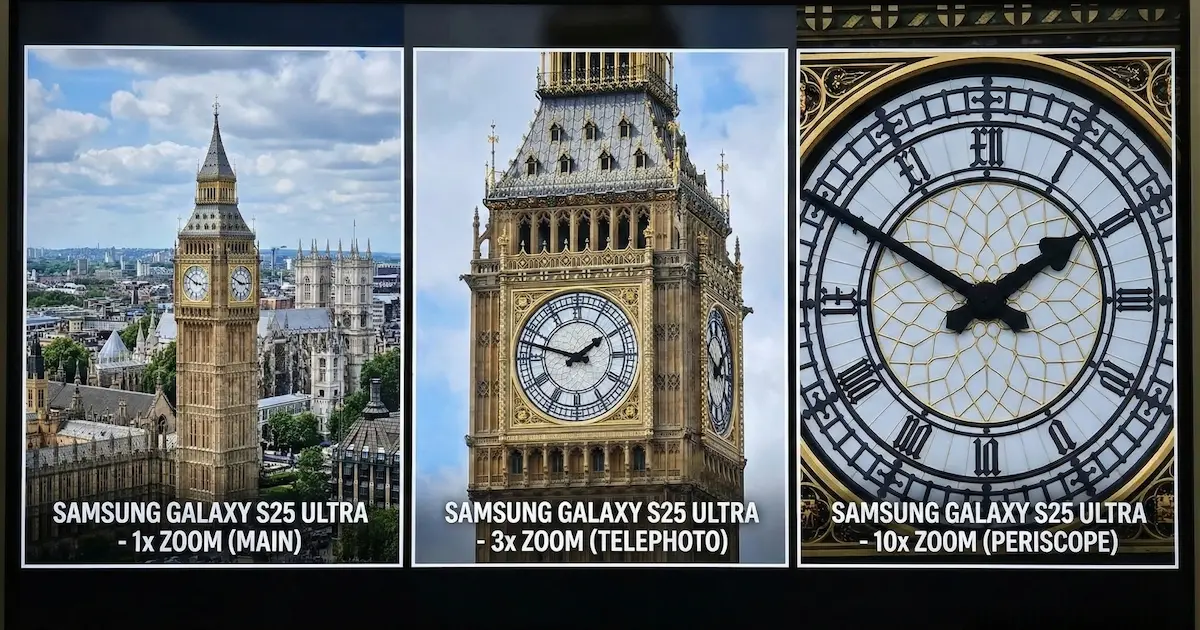
The S25 Ultra retains Samsung's kitchen-sink approach to mobile photography. The quad-camera setup includes a 200MP primary sensor, a new 50MP ultrawide (upgraded from 12MP on the S24 Ultra), a 10MP 3x telephoto, and a 50MP 5x periscope telephoto. This configuration excels at zoom photography, with usable results extending well beyond 10x magnification.
OnePlus simplified its approach with three 50MP sensors across the board — primary (Sony LYT-808), ultrawide (Samsung JN1), and 3x telephoto (Sony LYT-600). The Hasselblad partnership continues for colour tuning, though purists note the processing can be heavy-handed with contrast and saturation.
Camera comparison testing reveals nuanced results. At 1x magnification, both phones produce excellent images, though the S25 Ultra tends toward more subdued, natural colours while the OnePlus 13 pushes contrast and vibrancy. The Samsung handles HDR scenes more gracefully, revealing shadow detail that OnePlus sometimes clips.
Zoom performance heavily favours Samsung. At 3x, the OnePlus 13's dedicated telephoto actually produces sharper results thanks to its larger sensor. However, beyond 5x, Samsung's periscope lens delivers noticeably superior detail and less noise. The S25 Ultra's 10x telephoto capabilities remain unmatched in this comparison.
Low-light photography presents interesting trade-offs. The OnePlus 13 tends to brighten night scenes aggressively, sometimes creating artificially bright images. Samsung's approach preserves more ambient atmosphere, though neither phone struggles with typical low-light scenarios.
Video capabilities remain roughly equivalent, with both supporting 8K recording at 30fps. Samsung adds LOG video recording for professional colour grading workflows, Audio Eraser for removing unwanted sounds from footage, and more comprehensive video editing tools through its Galaxy AI suite.
Software & Longevity: Samsung's Clear Advantage
Software support represents perhaps the most significant differentiator. Samsung commits to seven years of Android OS updates and seven years of security patches for the S25 Ultra. The phone launched with Android 15 and One UI 7, meaning it will receive updates through Android 22 (expected around 2032).
OnePlus offers four years of Android updates and six years of security patches — respectable by industry standards but substantially shorter than Samsung's commitment. The OnePlus 13 running OxygenOS 15 will receive Android 16, 17, 18, and 19 before being cut off.
One UI 7 on the S25 Ultra represents Samsung's most polished software release, with deep Galaxy AI integration including Now Brief (personalized daily briefings), Circle to Search (enhanced visual search), Audio Eraser, and extensive on-device AI processing through the Personal Data Engine. The S Pen stylus adds productivity capabilities absent from the OnePlus, though Samsung removed Bluetooth connectivity from the S25 Ultra's S Pen, eliminating remote camera shutter and air gesture features.
OxygenOS 15 on the OnePlus 13 delivers a cleaner, faster user experience with less bloatware and quicker animations. AI features include Global Search, AI Notes, and AI Reply for messaging apps, though the suite feels less comprehensive than Samsung's offering.
Durability: OnePlus Surprises
The OnePlus 13 arrives with dual IP68 and IP69 certification across all variants — a significant upgrade from previous generations. The IP68 rating ensures protection against submersion in 1.5 meters of water for 30 minutes, while IP69 means resistance to high-pressure, high-temperature water jets.
Samsung's S25 Ultra carries the standard IP68 rating. Both phones use premium materials — titanium frames on both devices (Samsung upgraded to Grade 5 titanium), with Gorilla Glass protection front and back.
What Samsung's Premium Actually Buys
For the additional ₹55,000, the Galaxy S25 Ultra delivers:
- Superior zoom photography beyond 5x magnification
- Seven years of software updates versus four
- S Pen stylus with note-taking and productivity features
- More comprehensive AI features through Galaxy AI
- 200MP main camera with more resolution headroom for cropping
- Samsung ecosystem integration including DeX desktop mode
- Higher resale value historically in the Indian market
What OnePlus 13 Excels At
The OnePlus 13 counters with:
- Substantially lower price (₹55,000 savings)
- Larger 6,000mAh battery with silicon-carbon technology
- Faster 100W wired charging and 50W wireless charging
- Better IP69 water resistance rating
- Cleaner software experience with fewer pre-installed apps
- Slightly better sustained performance during extended gaming
The Verdict: Two Different Value Propositions
The Samsung Galaxy S25 Ultra remains the most complete Android smartphone available — but "complete" comes with a significant price tag that's difficult to justify purely on specifications.
For photography enthusiasts who regularly use zoom capabilities, productivity-focused users who value the S Pen, or anyone planning to keep their phone for five years or longer, Samsung's premium makes sense. The seven-year update commitment essentially guarantees the S25 Ultra will remain secure and functional well into 2032.
The OnePlus 13 represents exceptional value for Indian consumers who prioritize battery life, fast charging, and flagship performance without the ₹1+ lakh price tag. Its camera system handles 90% of shooting scenarios admirably, and the silicon-carbon battery technology provides a genuinely superior ownership experience for heavy users.
The honest answer? Most Indian buyers would be better served by the OnePlus 13 and banking the ₹55,000 difference. The S25 Ultra's advantages — while real — are increasingly niche in a market where smartphone cameras have reached "good enough" status for the majority of users.