Tech War: GPT-5.2 vs. Gemini 3 "Deep Think"—Which Model Actually Solves Math Better?
Let’s be honest: The last four weeks in AI have been exhausting. First, Google drops Gemini 3 in mid-November, claiming it can "think deeply" enough to solve humanity’s last exams. Then, OpenAI goes into a rumored "code red" and panic-ships GPT-5.2 just two days ago (December 11).
If you’re feeling severe whiplash, you’re not alone.
But amidst the marketing noise, the "100% context retention" claims, and Sam Altman’s cryptic tweets, one question actually matters for those of us trying to get work done: Which one of these digital brains can actually do the math? And I don’t mean simple arithmetic. I mean the nasty, complex, graduate-level problem-solving that usually makes LLMs hallucinate like a college student on finals week.
I’ve spent the last 48 hours running both models through the wringer. Here is the candid, zero-bullshit verdict on the Battle of the Brains: December 2025 Edition.
The Contenders: A Quick Tale of the Tape
Before we throw them into the calculus ring, let’s understand what we’re actually paying for.
1. Google Gemini 3 "Deep Think"
Released: November 18, 2025
- The Gimmick: "Parallel Reasoning." Instead of one chain of thought, it explores multiple paths simultaneously.
- Access: Google AI Ultra Subscription.
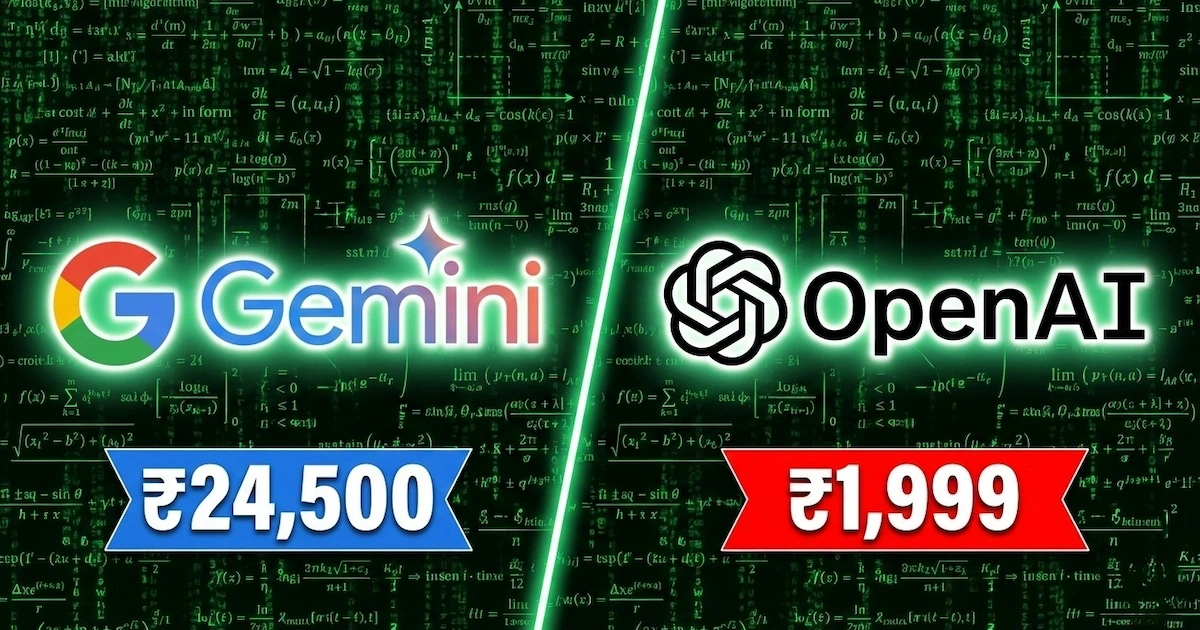
- India Pricing: Hold onto your wallets—₹24,500 per month. (Yes, you read that correctly. It’s priced for enterprise power-users, not casual chatters).
2. OpenAI GPT-5.2 (Thinking & Pro)
Released: December 11, 2025
- The Gimmick: Three flavors—Instant, Thinking, and Pro. "Thinking" is the sweet spot; "Pro" is the slow, expensive genius.
- Access: ChatGPT Plus/Pro/Enterprise.
- India Pricing: Standard Plus plans remain stable (~₹1,999/mo), but API costs for the "Pro" model are eye-watering ($21 per 1M input tokens).
Round 1: The Benchmarks (Paper Tigers?)
If you believe the press releases, both models are basically Einstein. But looking at the specific math benchmarks gives us a clearer picture of their distinct personalities.
The "FrontierMath" Test
This is the new gold standard—problems so hard they take graduate students hours.
- GPT-5.2 Thinking: Solved 40.3% of problems correctly.
- The Verdict: This is a "new industry record" according to OpenAI. If you need to solve partial differential equations or obscure statistical learning theory problems, GPT-5.2 seems to have the raw edge in textbook derivation.
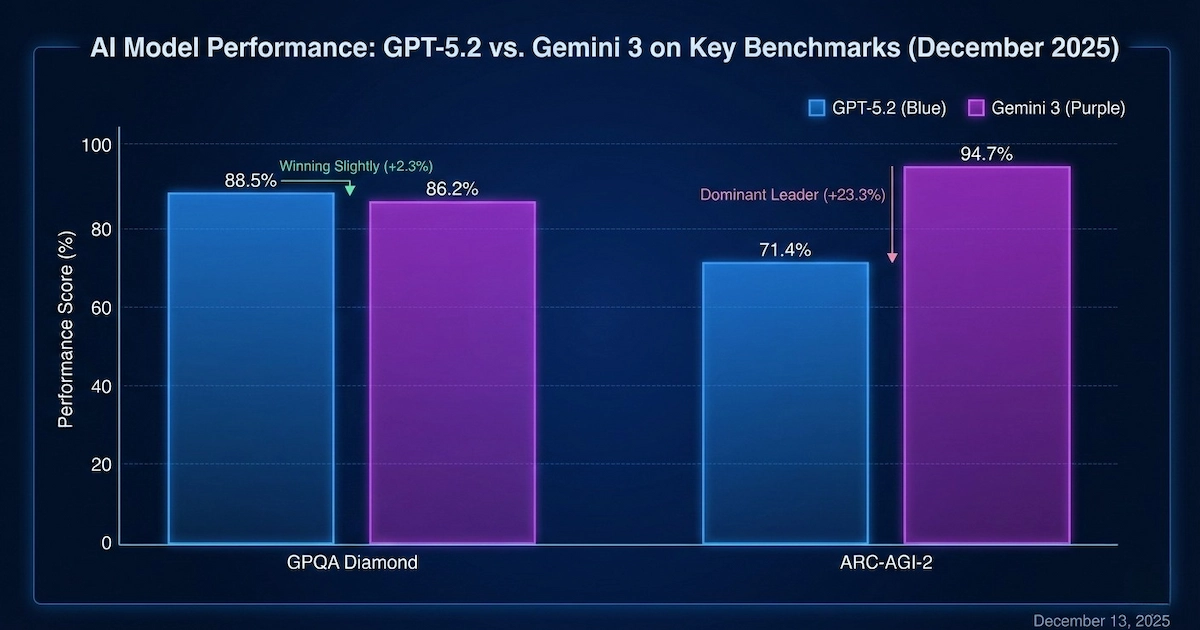
The "ARC-AGI-2" Test (Novel Reasoning)
This measures the ability to solve visual puzzles and logic problems the model has never seen before (no memorization allowed).
- Gemini 3 Deep Think: Scored 45.1%.
- GPT-5.1 (Previous Gen): Scored a measly 17.6%.
- The Verdict: Google is crushing it here. While GPT-5.2 is better at known math, Gemini 3 appears significantly more capable at novel puzzle solving and logic where there is no textbook answer to copy.
Round 2: The "Deep Think" Experience
Here is where the two diverge in philosophy.
Google's Approach: The Research Partner
Gemini 3 Deep Think feels like a research partner. It uses "System 2" search techniques (likely derived from AlphaProof) to "think" before answering.
- The Experience: You ask a question. The interface spins for 30 seconds. It shows you three different "thought paths" it considered.
- The Reality: It is painfully expensive in India. That ₹24,500/month price tag essentially gates this technology behind a corporate paywall.
OpenAI's Approach: The Daily Driver
GPT-5.2 "Thinking" is designed to be the daily driver.
- The Experience: Faster, punchier. Hallucination rates have dropped to 10.9% (down from ~16% in GPT-5). When it uses a browser, that drops further to 5.8%.
- The "Pro" Edge: OpenAI claims GPT-5.2 Pro helped researchers solve a 2019 open problem in statistical learning theory without human pointers. That is terrifyingly impressive.
Note: OpenAI has split the user base. "Instant" is for quick chats. "Thinking" is for work. "Pro" is for discovery. Be careful which one you select in the dropdown; the API costs for Pro are 12x higher than the base model.
Comparison: The Pros & Cons
Since we are talking about your money (and potentially your grades or job), let's break down the trade-offs directly.
Feature | OpenAI GPT-5.2 (Thinking) | Google Gemini 3 (Deep Think) |
Math Strength | Textbook Genius. Excellent at calculus, algebra, and known theorems. | Puzzle Master. Incredible at novel logic and problems never seen before. |
Speed | Fast (5-10 seconds per step). | Slow (20-60 seconds "thinking" time). |
India Pricing | Affordable (~₹1,999/mo). | Enterprise only (~₹24,500/mo). |
Context Window | 128k Tokens (Standard). | 2 Million Tokens (Massive). |
Visuals | Good chart generation via Python. | Native visual reasoning (can "see" math diagrams better). |
Best For | Students, Developers, Daily Tasks. | Researchers, Labs, Novel Discovery. |
What Experts Disagree On
There is a fascinating split in the AI community right now regarding "Reasoning":
- Team Google (The "Generalists"): They argue that Novel Reasoning (ARC-AGI-2) is the only path to AGI. Solving math problems from a textbook is just sophisticated memorization; solving a puzzle you've never seen is intelligence.
- Team OpenAI (The "Pragmatists"): They argue that Reliability (GPQA Diamond scores of 93.2%) is what makes a product useful. Who cares if it can solve a puzzle if it gets your tax calculation wrong?
My take? If I'm building a bridge, I want the Pragmatist. If I'm discovering a new element, I want the Generalist.
Risks & Unknowns
Before you commit, be aware of the "Ghost in the Machine."
- The "Confidence" Trap: Both models are now so good that when they do hallucinate, it looks incredibly convincing. GPT-5.2 has a habit of inventing citations that look real but don't exist. Always verify sources.
- Data Privacy (India): Google has not yet clarified if Gemini 3 "Deep Think" data is processed on Indian servers or routed to the US for the heavy compute. For regulated industries (fintech, health), this is a "wait and see" situation.
The Verdict
If you are a student, developer, or engineer in India today, here is the decision matrix:
- For Pure Textbook Math & Science: GPT-5.2 Pro is the current king. Its 93.2% score on GPQA Diamond makes it the ultimate tutor.
- For Logic Puzzles & "Out of the Box" Thinking: Gemini 3 Deep Think. If your math problem requires inventing a new way to look at data, Google’s "parallel reasoning" architecture has the edge.
- For Your Wallet: GPT-5.2. Google’s pricing strategy for Deep Think has effectively disqualified it for 99% of individual users.
My Take: OpenAI was clearly panicked by Gemini 3 (hence the "Code Red"), but they delivered. GPT-5.2 feels like the more polished product, while Gemini 3 feels like the more powerful experiment.