Vivo Vivo X300 5G (V2515 / V2509A)
Price (MRP): ₹75,999.00
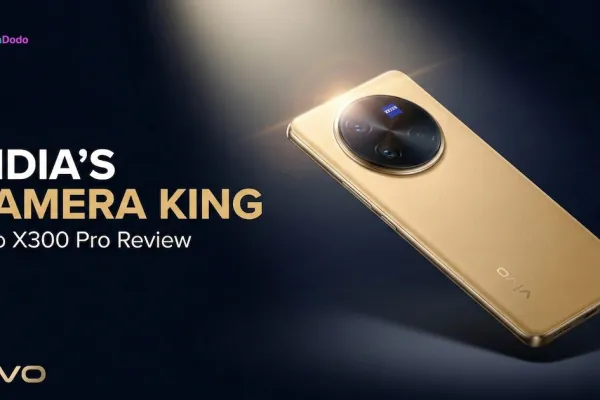
Vivo X300 Review: Compact Flagship Camera King
Ratings
Overall
Design
Performance
Features
Value
Pros & Cons
Pros:
- Compact flagship done right: 6.31" in a 190g package that fits any pocket
- Stellar battery life: 17+ hours active use from 6040mAh cell
- Blazing performance: Dimensity 9500 matches Snapdragon 8 Elite in real-world
- 5 years Android updates: OriginOS 6 commitment beats most competitors
-IP68/IP69 durability: Survives high-pressure water jets and 1.5m submersion
Cons:
- No telephoto camera versatility: 3x optical zoom feels limited at this price
- Premium pricing: ₹75,999 faces Snapdragon 8 Elite competition
- Zeiss Extender sold separately: ₹18,999 for full telephoto potential
- EU gets smaller battery: 5360mAh variant exists in some markets
⚡ Verdict
The Vivo X300 stands as 2025's most complete compact flagship, delivering a 200MP camera system that outclasses phones costing ₹30,000 more in photo consistency, wrapped in a genuinely pocketable form factor. Perfect for photographers tired of choosing between camera quality and one-hand usability. Buy if imaging matters more than peak benchmark scores—competitors like OnePlus 15 and iQOO 15 win synthetic tests, but the X300 wins where it actually counts: in your camera roll.
Scroll for specs, ratings, and where to buy.
Detailed Review
The phone industry forgot that smaller phones exist—Vivo didn't.
In a world of 6.8-inch slabs fighting for "Ultra" supremacy, the Vivo X300 walks in at 6.31 inches and proceeds to embarrass half the flagships twice its size. This isn't a "mini" phone with compromised specs. This is the X200 Pro Mini successor that received the full flagship treatment: same Dimensity 9500 as the Pro, same 6040mAh battery tech, same 5-year update commitment. Vivo essentially deleted the compromise.
Quick Take Box
What it is: A compact flagship smartphone with professional-grade Zeiss cameras and flagship internals, designed for users who prioritize photography and one-hand usability.
Who it's for: Photography enthusiasts who travel light, professionals needing a capable daily driver that doesn't require cargo pants, anyone upgrading from older iPhones who want proper cameras without the bulk.
Reality check: The 3x telephoto won't match the X300 Pro's 200MP periscope reach, and the speakers won't impress audiophiles. You're paying flagship prices for flagship photography—not flagship audio or zoom range.
Design & Build Quality
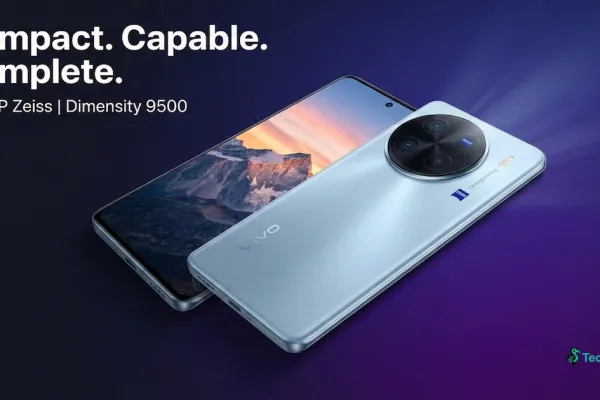
The X300 nails compact flagship design. At 150.6 x 71.9 x 8mm and 190g, this feels like the phone Samsung forgot to make when they abandoned reasonable screen sizes. The matte glass back resists fingerprints admirably, and that circular Zeiss camera module has become Vivo's signature aesthetic.
Durability credentials are serious: IP68 water resistance for 30-minute submersion at 1.5 meters, plus the IP69 rating for high-pressure water jets. The aluminum alloy frame feels premium without the brick-like weight of competing flagships. The camera module blends into the back panel without dust-collecting gaps—a small detail that shows real engineering thought.
The build uses reinforced glass with a Mohs level 4 rating, and there's an ultrasonic under-display fingerprint scanner replacing the optical readers of previous generations. The scanner is fast, reliable in varied lighting, and works with wet fingers.
For the one-hand crowd: This might be the only 2025 flagship where you can actually reach the notification shade without hand gymnastics.
For the case users: Vivo includes a color-matched protective case in the box—soft finish, decent grip, doesn't add significant bulk.
Display & Multimedia
The 6.31-inch LTPO AMOLED panel delivers flagship visuals:
Specification | Detail |
Resolution | 1216 x 2640 pixels (460 ppi) |
Refresh Rate | 1-120Hz adaptive |
Color Depth | 10-bit, 1B colors |
Peak Brightness | 4500 nits (claimed) / ~2000 nits measured |
HDR Support | HDR10+, HDR Vivid, Ultra HDR |
PWM Dimming | 2160Hz + DC dimming |
Real-world brightness measured at approximately 2000 nits for a 75% white swatch with adaptive brightness enabled, and over 2650 nits for a 10% white window. That's properly impressive for outdoor visibility, though it falls short of the 4500-nit marketing claim (which likely references extremely specific HDR conditions).
Color accuracy is excellent—vivid without being oversaturated, with deep blacks that make streaming content genuinely enjoyable. The 120Hz smoothness is immediately noticeable in UI navigation, and the LTPO implementation drops to 1Hz for static content, preserving battery.
Audio disappointment: Stereo speakers earned a "Very Good" loudness rating in testing but the actual sound quality is average at best. Vocals are acceptable, bass exists but lacks depth, and the high-frequency range falls behind competitors. The Galaxy S25 and iPhone sound noticeably better. If speaker quality matters to you, this isn't your phone.
Performance & Software
The MediaTek Dimensity 9500 powering the X300 was co-developed with Vivo, and the optimization shows:
Benchmark | Score |
AnTuTu v10 | 2,346,352 |
AnTuTu v11 | 3,416,530 |
Geekbench 6 Single-Core | ~3,100 |
Geekbench 6 Multi-Core | ~10,129 |
The Dimensity 9500 sits marginally behind the Snapdragon 8 Elite Gen 5 in raw benchmarks—OnePlus 15 and iQOO 15 will win synthetic tests. In real-world usage? You won't notice the difference. The phone tears through multitasking, launches apps instantly, and handles gaming without complaints.
Thermal management impressed during testing. Extended gaming sessions kept temperatures below 38°C in non-AC environments—remarkable for a compact form factor. The 3nm process efficiency pays dividends here.
Gaming reality: Genshin Impact, Call of Duty Mobile, and demanding titles run smoothly at high settings. The Arm G1-Ultra GPU handles ray tracing, though sustained performance under extended load shows some throttling. Gamers pushing multi-hour sessions might prefer the larger cooling systems in the OnePlus 15 or iQOO 15.
OriginOS 6: This is the biggest software upgrade Vivo has made in years. Based on Android 16, OriginOS 6 replaces FunTouch OS and feels genuinely refined. The translucent design aesthetic is pleasant, animations are smooth, and memory management keeps apps alive in the background effectively. Vivo promises 5 major Android upgrades and 7 years of security patches—matching Samsung's commitment.
The bloatware situation: Some pre-installed apps exist, but the situation is significantly better than previous Vivo phones. Most can be uninstalled, and the overall software experience feels less cluttered.
Camera System
This is where the X300 justifies its existence. The Zeiss-co-engineered triple camera setup:
Camera | Sensor | Lens | Features |
Main | 200MP Samsung ISOCELL HPB (1/1.4") | f/1.68, 23mm | PDAF, OIS, Zeiss T* coating |
Ultrawide | 50MP Samsung JN1 (1/2.76") | f/2.0 | Autofocus |
Telephoto | 50MP Sony LYT-602 (1/1.95") | f/2.57, 70mm (3x optical) | OIS, APO certified |
Front | 50MP Samsung JN1 (1/2.76") | f/2.0, 20mm | Autofocus |
Daylight Performance: The 200MP main camera produces stunning detail with Vivo's characteristically pleasant color science. Images are sharp without aggressive over-sharpening, dynamic range is wide, and highlights are controlled. The 1/1.4-inch sensor size captures enough light for consistently excellent results across varied conditions.
Portrait Excellence: Zeiss color profiles dial back contrast slightly for more natural skin tones. Edge detection is reliable, bokeh appears convincing, and the overall portrait output ranks among the best in the segment.
Telephoto Reality: The 70mm equivalent 3x telephoto earns Zeiss APO certification—impressive optics for a secondary camera. Detail at 3x optical is excellent, and 6x digital zoom remains usable. Macro capability down to 20cm focuses well. However, compared to the X300 Pro's 200MP periscope, zoom reach is limited. The optional Zeiss 2.35x Telephoto Extender (₹18,999) extends optical reach to 7.7x, but that's a significant additional investment.
Ultrawide Performance: 50MP resolution with autofocus produces sharp, detailed ultrawide shots with excellent corner-to-corner consistency. Color matching across all three cameras is seamless.
Low Light: Night mode works effectively without over-brightening scenes. Vivo's approach preserves natural night atmospheres rather than turning darkness into artificial daylight. Noise handling is excellent for the sensor size.
Video Capabilities: 4K recording at 30/60/120fps, with HDR capture available. Stabilization is solid, though not class-leading. 4K Portrait video at 60fps with realistic bokeh is a standout feature—something even iPhones struggle to match. Log video at 4K 120fps with LUT support gives creators serious flexibility.
Front Camera Upgrade: The 50MP autofocus selfie camera is a massive improvement over previous generations. 4K 60fps front video, reliable autofocus, and good low-light performance.
Battery & Charging
The 6040mAh Silicon-Carbon battery delivered an impressive 17 hours 31 minutes Active Use Score in standardized testing:
Test | Endurance |
Voice Calls | Excellent |
Web Browsing | Excellent |
Video Streaming | Excellent |
Gaming | Excellent |
Active Use Score | 17:31 hours |
That's genuinely outstanding for a compact flagship. Real-world usage translates to comfortable full-day battery life with heavy usage, or pushing into day two with moderate use.
Charging Performance (90W FlashCharge):
Duration | Charge Level |
15 minutes | 37% |
30 minutes | 67% |
Full charge | 48 minutes |
Wireless Charging: 40W wireless (upgraded from 30W on X200 series) and reverse wireless/wired charging supported.
EU Battery Warning: European models receive a 5360mAh battery due to shipping regulations—approximately 11% smaller capacity. Indian and Asian models get the full 6040mAh.
Connectivity & Extras
Feature | Specification |
5G Bands | 1, 2, 3, 5, 7, 8, 18, 20, 25, 26, 28, 34, 38, 39, 40, 41, 48, 66, 77, 78 (SA/NSA/Sub6) |
Wi-Fi | Wi-Fi 7 (802.11 a/b/g/n/ac/6/7) dual-band |
Bluetooth | 5.4 with aptX HD, LHDC 5 |
NFC | Yes |
IR Blaster | Yes |
USB | Type-C 3.2, OTG |
Positioning | GPS (L1+L5), GLONASS, BDS, Galileo, QZSS, NavIC |
SIM | Dual Nano-SIM + eSIM (max 2 active) |
Missing Features: No 3.5mm headphone jack, no microSD expansion. The storage starts at 256GB with UFS 4.1—fast enough that the missing card slot won't hurt most users.
IR Blaster: Still useful for controlling TVs, ACs, and appliances. A feature many flagships have abandoned.
Fingerprint Scanner: Ultrasonic under-display reader is fast, reliable, and works with wet fingers—a genuine upgrade over optical alternatives.
Marketing Claims Reality Check
Vivo Claims | Reality |
"4500 nits peak brightness" | ~2000 nits measured in real conditions—excellent but not industry-leading |
"Dimensity 9500 performance" | Competitive with Snapdragon 8 Elite daily; loses in sustained gaming benchmarks |
"Gimbal-grade stabilization" | CIPA 4.5 rating delivers smooth video, though Pro model's 5.5 rating is better |
"Compact flagship without compromise" | True for cameras, battery, performance; compromised on speakers and zoom reach |
"7000mAh equivalent battery efficiency" | Marketing speak—6040mAh performs like 6040mAh, but efficiency is genuinely excellent |
Competitive Analysis
Direct Rival - OnePlus 15 (₹72,999): The OnePlus runs Snapdragon 8 Elite Gen 5, wins benchmark tests, has a larger 6.85" display, bigger 6100mAh battery, and faster 120W charging. The X300 counters with better camera consistency, compact size, and Zeiss imaging. Choose OnePlus for raw power, Vivo for photography.
Value Alternative - iQOO 15 (₹72,999): Same OriginOS 6, massive 7000mAh battery, 144Hz display, Snapdragon 8 Elite Gen 5. Better gaming phone with superior cooling. The X300's 200MP main camera and compact form factor are the differentiators.
Aspirational Upgrade - Vivo X300 Pro (₹1,09,999): Same Dimensity 9500 in a larger 6.78" body with the star attraction: 200MP periscope telephoto for serious zoom photography. Worth the ₹34,000 premium only if telephoto reach is essential.
Regional Considerations for India
- 5G Network Compatibility: Full band support for Jio and Airtel 5G networks
- Manufacturing: Made in India at Vivo's Greater Noida facility
- Service Network: Extensive service center presence across India
- Warranty: 1 year standard + 1 year extended with launch offers
- Battery Version: India receives the full 6040mAh variant (not the reduced EU version)
Sustainability & Longevity
- OS Updates: 5 major Android upgrades promised
- Security Patches: 7 years commitment
- Battery Replacement: Available through authorized service centers (~₹3,500-4,500 estimated)
- Trade-in Value: 60% assured buyback program available at launch
- Repairability: EU Class C rating—moderate repairability
Specifications
General
Where to Buy
Support our reviews by purchasing through these affiliate links. We may earn a commission at no extra cost to you.
Affiliate Disclosure: Links above are affiliate links. When you make a purchase through these links, we may receive a commission. This helps support our content creation and doesn't affect the price you pay.