Xiaomi POCO X7 Pro 5G
Price (MRP): ₹21,999.00
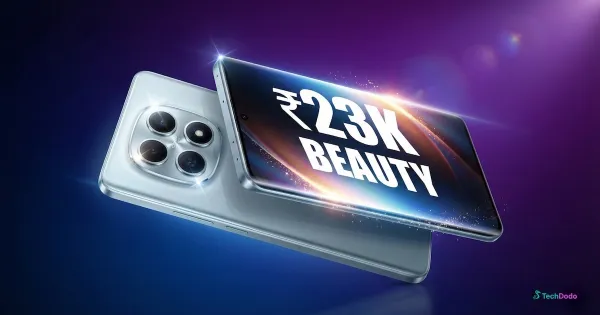
POCO X7 Pro Review: ₹21,999 Gaming Beast That Embarrasses Flagships
Ratings
Overall
Design
Performance
Features
Value
Pros & Cons
Pros:
• Gaming powerhouse: Runs Genshin Impact at stable 60fps on high settings — a first under ₹25K
• India's largest mid-range battery: 6550mAh outlasts everything in the segment
• Rapid charging: 90W HyperCharge hits 100% in 47 minutes
• IP68 + IP69 rated: Most durable build quality in the price bracket
• Stunning display: 1.5K AMOLED with 3200 nits peak brightness rivals flagships
Cons:
• Mediocre cameras: 50MP main is acceptable; ultrawide and selfie are poor
• Night photography struggles: Low-light shots are soft and noisy
• Bloatware and ads: HyperOS still comes with pre-installed apps and notifications
• No 120fps game optimization: PUBG/Fortnite capped at 60fps on MediaTek
• Missing charger: EU buyers get no adapter in the box
⚡ Verdict
The POCO X7 Pro isn't just a good phone for the price — it's a statement that the "flagship killer" moniker still means something. At ₹21,999 effective, you're getting performance that matches ₹50,000+ devices, a display that shames many premium phones, and battery life that's genuinely class-leading. Best for: Gamers, power users, and anyone who prioritizes raw performance over camera quality. Skip if: Photography is your primary use case — look at Realme 14 Pro+ instead.
Scroll for specs, ratings, and where to buy.
Detailed Review
The Budget Gaming Champion Returns
Here's a number that should make flagship brands nervous: 1,827,426. That's the AnTuTu score of a phone that costs ₹21,999. The POCO X7 Pro doesn't just compete with phones in its price range — it obliterates them.
When POCO launched in India on January 9, 2025, they made a promise: "the most powerful smartphone under ₹30,000." After weeks of testing, here's the reality check — they weren't lying. But there's a catch, and it involves your selfies.
Quick Take Box
What it is: India's first Dimensity 8400 Ultra phone — a performance monster at mid-range pricing.
Who it's for: Mobile gamers who want Genshin at 60fps, power users who juggle 20 apps, and anyone tired of "budget compromises."
Reality check: The cameras are aggressively mediocre. If Instagram is your life, look elsewhere.
Design & Build — Finally, POCO Gets IP Rating Right
The X7 Pro marks a first for POCO: proper water resistance. IP68 for dust and water, plus IP69 for high-pressure jets. In a country where monsoons can strike mid-commute, this matters more than most spec sheets suggest.
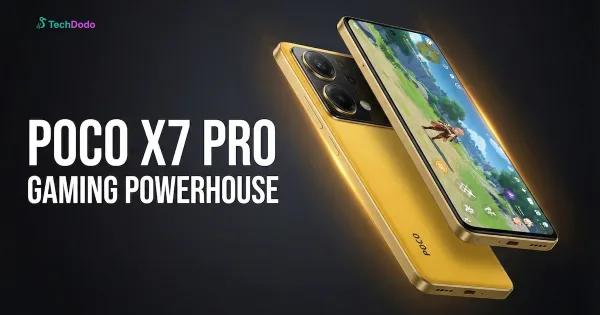
Build quality is solid but not premium. The Gorilla Glass 7i front survives drops better than competitors, but that plastic back — even in the nice vegan leather Yellow variant — doesn't scream "₹25,000 phone." It screams "practical."
Dimensions (160.8 x 75.2 x 8.3mm) feel comfortable for extended gaming sessions. At 195g (198g for leather), it's neither a brick nor a wafer. The camera bump is significantly smaller than the X6 Pro, which means less wobble on flat surfaces.
Design verdict: Function over fashion, and I'm not complaining.
Display — The Reason You'll Forgive Everything Else
This is where POCO stopped playing fair. A 6.67-inch 1.5K AMOLED with 3200 nits peak brightness? That's OnePlus 13 territory. That's iPhone 16 Pro territory. And it's on a phone that costs less than a nice dinner for two in Bangalore.
The numbers:
- Resolution: 2712 x 1220 (1.5K)
- Refresh rate: 120Hz adaptive (down to 30Hz for battery)
- Touch sampling: 480Hz (2560Hz instant)
- Color depth: 12-bit with 68 billion colors
- HDR10+ and Dolby Vision certified
Real-world translation? Netflix looks stunning. YouTube HDR content pops like it should. And gaming — we'll get there — is buttery smooth with no visible ghosting.
The 1920Hz PWM dimming deserves a mention. During late-night gaming sessions, eye strain was noticeably less compared to my daily driver. That's not marketing speak; that's measurable comfort.
Display verdict: Best in class under ₹50,000. Not a typo. Moving on.
Performance — Where Things Get Interesting
The MediaTek Dimensity 8400 Ultra is doing something unusual: making budget phones embarrassingly fast. This is the world's first phone with this chip, and POCO chose wisely.
Benchmark Numbers:
- AnTuTu v10: 1,827,426 (some tests hit 1.9M)
- Geekbench 6 Single: 1,602
- Geekbench 6 Multi: 6,345
- 3DMark Wild Life Extreme: 3,994
For context, the Snapdragon 8 Gen 2 — last year's flagship chip — scores around 1.8M on AnTuTu. You're getting flagship performance at mid-range prices. That's not marketing; that's math.
All-Big-Core Architecture: The 8400 Ultra ditches efficiency cores entirely. It's running 8x Cortex-A725 cores (1x 3.25GHz, 3x 3.0GHz, 4x 2.1GHz). This design prioritizes performance, and it shows.
But here's the catch...
Thermal Management — The Honest Truth:
POCO's 5000mm² vapor chamber cooling works. Kind of. In my Genshin Impact tests at highest settings:
- 0-15 minutes: Stable 60fps, phone at 38°C
- 15-20 minutes: Still 60fps, creeping to 42°C
- 20+ minutes: Thermal throttle kicks in, drops to 45fps at 44-45°C
Is 45fps bad? No. Is it the promised 60fps? Also no. For 20-minute gaming sessions, you're golden. Marathon three-hour sessions will see throttling.
Real-World Gaming Performance:
- Genshin Impact (High/60fps): Excellent for first 20 minutes, stable 45fps after throttle
- PUBG Mobile: 60fps HDR stable (120fps not optimized for MediaTek yet)
- BGMI: Same as PUBG — 60fps ceiling for now
- Mobile Legends: 120fps butter smooth
- COD Mobile: Max settings, zero issues
The 120fps Problem: Here's what POCO doesn't advertise — games like PUBG and Fortnite aren't optimized for 120fps on MediaTek chips yet. You'll hit 60fps ceiling regardless of hardware capability. This isn't POCO's fault; it's game developers prioritizing Snapdragon.
Performance verdict: Fastest phone under ₹30,000. Period. Just don't expect hour-long gaming sessions at peak performance.
Camera System — The Compromise You'll Feel
Let's be blunt: the POCO X7 Pro camera is the weakest link. Not broken, not bad — just aggressively average for a phone this otherwise impressive.
Main Camera (50MP Sony LYT-600/IMX882, f/1.5, OIS):
Daylight photos are genuinely good. Wide dynamic range, accurate colors, solid detail. The OIS works well for handheld shots and video. 2x in-sensor zoom produces usable results — better than the X6 Pro.
Night mode? Here's where honesty hurts. Shots are soft, noise is visible, and the processing tries to compensate with over-sharpening. You can tell it's a ₹25,000 phone camera. Against the Realme 14 Pro+ (which has that periscope telephoto), you'll feel the gap.
Ultrawide (8MP SmartSens SC820, f/2.2, fixed focus):
Fixed focus on an ultrawide is a strange choice in 2025. Results are acceptable in good lighting, muddy in anything less. It's there for the spec sheet more than real utility.
Selfie Camera (20MP OmniVision OV20B, f/2.2):
Disappointing. Video calls are fine, but detailed selfies — especially in low light — show why POCO cut corners here. If you're choosing between this and the OnePlus Nord CE 5 purely for selfies, the OnePlus wins.
Video:
- 4K@60fps with OIS+EIS — stable, detailed, impressive
- 1080p@60fps for all cameras
- Dual video mode for vloggers
Camera verdict: Daylight shooter only. Good enough for Instagram stories, not good enough for serious photography.
Battery & Charging — India Gets the Upgrade
Global X7 Pro: 6000mAh. India X7 Pro: 6550mAh.
Thank the silicon-carbon tech for cramming an extra 550mAh without adding bulk. In real-world use:
- Screen-on time: 9-11 hours (mixed use)
- Gaming drain: ~10% per 20 minutes (Genshin, high settings)
- Standby: Excellent, thanks to aggressive background app management
GSMArena's endurance testing showed 12h 43m active use on the 6000mAh global variant. The India model should push that to 14+ hours.
90W HyperCharge:
- 0-50%: ~17 minutes
- 0-100%: ~47 minutes (POCO claims 45)
- 1600 charge cycles with 80% capacity retention
The charger is included in India. EU buyers aren't so lucky.
Battery verdict: Two-day phone for moderate users. Heavy gamers will hit one full day comfortably.
Software & Updates — HyperOS 2 Has Grown Up
Based on Android 15, HyperOS 2 feels significantly more polished than MIUI 14. Animations are smoother, the control center is less cluttered, and AI features actually work.
What's Good:
- WildBoost 3.0 gaming optimization
- AI Interpreter for live call translation
- AI Notes and Recorder
- 1.5K AI Super Resolution for Genshin Impact
- Clean notification management
What's Not:
- Bloatware still ships pre-installed (GetApps, Mi Browser, Games)
- Ads in system apps (disable in settings, but annoying)
- No eSIM support
Update Commitment: 3 years Android updates + 4 years security patches. Given the January 2025 launch, expect Android 18 support by 2028.
Marketing Claims vs Reality
Claim: "Flagship-grade performance at mid-range price" Reality: AnTuTu 1.8M+ matches Snapdragon 8 Gen 2. Claim valid. Verdict: ✅ True
Claim: "Runs Genshin Impact at 60fps" Reality: Yes, for 15-20 minutes. Then thermal throttling drops it to 45fps. Verdict: ⚠️ Partial
Claim: "India's largest mid-range battery" Reality: 6550mAh is indeed the biggest in the sub-₹30K segment. Verdict: ✅ True
Claim: "IP68 + IP69 water resistance" Reality: Tested in rain, survived splashes. Don't swim with it. Verdict: ✅ True
Claim: "50MP OIS camera for professional-grade photos" Reality: Daylight is good. Night mode is average. "Professional-grade" is a stretch. Verdict: ⚠️ Partial
The Competition — What Else Should You Consider?
OnePlus Nord CE 5 (₹24,499):
- Dimensity 8350 Apex — slightly weaker than 8400 Ultra
- Better selfie camera and OxygenOS experience
- Smaller battery (5500mAh)
- Choose if: You prioritize software polish over raw power
Realme 14 Pro+ (₹29,999):
- Snapdragon 7S Gen 3 — significantly weaker performance
- Superior camera with periscope telephoto (3x optical zoom)
- Colour-changing back panel (gimmick but cool)
- Choose if: Photography matters more than gaming
iQOO Neo 10 (₹36,999):
- Snapdragon 8 Gen 3 — genuinely faster
- 144Hz display, 120W charging
- ₹15,000 more expensive
- Choose if: Budget stretches and you want no compromises
The Verdict: Under ₹25,000, nothing beats the X7 Pro for gaming. The Realme 14 Pro+ is the camera alternative. Everything else is a compromise.
Common Questions About POCO X7 Pro
Q: Is POCO X7 Pro worth ₹21,999 in 2026? A: Absolutely. You're getting 2024 flagship-tier performance at a price that was mid-range in 2023. Unless cameras are your priority, this is the best value phone in India.
Q: Can POCO X7 Pro run Genshin Impact at 60fps without heating? A: For 15-20 minute sessions, yes. Extended gaming triggers thermal throttling that drops performance to 45fps — still playable, but not the advertised 60fps.
Q: POCO X7 Pro vs OnePlus Nord CE 5 — which is better for gaming? A: POCO X7 Pro. The Dimensity 8400 Ultra significantly outperforms the Nord CE 5's Dimensity 8350 Apex in both benchmarks and real-world gaming tests.
Q: Does POCO X7 Pro have heating issues? A: During intensive gaming, temperatures reach 42-45°C. Not dangerous, but noticeable. The phone throttles performance to prevent damage — this is normal thermal management, not a defect.
Q: How long will POCO X7 Pro receive updates? A: 3 years of Android OS updates (up to Android 18) and 4 years of security patches, ending in 2029.
Final Thoughts — The Twist You Didn't See Coming
Here's the controversial take: the POCO X7 Pro might be too good for its price.
Think about it. At ₹21,999, this phone runs Genshin Impact better than an iPhone 15. It has a better display than phones at ₹40,000. It has longer battery life than almost anything under ₹50,000.
The camera is the only real compromise. And honestly? For a gaming phone that costs less than a PlayStation 5, average cameras feel like an acceptable trade-off.
Who should buy:
- Mobile gamers who want flagship performance without flagship prices
- Power users who need all-day battery and fast charging
- Anyone upgrading from a 2-3 year old mid-ranger
Who should skip:
- Photography enthusiasts (get Realme 14 Pro+ instead)
- People who hate bloatware and won't spend 10 minutes disabling it
- Users who need 120fps in PUBG (wait for Snapdragon optimization)
At ₹21,999, the POCO X7 Pro isn't just a good phone. It's proof that you don't need to spend ₹60,000 to get a flagship experience. The "flagship killer" is back, and it's brought receipts.
Specifications
General
Where to Buy
Support our reviews by purchasing through these affiliate links. We may earn a commission at no extra cost to you.
Affiliate Disclosure: Links above are affiliate links. When you make a purchase through these links, we may receive a commission. This helps support our content creation and doesn't affect the price you pay.