An Indian YouTube channel featuring a monkey fighting demons and traveling in a helicopter made of tomatoes is now the world's biggest AI slop producer—pulling in an estimated ₹35 crores annually.
Quick Answer: AI slop is low-quality, AI-generated video content flooding YouTube. A December 2025 study found 21% of videos shown to new users are AI slop, with India's Bandar Apna Dost channel leading globally at 2.4 billion views. YouTube updated monetization rules in July 2025, but enforcement remains patchy.
Here's the thing. While you were scrolling through YouTube Shorts last night, there's a 1-in-3 chance that what you watched was either AI-generated garbage or what researchers clinically call "brainrot." And the platform's algorithm? It's not fighting this—it's actively serving it to you.
A major new study by Kapwing, a California-based video editing company, just quantified what many of us suspected: YouTube has a synthetic content problem. And an Indian channel is leading the global charge.
The Numbers That Should Alarm You
Kapwing's researchers analyzed 15,000 of YouTube's most popular channels—the top 100 in every country—and found 278 channels consisting entirely of AI slop. The combined reach is staggering:
Metric | Value |
Total Views | 63 billion+ |
Total Subscribers | 221 million |
Estimated Annual Revenue | $117 million (₹975 crores) |
AI Slop in New User Feed | 21% |
Brainrot in New User Feed | 33% |
To test what new users experience, researchers created a fresh YouTube account and watched the first 500 Shorts recommended by the algorithm. The result? 104 were pure AI slop. Another 61 were brainrot. That's one-third of your initial YouTube experience being synthetic or mind-numbing content.
But here's what nobody's talking about: the economics are insane.
India's ₹35 Crore Monkey Business
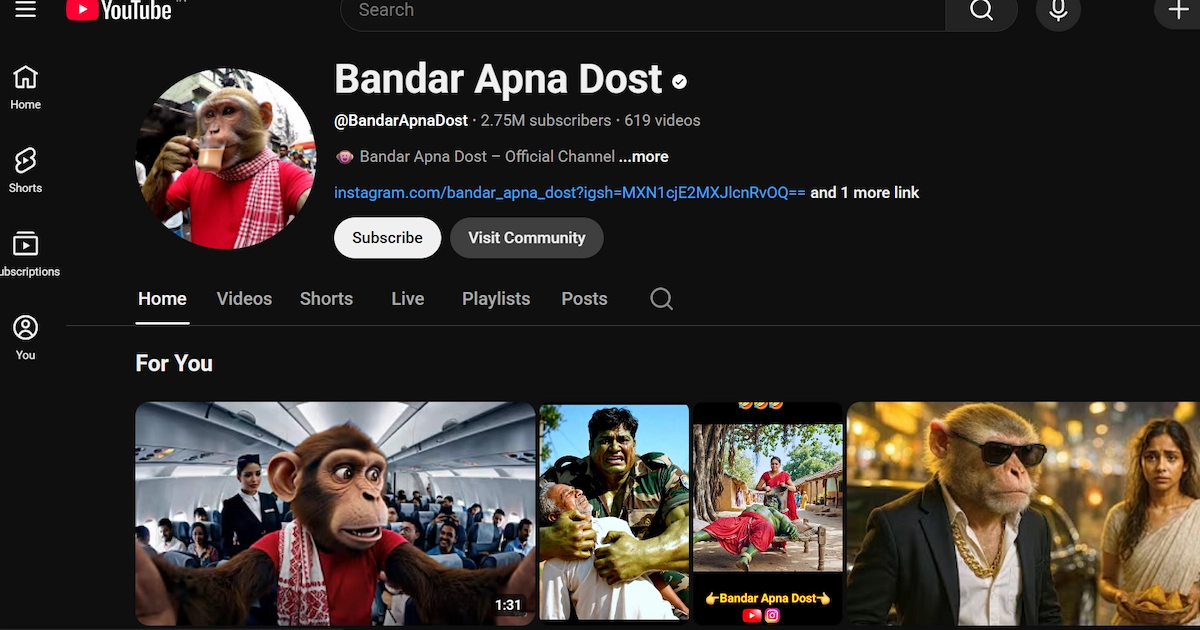
The content is bizarre. A rhesus monkey character teams up with a muscular Hulk-inspired figure to fight demons. They travel in helicopters made of tomatoes. The videos follow near-identical setups with minimal variation.
Bandar Apna Dost Stats | Value |
Total Views | 2.4 billion |
Estimated Annual Revenue | $4.25 million (₹35 crores) |
Videos Published | 500+ |
Instagram Followers | ~100,000 |
The channel's Facebook page credits a "digital creator" named Surajit Karmakar. Neither Karmakar nor the channel responded to media requests for comment.
Rohini Lakshané, a researcher specializing in technology and digital rights, told The Guardian that the channel's success stems from "its level of absurd, the hyper-masculine tropes, and the absence of argument, which facilitates the entry of new viewers."
Translation: the content is so weird and plotless that language barriers don't matter. Anyone can watch it without understanding a word.
The Global Slop Economy: How It Works
The slop economy isn't accidental. It's a sophisticated operation that exploits three factors:
1. Near-Zero Production Costs
Modern AI video tools have made content creation absurdly cheap. Tools like Runway (which powers some of Kapwing's features), Pika, Google's Veo, and various image generators let anyone produce passable videos from text prompts. What once required cameras, actors, and editing suites now needs only a laptop and subscription.
A typical AI slop video costs pennies to produce. Each view generates revenue. The math is simple: produce enough videos, and millions follow.
2. Algorithm Gaming
YouTube's recommendation system rewards engagement metrics—watch time, click-through rates, completion rates. AI slop channels have reverse-engineered what triggers these signals:
- Bizarre thumbnails that demand clicks
- Short, repetitive content that's easy to complete
- Surreal visuals that keep viewers watching in confused fascination
- No language dependency (works globally without translation)
3. The Course Scam Layer
Here's where it gets darker. Many AI slop creators aren't just making money from ads—they're selling courses teaching others how to replicate their success. According to Kapwing's research, "individuals selling courses and 'growth strategies' that promise viral success" often earn more than the actual creators.
It's a pyramid built on synthetic content.
What YouTube Is (and Isn't) Doing
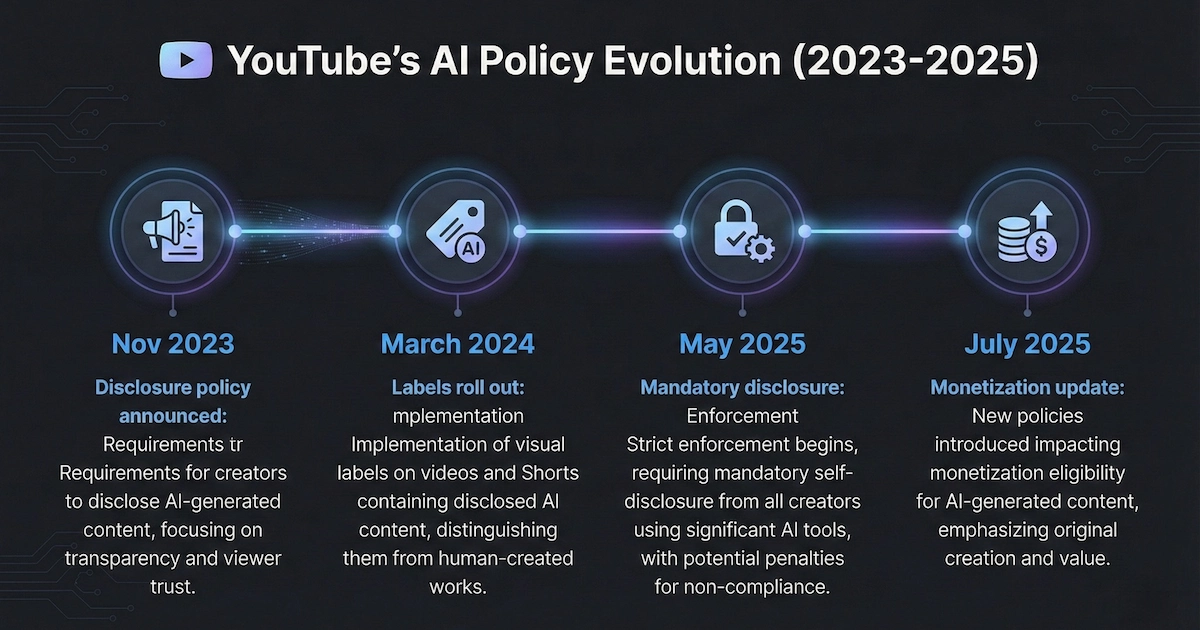
YouTube's response has been a mixed bag of policy updates and selective enforcement.
What They've Done:
- May 2025: Mandatory disclosure for "realistic altered or synthetic content"
- July 2025: Updated monetization policy requiring content to be "significantly original and authentic"
- December 2025: Terminated Screen Culture and KH Studio (two major AI fake trailer channels with 2 million+ combined subscribers)
What's Not Working:
YouTube CEO Neal Mohan has called generative AI the "biggest game-changer" since the platform's launch, comparing it to what synthesizers did for music. But this framing reveals the tension: YouTube sees AI as an innovation opportunity, not just a moderation problem.
The disclosure system relies largely on creator self-reporting. YouTube can apply labels automatically "if it detects embedded metadata suggesting generative origin," but many AI tools don't embed such metadata. And the July 2025 monetization update specifically targets "inauthentic, mass-produced" content—but channels like Bandar Apna Dost continue operating.
The catch? YouTube makes money from ads on these videos too. Demonetizing slop means losing revenue.
The Developer Angle: How AI Slop Gets Made
For the technically curious, here's the production pipeline most slop channels use:
Image Generation Layer:
- Midjourney, DALL-E, or Stable Diffusion for base images
- Character consistency through LoRA models or seed locking
- ChatGPT or Claude for prompt generation
Video Generation Layer:
- Runway Gen-3/Gen-4 for image-to-video animation
- Pika for stylized, viral-ready clips
- Kling AI for longer sequences at lower cost
- Luma Dream Machine for quick prototyping
Audio Layer:
- ElevenLabs or similar for AI voiceovers
- Royalty-free background music
- Automated subtitle generation via CapCut or similar
Automation Layer:
- Custom scripts to batch-generate variations
- Scheduling tools for consistent posting
- A/B testing thumbnails for maximum CTR
The entire pipeline can run with minimal human intervention. One person can operate multiple channels across different niches simultaneously.
Why Detection Fails:
YouTube's content moderation uses AI classifiers to identify potentially violative content. But detecting AI-generated video is technically challenging:
- No consistent metadata standard across generation tools
- Visual artifacts that indicated AI content in 2023 are largely gone in 2025 models
- Stylized or animated content blurs the line between "AI-generated" and "AI-assisted"
- C2PA provenance standards are voluntary and easily stripped
What This Means for Indian Creators and Viewers
For Creators:
If you're a legitimate Indian creator, you're now competing against channels that can produce 10-20 videos daily at near-zero marginal cost. The algorithm doesn't distinguish between a video that took you 40 hours and one generated in 4 minutes—it only sees engagement metrics.
The July 2025 monetization update theoretically helps, requiring "original creative input." But enforcement is inconsistent, and established slop channels seem grandfathered in.
For Viewers:
Your YouTube experience is increasingly synthetic. That "just one more video" pull you feel at 2 AM? It might be engineered by content specifically designed to exploit your attention, created by algorithms optimizing for algorithms.
The illusory truth effect is real: research shows people are more likely to believe claims they've seen repeatedly, even when explicitly told content is fake. AI slop normalizes synthetic media in ways that erode our ability to distinguish real from generated.
Common Questions About YouTube AI Slop
What is AI slop on YouTube?
AI slop refers to low-quality, AI-generated videos created to exploit recommendation algorithms and farm views. These include bizarre animations, synthetic voices, and repetitive content produced at industrial scale with minimal human creativity.
Is AI-generated content allowed on YouTube in India?
Yes, but with restrictions. Since May 2025, creators must disclose realistic AI-generated content. Since July 2025, "inauthentic, mass-produced" AI content isn't eligible for monetization—though enforcement remains inconsistent.
How do I identify AI slop videos?
Look for: repetitive themes with minor variations, bizarre visual combinations (monkey + Hulk + demons), synthetic-looking movements, no coherent narrative, and channels with hundreds of videos but similar content. The description may (but often doesn't) include AI disclosure labels.
The Bottom Line
YouTube has an AI slop problem, and India is at the center of it. The world's most-viewed AI slop channel is Indian, earning more annually than most tech salaries in the country. Meanwhile, YouTube's algorithm happily serves synthetic content to 1 in 5 new users.
The platform's response—disclosure requirements and monetization tweaks—addresses symptoms, not causes. As long as AI tools make content production essentially free, and YouTube's algorithm rewards engagement over authenticity, the slop will keep flowing.
For creators, the message is uncomfortable: the bar for "content" has dropped to the floor. For viewers, it's worse: the feed you trust is increasingly fake, and distinguishing real from synthetic will only get harder.
YouTube CEO Mohan says "the genius is going to lie whether you did it in a way that was profoundly original or creative." He's right. But right now, the algorithm doesn't care about genius. It cares about watch time.
And the monkeys keep winning.
We'll update this article when YouTube announces further policy changes or enforcement actions.