The End of Anonymous Chatting? Why WhatsApp and Telegram Are About to Get Annoying
Let’s be honest for a second: we’ve all gotten used to a certain level of "digital fluidity." You pop a SIM card out, put in a travel SIM, and your WhatsApp keeps working fine. You leave WhatsApp Web open on your work laptop for weeks, never scanning that QR code again. It was convenient. It was easy.
And as of this week, it is officially over.
The Department of Telecommunications (DoT) has dropped a regulatory hammer that’s going to change how you log in and stay logged in to apps like WhatsApp, Telegram, and Signal. It’s called "SIM Binding," and if you’re the type of person who juggles devices or travels often, you’re going to hate it.
Here is the no-nonsense breakdown of why your favorite apps are about to get a lot stricter, and why the government says it’s for your own good.
The New Reality: "No SIM, No Chat"
For years, apps like WhatsApp were technically "Over-The-Top" (OTT) players. They rode on top of the telecom network but didn't have to follow the strict rules that Airtel or Jio did. That changed with the classification of these apps as Telecommunication Identifier User Entities (TIUEs) under the new cybersecurity amendments.
The DoT has issued a directive giving messaging platforms 90 days (from late November 2025) to enforce two major changes:
1. Mandatory SIM Binding
Currently, you verify your phone number once (via OTP) when you install WhatsApp. After that, you can remove the SIM, throw it in a drawer, or put in a completely different SIM, and WhatsApp works fine.
The Change: Apps must now "continuously" verify that the registered SIM is physically present in the device.
- If you remove the SIM: The app stops working.
- If you swap SIMs: You likely have to re-register the app to the new number immediately.
2. The 6-Hour Web Logout
This is the one that’s going to hurt office workers. Right now, WhatsApp Web stays logged in until you manually log out or your phone loses connection for 14 days.
The Change: Web sessions must now automatically time out every six hours.
- The Impact: You will need to re-authenticate (scan the QR code or use biometrics) twice a day during a standard work shift.
Note: These rules apply to "significant" communication intermediaries—basically the big ones: WhatsApp, Telegram, Signal, and Snapchat.
Why Is This Happening? (The "So What")
You might be thinking, "Great, more bureaucracy." But there is a logic here, even if it’s a painful one.
The government’s argument—backed by the Cellular Operators Association of India (COAI)—is that the current system is a playground for fraudsters.
- The "Burner" Problem: Scammers often bulk-buy SIM cards, register WhatsApp accounts on cheap phones, and then discard the SIMs. They continue using the WhatsApp account over Wi-Fi to run phishing scams (like the infamous "Dad, I lost my phone, send money" texts).
- International Fraud: Many of these scams originate from outside India using Indian numbers that are no longer active on the telecom network.
By forcing SIM Binding, the government ensures that every active WhatsApp account is tethered to a live, trackable, and KYC-verified mobile connection. If the SIM dies, the scammer's account dies.
Pros and Cons: The Trade-off
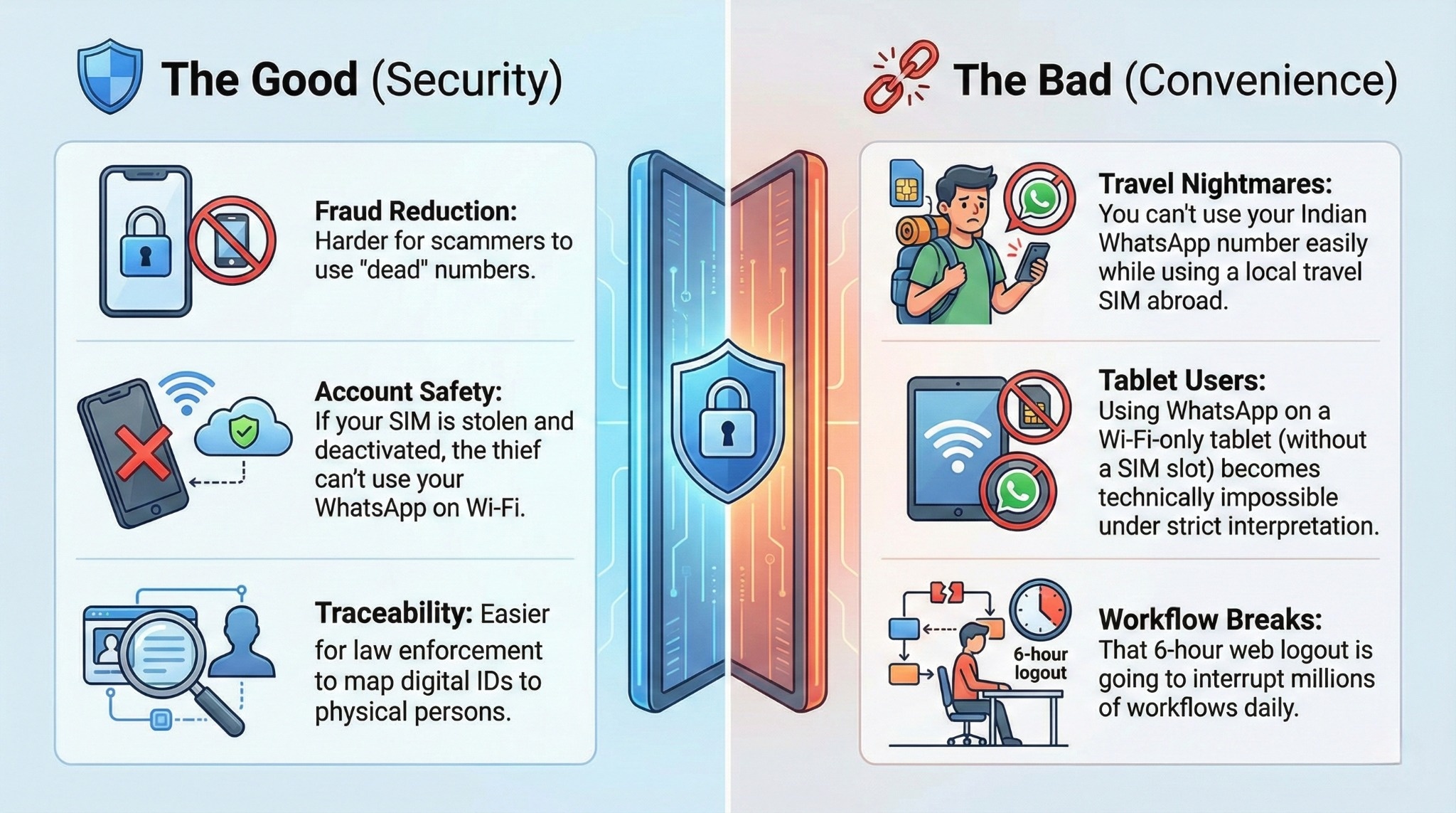
The Technical Pivot: Passkeys are the Silver Lining
While the government is making logins harder, the tech giants are trying to make them safer (and slightly less annoying) using Passkeys.
If you haven't set this up yet, do it now. WhatsApp and X (formerly Twitter) have been rolling this out aggressively.
- What is it? Instead of waiting for an SMS OTP (which can be intercepted or delayed), you use your face (FaceID) or fingerprint to log in.
- Why it matters now: With the new SIM binding rules, you might be logging in more often. Passkeys make that process instant. It relies on cryptographic keys stored on your device, not a code sent over a shaky network.
What Experts Disagree On
The industry is currently divided on the implementation.
- The "Technically Impossible" Argument: Tech bodies (like IAMAI) argue that SIM binding disrupts legitimate multi-device features. WhatsApp’s "Linked Devices" feature was designed to let you use the phone independently. This regulation forces a step backward in technology.
- The Privacy Concern: Critics argue this effectively kills anonymity. Telegram, which recently updated its policy to share IP addresses and phone numbers with authorities upon legal request (following CEO Pavel Durov’s legal troubles in France), is already less private than before. SIM binding tightens that loop further.
Risks and Unknowns
There is still a lot of fog of war here.
- Wi-Fi Only Zones: What happens if you are in a basement with Wi-Fi but zero cellular signal? Does WhatsApp stop working because it can't "ping" the SIM to verify it?
- The "Travel Mode" Loophole: Will the DoT allow a "Travel Mode" exception for users who can prove they are abroad? Currently, the directive says "continuous" verification, which implies no exceptions.
Conclusion: Adapt or Delete
The era of the "setup and forget" messaging app is ending in India. The government is treating your WhatsApp account less like a chat room and more like a digital passport—it needs to be valid, verified, and physically on you at all times.
For the average user, this means a bit more friction. For the privacy absolutist, it’s a nightmare. But for the thousands of people who get scammed daily by ghost numbers? It might just be the fix they needed.
Next Step for You: Go to your WhatsApp Settings > Account > Passkeys and set it up immediately. If the new login rules kick in as scheduled in Feb 2026, you’ll want the fastest way back into your account.