
Stop Learning Syntax: Why 'Vibe Coding' Is the New Normal
You know that feeling when you spend four hours debugging a Python script, only to realize you missed a colon on line 42? That specific type of frustration—the hallmark of the "learning to code" journey for millions of Indian engineering students—is officially an antique.
If you are currently memorizing the syntax for useEffect hooks or struggling to remember how to slice an array in JavaScript, stop.
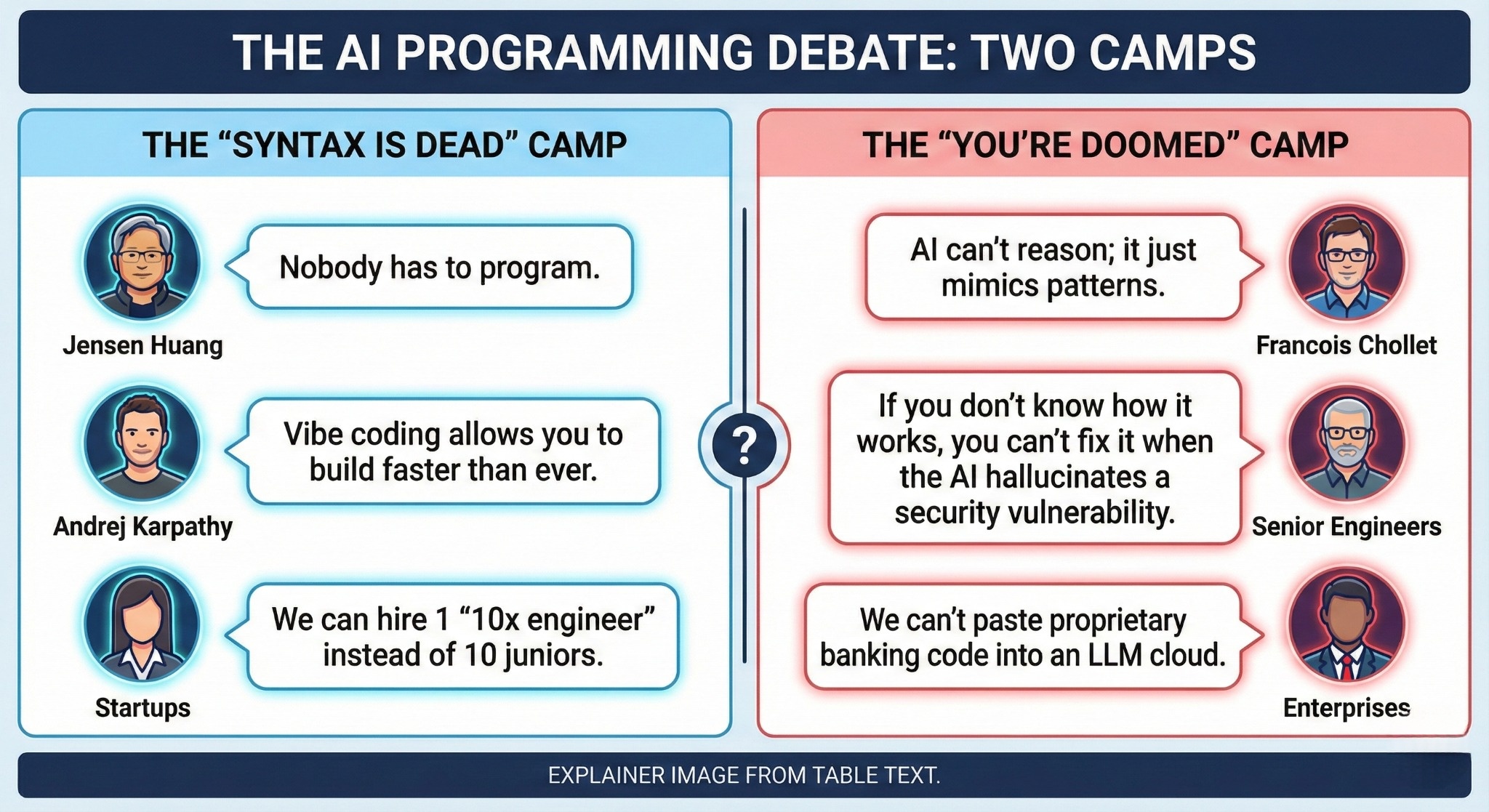
A new paradigm has arrived, christened "Vibe Coding" by former Tesla AI Director Andrej Karpathy. It’s a shift that NVIDIA CEO Jensen Huang predicted when he famously said, "It is our job to create computing technology such that nobody has to program."
For the global tech community, this is a cool evolution. For the Indian IT sector—built on the backs of millions of service-level coders—this is an existential fire alarm.
The Death of the Syntax Error
For the last two decades, "learning to code" meant learning to speak the computer's language. You had to be a translator. You had a logic in your head ("I want this button to turn green when clicked"), and you had to translate it into strict, unforgiving syntax that a compiler could understand.
Vibe Coding flips this.
Instead of you learning the computer's language, the computer has finally learned yours.
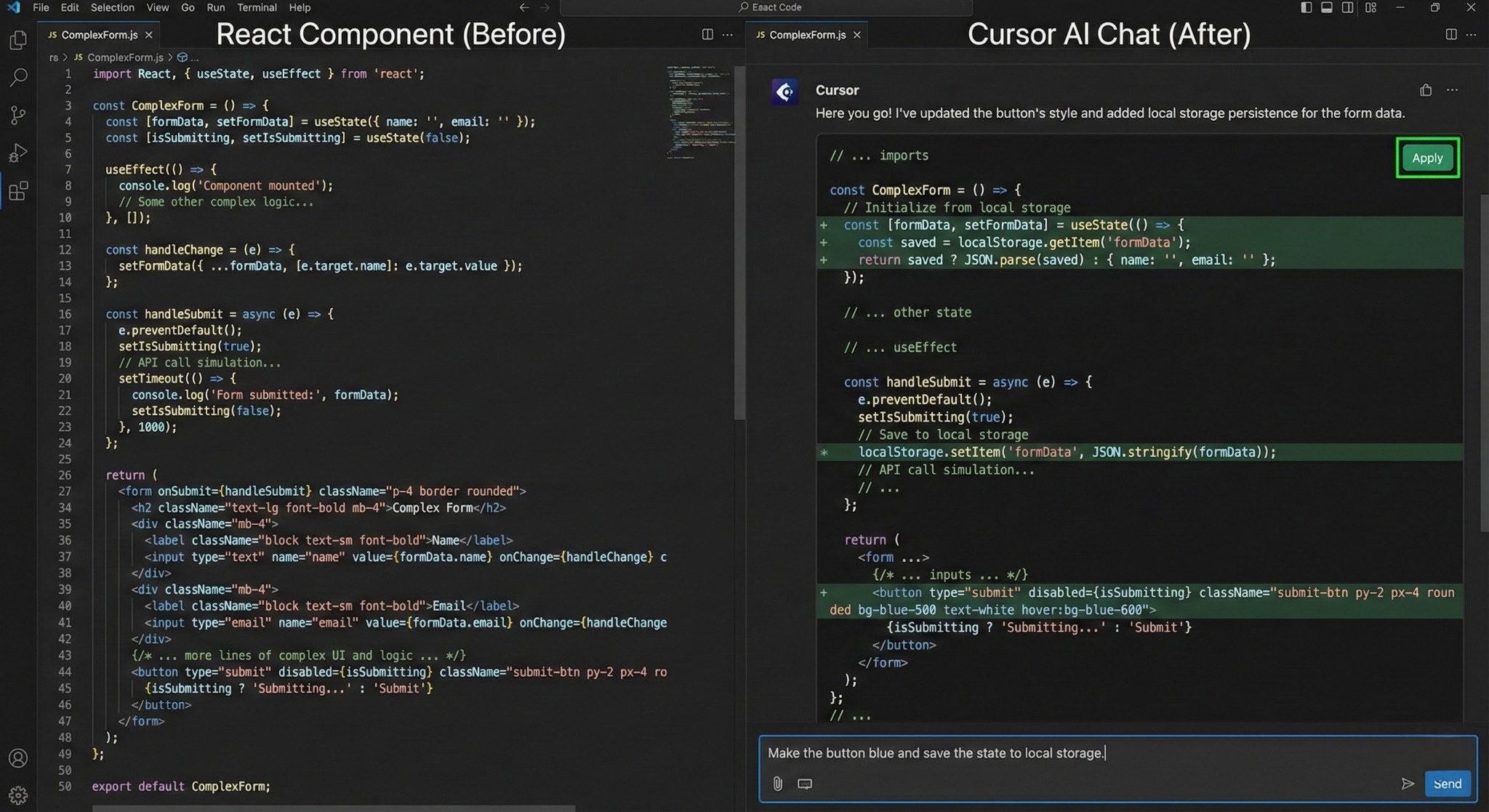
"I just see things, say things, run things, and copy-paste things, and it mostly works," Karpathy tweeted in February 2025. He describes a workflow where he writes almost zero code himself. He manages the "vibes"—the intent, the logic, the input and output—and lets an AI (specifically tools like Cursor or Claude 3.5 Sonnet) handle the actual typing.
You don't write the loop; you tell the AI to "process every item in the list." You don't debug the error; you paste the error message into the chat and hit "Apply Fix."
What exactly is "Vibe Coding"?
It is the transition from Writing Code to Managing Logic.
- Old Way: Write function -> Run -> Syntax Error -> Google -> Fix -> Run -> Logic Error -> Debug -> Cry.
- Vibe Way: Prompt intent ("Make a snake game in Python") -> AI writes code -> Run -> It breaks -> Paste error to AI -> AI Fixes -> Run -> It works.
You are no longer the bricklayer; you are the architect pointing at the wall and saying, "Build that there."
The Toolstack: Your New coworkers
If you’re still using a vanilla installation of VS Code, you are bringing a knife to a nuclear war. Here is the stack driving the Vibe Coding movement:
- Cursor (The King): This is a fork of VS Code that has AI baked into its DNA. Its "Composer" feature allows you to edit multiple files simultaneously just by describing a feature.
- India Pricing: The "Pro" plan is $20/month (approx. ₹1,700 + GST). The free tier is decent but hits limits fast.
- Replit Agent: An autonomous agent that can build full-stack apps from a single prompt. It doesn’t just write code; it plans, installs dependencies, and deploys.
- GitHub Copilot: The OG. While still powerful, many "vibe coders" feel it lags behind Cursor’s context awareness.
- India Pricing: $10/month (approx. ₹850).
- Bolt.new: A browser-based tool that lets you prompt full websites into existence instantly.
The "Bangalore Problem": Why India Needs to Wake Up
This is where it gets tricky for us.
For years, the Indian "Mass Recruiter" model (TCS, Infosys, Wipro, etc.) relied on hiring fresh engineering grads and training them for 3-6 months on Java or .NET syntax. The value proposition was: You have a spec, but you don't have the time to type it out. We have thousands of people who can type it out for you.
Vibe Coding destroys that value proposition.
If a senior architect in California can use Cursor to generate the same boilerplate code that used to require a team of five junior devs in Pune, what happens to those junior jobs?
NASSCOM has already flagged this shift. In a recent report, they noted a drop in demand for "routine coding roles" even as demand for AI-specialized roles spikes. The "Service" economy is being forced to become a "Product" economy.
The New Skill Gap
The interview question is changing from "Reverse a linked list on this whiteboard" to "Here is a broken SaaS app; use AI to fix it and deploy a new feature in 20 minutes."
Your ability to memorize syntax is now worth ₹0. Your ability to verify AI output, understand system architecture, and spot logic flaws is worth millions.
What Experts Disagree On
While the hype is real, the industry is split on the danger.
Risks: The "Hallucination" Trap
Vibe Coding feels like magic until it doesn't.
The biggest risk is blind trust. LLMs are confident liars. They will hallucinate a software library that doesn't exist (this happens frequently with Python packages). If you are "vibing" too hard and not reading the code, you might import a vulnerability or a broken dependency.
The Golden Rule: AI writes the draft; you are the editor. You cannot edit what you do not understand. You still need to know what a loop is, even if you never type one again.
Conclusion: Don't Panic, Pivot
Is coding dead? No. But "coding" as a manual labor activity is dying.
If you are a student or a junior dev in India right now:
- Stop optimizing for syntax. Don't memorize the dictionary; learn how to tell a story.
- Master the tools. proficiency in Cursor/Replit is now a resume skill.
- Build things. The barrier to entry has dropped. You have no excuse not to have a deployed app.
The era of the "coder" is ending. The era of the "builder" has just begun.
Next Step for You: Download Cursor today (the free version). Import a small, old project of yours. Open the "Composer" (Cmd+I or Ctrl+I) and type: "Refactor this code to be cleaner and add comments explaining how it works." Watch the magic happen, then ask yourself: If the AI can do this, what should I be doing instead?