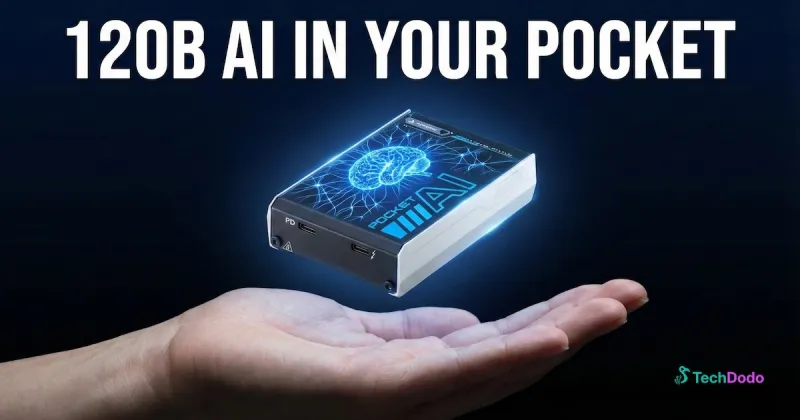
Quick Answer: Tiiny AI Pocket Lab is a Guinness-certified pocket supercomputer that runs 120B-parameter LLMs offline for ~₹1.2 lakh. Best for developers and researchers who want private, cloud-free AI. The catch: India isn't in priority shipping, and it's still a Kickstarter product.
Here's the uncomfortable truth about AI in 2026: every prompt you type travels to a server farm thousands of kilometres away. Your data. Your documents. Your half-baked business ideas. All processed on someone else's hardware, billed by the token, stored who-knows-where.
A US startup called Tiiny AI thinks this is broken. Their solution? A device roughly the size of a power bank that runs full-scale AI models entirely on your desk. No cloud. No subscriptions. No internet required.
The Tiiny AI Pocket Lab made its debut at CES 2026 in Las Vegas, where it demonstrated something that made industry observers do a double-take: running 120-billion-parameter large language models completely offline, achieving real-world speeds of 20+ tokens per second. That's not a typo. According to the company's official press release, models at this scale typically require server racks or professional GPUs costing tens of thousands of dollars.
And yes, Guinness World Records verified it as the world's smallest mini PC capable of running a 100B-parameter LLM locally.
What's Actually Inside This Thing?
Let's talk specifications, because the numbers here are genuinely unusual for a 300-gram device.
According to Tiiny AI's official technical documentation, the Pocket Lab packs an ARM v9.2 architecture with a 12-core CPU, paired with a dedicated Neural Processing Unit delivering 190 TOPS (trillions of operations per second). For context, TechRadar notes that current-generation "AI PCs" from major manufacturers typically hover between 40 and 50 TOPS. The Pocket Lab claims nearly four times that.
The memory configuration is where things get aggressive. The device includes 80GB of LPDDR5X RAM running at 6400MT/s — enough to load models that would crash most consumer laptops. As Remio.ai's technical analysis points out, most consumer laptops max out at 32GB or 64GB. The Pocket Lab's memory isn't upgradeable (it's soldered), but 80GB provides sufficient headroom for even 120B-parameter models through aggressive quantization.
Storage is a 1TB PCIe 4.0 SSD. Power consumption sits at 30W TDP, with typical system power around 65W — roughly what a mid-range laptop draws.
The dimensions, per Tiiny AI's specifications: 142 × 80 × 22 mm, weighing 300 grams. That's smaller than most external hard drives.
The Software Making It Possible
Raw hardware doesn't run 120B models in 300 grams. Two key technologies make the Pocket Lab's claims plausible.
TurboSparse is Tiiny AI's neuron-level sparse activation technique. The idea is straightforward: when you ask an AI model a question, you don't need every parameter active for every token. TurboSparse selectively activates only the neurons relevant to your specific query, dramatically reducing computational load.
PowerInfer is an open-source heterogeneous inference engine with over 8,000 GitHub stars. According to WCCFTech's coverage, it dynamically distributes computation across the CPU and NPU, enabling what the company calls "server-grade performance at a fraction of traditional power consumption."
Both technologies exist. PowerInfer is publicly available on GitHub. Whether they combine to deliver the claimed performance in this specific form factor? That remains to be independently verified at scale.
The software side includes TiinyOS, a platform Tiiny AI introduced at CES that offers one-click deployment of open-source models. Supported models include Llama, Qwen, DeepSeek, Mistral, Phi, and GPT-OSS variants up to 120B parameters. Agent frameworks like OpenManus, ComfyUI, Flowise, and SillyTavern are also compatible.
How Does It Compare to NVIDIA's DGX Spark?
You've probably heard about NVIDIA's DGX Spark (formerly Project DIGITS), which launched at a $3,999 price point in October 2025. Let's put these side-by-side.
Specification | Tiiny AI Pocket Lab | NVIDIA DGX Spark |
Price | $1,399-$1,500 (~₹1.2-1.28 lakh) | $3,999 (~₹3.4 lakh) |
Memory | 80GB LPDDR5X | 128GB LPDDR5x |
AI Compute | 190 TOPS (NPU) | 1 PFLOP (FP4) |
Max Model Size | 120B parameters | 200B parameters |
Power | 65W typical | Higher TDP |
Form Factor | 300g, pocket-sized | Desktop form factor |
OS | TiinyOS (Linux-based) | DGX OS (Ubuntu-based) |
The DGX Spark wins on raw specifications — more memory, more compute headroom, better ecosystem integration with NVIDIA's professional stack. Signal65's first-look analysis notes that DGX Spark is designed for prototyping and fine-tuning, not just inference.
But here's the thing: the Pocket Lab costs roughly one-third the price. For developers who need to run models (not train them) with complete privacy, and who don't need NVIDIA's CUDA ecosystem specifically, that price gap matters.
According to Hardware Corner's benchmark analysis, NVIDIA's DGX Spark achieves approximately 3 tokens per second on DeepSeek R1 Distil Llama-70B Q8. Tiiny AI claims 18-40 tokens/s for their supported models, though direct comparison requires identical model configurations.
The India Question: Can You Actually Buy This?
Here's where things get complicated for Indian readers.
According to Tiiny AI's official FAQ, priority shipping covers the United States, Germany, UK, France, Italy, Spain, Netherlands, and Singapore. India is not on that list.
The company states that "other regions may be supported with additional shipping fees" — but there's no clarity on what those fees would be, whether customs duties apply, or what warranty and support look like for non-priority regions. The device launches on Kickstarter in February 2026 with an estimated delivery of August 2026.
For Indian developers interested in local AI hardware, this means:
- You'll likely pay import duties on top of the ~₹1.2-1.3 lakh base price
- Shipping is uncertain — check Kickstarter eligibility at campaign launch
- Support and warranty for India remains unaddressed
If Tiiny AI opens official India distribution (through Amazon.in or direct sales), this changes. As of January 2026, that hasn't happened.
Who Should Actually Care About This?
The Pocket Lab isn't trying to compete with ChatGPT Plus or Claude Pro for everyday users. It's aimed at a specific audience.
Developers building AI applications who want to test models locally before cloud deployment. The plug-and-play approach means your existing laptop becomes the interface, while the Pocket Lab handles inference.
Researchers handling sensitive data — legal documents, medical records, proprietary code — where cloud processing creates compliance risks. According to Interesting Engineering, the device stores everything locally with bank-level AES-256 encryption.
Privacy-conscious professionals tired of wondering where their prompts end up. With the Pocket Lab, your queries never leave your device.
Cost-conscious power users who've done the math on subscription fees. At ₹1.2 lakh upfront with no recurring costs, versus ₹2,000-3,000/month for premium AI subscriptions indefinitely, the break-even point arrives surprisingly fast for heavy users.
What We Don't Know Yet
Let's be honest about the gaps.
Independent benchmarks don't exist yet. The 20+ tokens/s claim at CES was a company demonstration. Real-world performance across different models and workloads needs third-party verification.
Long-term reliability is untested. This is first-generation hardware from a startup founded in 2024. The team includes engineers from MIT, Stanford, Intel, and Meta, according to Jon Peddie Research, but that doesn't guarantee product maturity.
"OTA hardware upgrades" is confusing language. TechRadar flagged this in their coverage — you cannot download more RAM. This likely refers to firmware updates that optimize performance, but the phrasing suggests either imprecise wording or marketing overreach.
India distribution remains vague. For a product launching through Kickstarter with priority shipping to specific Western markets and Singapore, Indian availability is genuinely uncertain.
The Bottom Line
The Tiiny AI Pocket Lab represents something legitimately interesting: a credible attempt to put serious local AI capability into a portable, affordable form factor. The Guinness certification suggests the core technical claims have merit. The CES demo showed real performance.
But it's still a Kickstarter product from a young startup, with India firmly outside the initial distribution focus. If you're an Indian developer excited about local AI hardware, this is worth watching closely — not necessarily worth pre-ordering blindly.
For those who value privacy over convenience, who've calculated the lifetime cost of cloud AI subscriptions, or who simply want to run LLMs on an airplane at 35,000 feet, the Pocket Lab offers something currently unavailable in the market.
Whether it delivers on those promises? We'll update this when independent reviews emerge post-delivery in late 2026.