
SpaceX’s 150th Launch Puts 8,800 Satellites in Orbit: What It Means for Your Internet
Let’s be honest: at this point, a SpaceX launch feels about as routine as a BMTC bus leaving the depot—except the bus is usually late, and the rocket is almost always on time.
But the launch on November 22, 2025, wasn’t just another Tuesday at the office for Elon Musk’s space company. When that Falcon 9 lifted off from Cape Canaveral carrying 29 fresh Starlink satellites, it marked the 150th Falcon 9 flight of the year.
Read that again. One hundred and fifty launches. In one year. That is a cadence that old-school aerospace giants claimed was impossible, dangerous, or both.
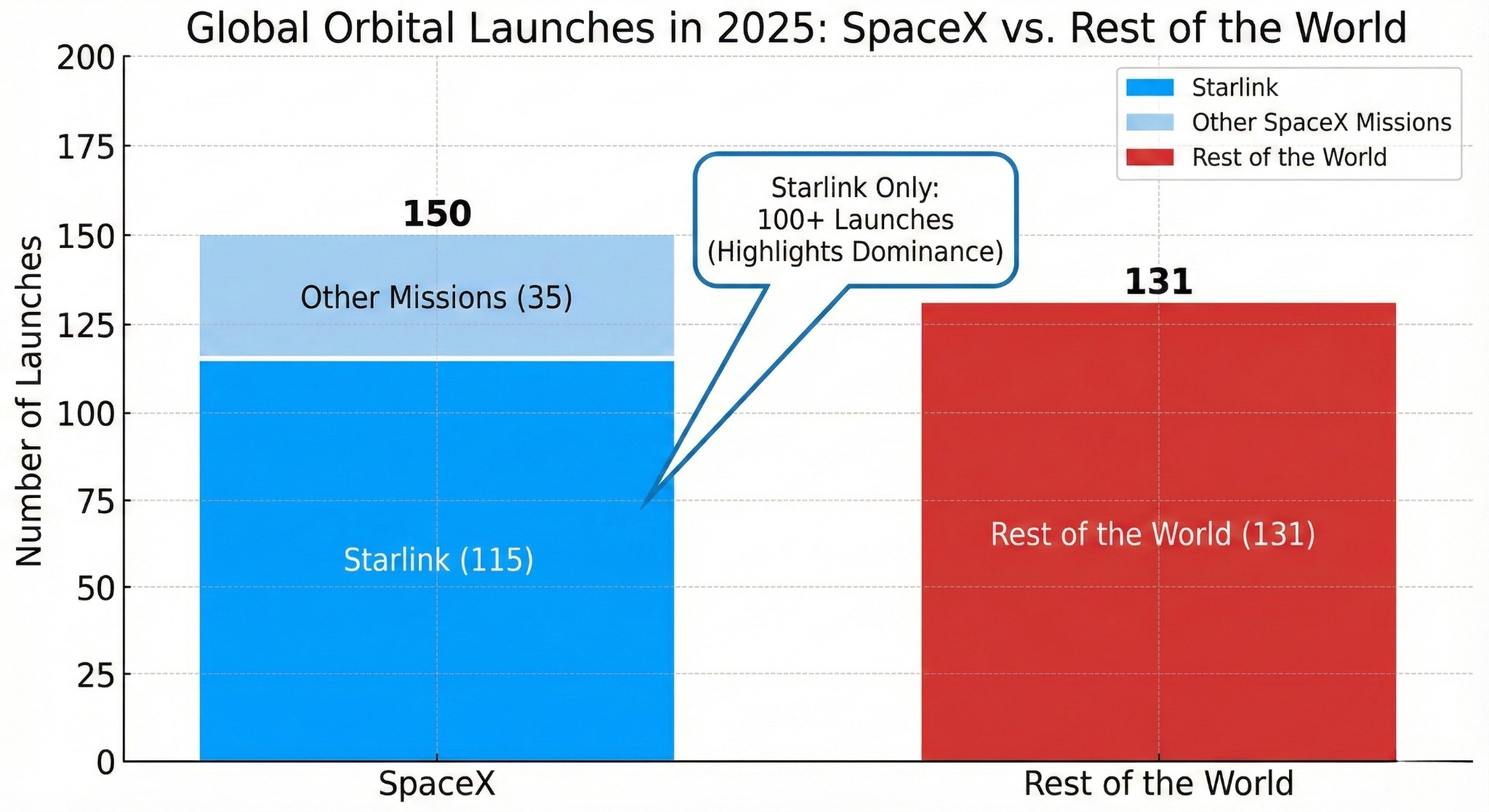
With this mission, the operational Starlink constellation has officially swollen to over 8,800 satellites in Low Earth Orbit (LEO). For context, before Starlink began, humanity had launched fewer than 9,000 satellites in the entire history of spaceflight.
So, we have a sky full of routers. But for those of us in Bengaluru, Mumbai, or the remote hills of Himachal, the burning question remains: Can we use it yet?
The Scale: Why 8,800 Satellites Matter
You might be wondering, "Why do they need so many? Isn't 5,000 enough?"
In the world of LEO internet, density is destiny. Unlike traditional geostationary satellites that sit 35,000 km away and beam internet with the latency of a Zoom call in 2005, Starlink satellites zoom around at 550 km. They move fast.
- The Relay Race: Because they move so fast, your dish (User Terminal) hands off your connection from one satellite to another every few minutes. More satellites = smoother handoffs and fewer dropped calls.
- Capacity Crunch: The more users sign up (and Starlink crossed 8 million subscribers this month), the more bandwidth is needed per square kilometer. Those 8,800 satellites are the only thing preventing your speed from dropping to 2G levels during peak hours.
The 2025 Upgrades
The satellites launching now aren't the basic versions from 2019. These are mostly V2 Minis and the newer V2s.
- Laser Links: They talk to each other in space, routing data over oceans without needing ground stations nearby.
- Direct-to-Cell: A chunk of these new birds can beam text and basic data directly to unmodified LTE phones (a feature T-Mobile is already testing in the US).
The India Status: So Close, Yet So Bureaucratic
Here is the part that frustrates every Indian tech enthusiast. While the rest of the world is unboxing their rectangular dish kits, we are still refreshing news pages.
As of late November 2025, here is the exact situation in India:
- The Good News: Starlink has the licenses. They secured the GMPCS (Global Mobile Personal Communication by Satellite) license back in June 2025 and received the nod from IN-SPACe (India's space regulator) shortly after. Legally, they are recognized.
- The Bad News: The service is not live. Why? Because the "Commercial Launch" button is behind a glass case locked by the Ministry of Home Affairs (MHA) and the Department of Telecommunications (DoT).
The Bottleneck: Security & Spectrum
The Indian government plays hardball with data. The current holdup revolves around security clearance. The MHA wants absolute guarantees that data traffic generated in India stays in India (data localization) and that security agencies can intercept traffic if needed (lawful interception).
Starlink’s architecture, which is designed to be borderless, clashes with these rigid sovereign requirements. There is also the "spectrum war." While the Telecommunications Act 2023 settled that satellite spectrum would be given administratively (not auctioned), the pricing and specific frequency allocation rules are still being fine-tuned by TRAI.
Note: Rumors peg the India pricing for the Starlink kit at around ₹33,000, with a monthly subscription near ₹3,500 - ₹4,000. If true, this puts it firmly in the "premium" bracket, competing with high-end fiber plans but offering mobility that fiber can't touch.
[IMAGE SUGGESTION: A split infographic. Left side: "Global Starlink" showing a connected home. Right side: "India Starlink" showing a 'Pending Approval' stamp over a map of India.]
The Dark Side of a Bright Sky
We cannot talk about 8,800 satellites without addressing the elephant in the room—or rather, the swarm in the sky.
Astronomers are tired. The sheer number of satellites is causing "photobombing" of critical astronomical data. Despite SpaceX equipping new satellites with "dark sat" coatings to reduce reflectivity, 8,800 moving objects reflect a lot of sunlight.
- Radio Interference: It’s not just light. Radio astronomers are finding that the "noise" from these constellations is bleeding into frequencies used to listen to the early universe.
- The Kessler Syndrome: With over 100 launches a year dedicated just to Starlink, LEO is getting crowded. SpaceX has automated collision avoidance, but the margin for error is shrinking. One bad collision could create a debris field that knocks out other satellites.
What Experts Disagree On
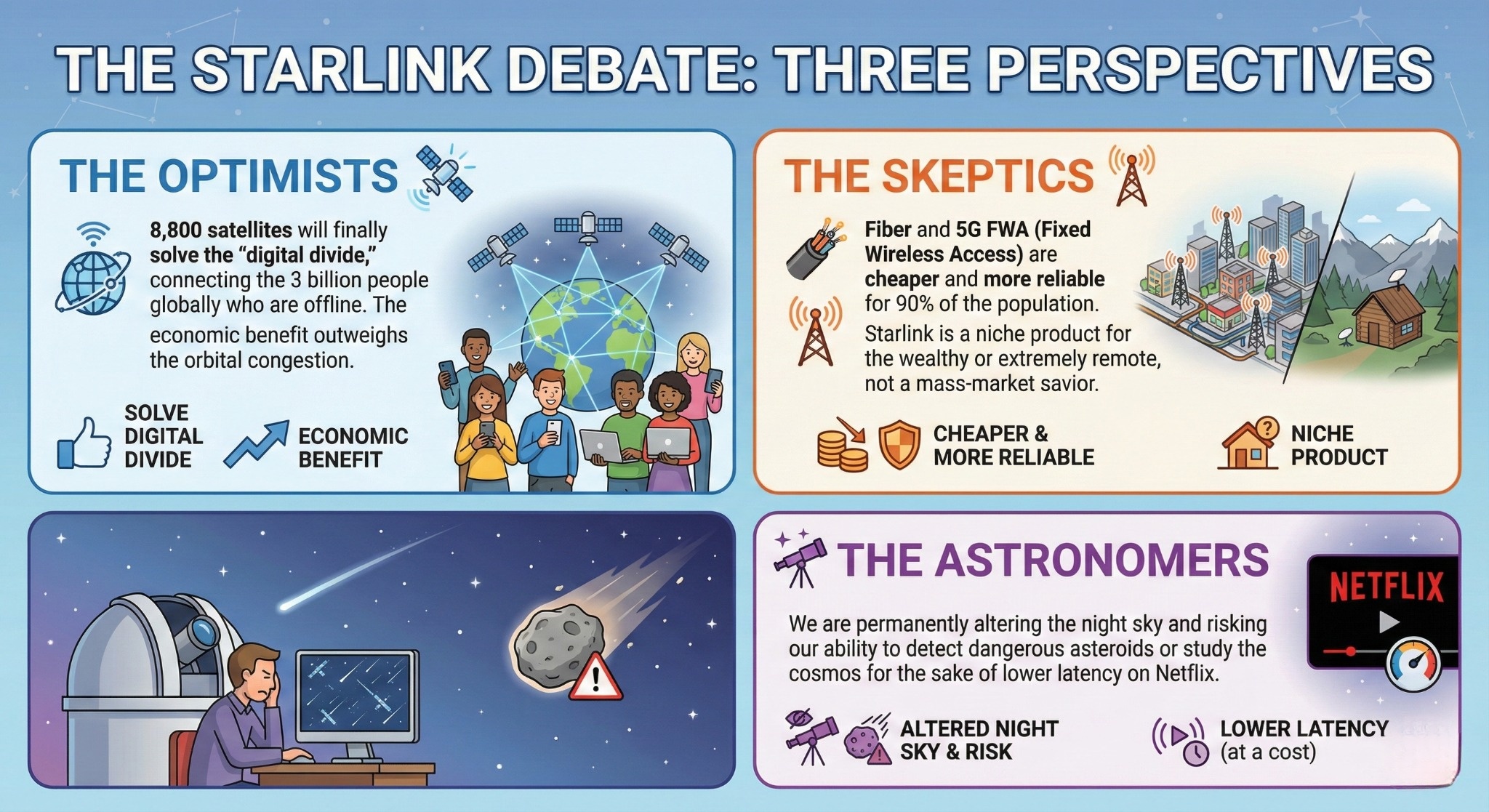
SpaceX’s achievement of 150 launches in 2025 is an engineering marvel. They have effectively built a relentless conveyor belt to the stars. The network is getting faster, stronger, and more resilient every day.
But for India, 2025 feels like a year of "almost." We have the regulations, we have the licenses, but we lack the service. Until the security concerns are ironed out, Starlink remains a cool piece of tech we can watch fly over our heads, but cannot actually use to tweet about it.
We will update this article the moment the DoT announces the final spectrum allocation or if Starlink opens official pre-orders in India.