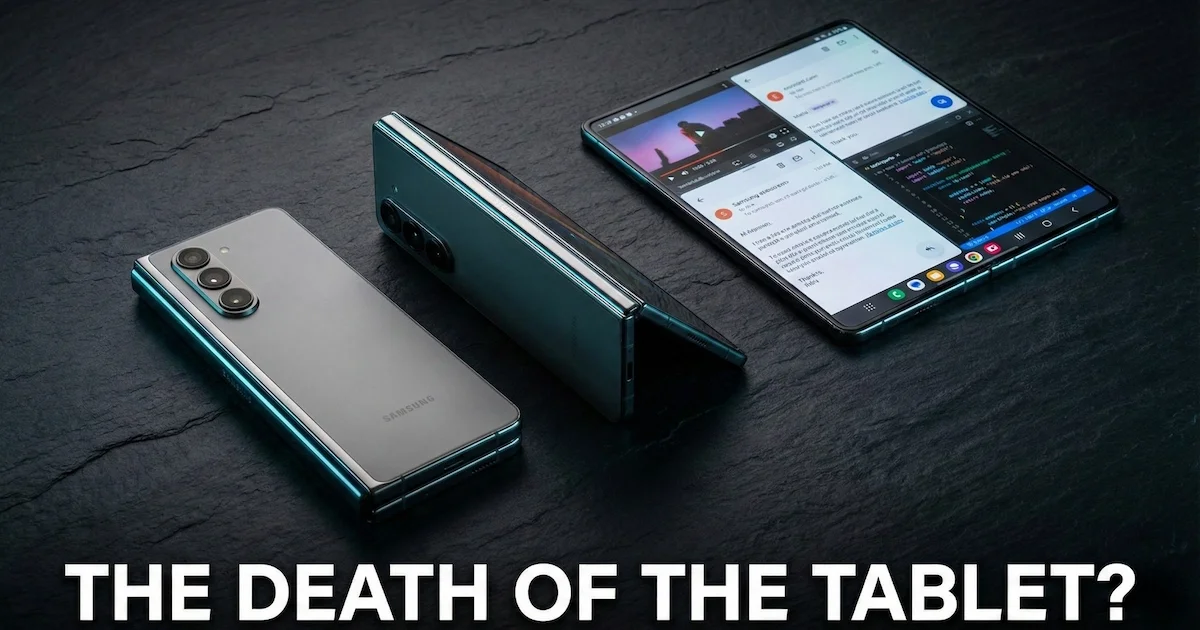
The Tablet Is Dead. Long Live the ₹2.5 Lakh Phone.
Let’s be honest. We all knew this was coming.
For years, we’ve watched concepts, leaked prototypes, and that one Westworld episode where a character unfolds a tablet into a phone. We treated it like flying cars—cool, but probably a logistical nightmare.
Well, the nightmare is over, and the dream is expensive.
As of today, December 12, 2025, the Samsung Galaxy Z TriFold is officially on sale (in South Korea, at least). It is a dual-hinge, triple-screened monstrosity of engineering that opens up into a massive 10-inch tablet. It is thinner than your current phone, powerful enough to run a small country, and costs more than a decent second-hand bike in Bengaluru.
Is it necessary? Absolutely not. Do I want one? Desperately.
Here is everything you need to know about the device that just made your iPad Mini obsolete.
The "Dual-Hinge" Innovation
The headline feature is obvious: The Screen.
Unlike the standard Galaxy Z Fold series (which feels like opening a book), the TriFold opens like a brochure. It uses two distinct hinges to fold the device into a "Z" shape.
- Folded: You get a standard 6.5-inch cover display (2520 x 1080).
- Unfolded: A seamless 10-inch Dynamic AMOLED 2X canvas (2160 x 1584).
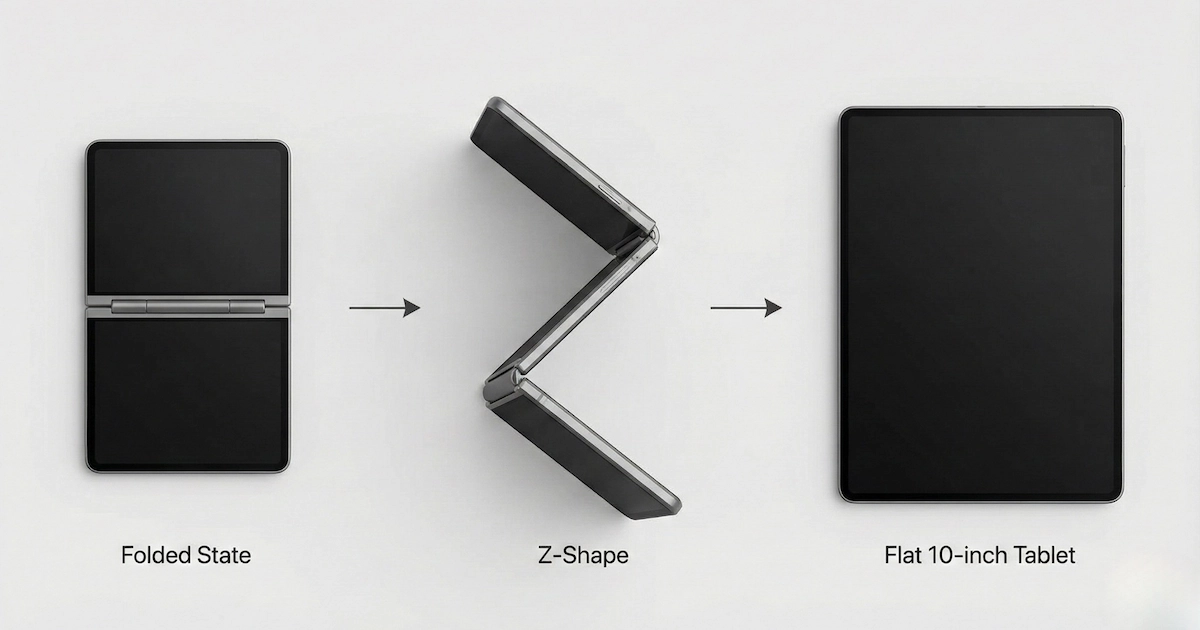
The engineering creates a unique dynamic. When fully open, it’s not "kind of" a tablet; it is a tablet. At 3.9mm thin (unfolded), it is shockingly slender—thinner than the USB-C port used to charge it.
But physics always collects its debt. When you fold it up, you are stacking three screens. The result is a 12.9mm thick brick in your pocket. Heavy? Yes (309g). But for context, the iPhone 17 Pro Max is pushing 230g, so it’s not that far off.
Specs That Justify the Price Tag (Almost)
Samsung didn't just throw extra glass at us; they packed the engine room too.
Feature | Specification |
Processor | Snapdragon 8 Elite (3nm) |
RAM | 16GB (Standard) |
Storage | 512GB / 1TB UFS 4.0 |
Main Camera | 200MP (OIS, f/1.7) |
Telephoto | 10MP (3x Optical Zoom) |
Battery | 5,600mAh (Split across panels) |
Charging | 45W Wired / 15W Wireless |
Durability | IP48 (Water resistant, not dust proof) |
Note on Durability: The IP48 rating is a big deal. The '4' means it's protected against solid objects larger than 1mm (like wires), but not fine dust. Do not take this to the beach. The '8' means it can survive a dunk in water.
The India Angle: When and How Much?
Here is the bad news.
As of today (Dec 12), the device is only retailing in South Korea. The confirmed price is KRW 3,594,000.
- Direct Conversion: ~₹2,19,000
- Realistic India Price: ~₹2,49,999 - ₹2,60,000 (after GST and import duties)
Availability:
Samsung has confirmed a global rollout to China and the UAE later this month, with the US getting it in Q1 2026. For India? Expect an announcement in Jan/Feb 2026, likely coinciding with the Galaxy S26 series launch event.
[IMAGE SUGGESTION: A chart comparing the launch price of the Galaxy Z Fold 7 vs. the Z TriFold vs. the Huawei Mate XT in INR.]
Why This Matters (Beyond the Hype)
You might look at this and say, "Who needs three screens?"
But that’s the wrong question. The question is, "Why do we carry a phone and a tablet?"
With Android 16 and One UI 8, Samsung has finally nailed the software for this form factor. You can run three full-sized apps side-by-side. You can watch a YouTube video on the top third, take notes in the middle, and doom-scroll Twitter on the bottom.
This is the convergence device we were promised a decade ago. It’s clunky, it’s expensive, and the battery life will likely struggle to hit 6 hours of screen-on time with all that glass lit up. But it exists.
What Experts Disagree On
While the display is universally praised, tech analysts are split on the cameras.
- The Optimists: Praise the inclusion of the 200MP sensor from the S-series Ultra, a massive upgrade over the usual "good enough" cameras on foldables.
- The Skeptics: Point out that the 3x optical zoom is weak for a device this expensive. At ₹2.5 Lakh, users expect the 10x periscope zoom found in the Ultra series, but the thin 3.9mm chassis physically couldn't fit it.
Risks & Unknowns
- The Crease Situation: Dual hinges mean two creases. While Samsung uses "UTG 2.0" (Ultra Thin Glass), initial hands-on reports suggest the creases are visible at off-angles.
- Repairability: If you break the middle screen, you are likely replacing the entire display assembly. The repair cost alone could probably buy you a standard iPhone.
- Dust Resistance: As mentioned, IP48 is not IP68. Pocket lint is still the enemy of the hinge.
Conclusion
The Galaxy Z TriFold is a flex. It’s Samsung looking at Huawei’s Mate XT and saying, "We can do that, but with Google Play Services."
For 99% of us, this phone makes zero financial sense. But for that 1% of power users who live on flights and hotels, this is the ultimate mobile office.
We'll update this article the moment Samsung India confirms the local launch date and official INR pricing.