The World's Best-Performing Stock Has a Dirty Little Secret
Somewhere in the chaos of India's retail investing boom, a company with two full-time employees, negative revenue, and zero semiconductor manufacturing became worth $1.7 billion (approximately ₹14,500 crore).
Let that sink in for a moment.
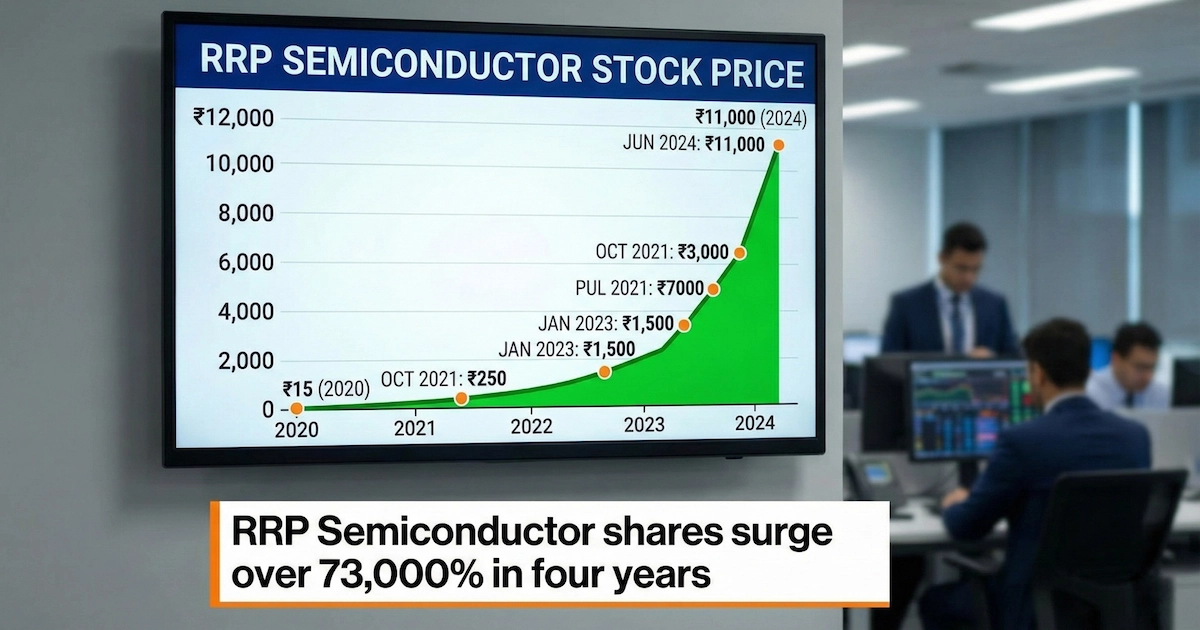
RRP Semiconductor Ltd. didn't just outperform every Indian stock in 2024-2025. It delivered a 55,000% return in just 20 months—making it the world's best-performing stock among companies valued above $1 billion. The shares went from ₹15 in April 2024 to over ₹11,000 by December 2025.
For comparison, Nvidia—the actual AI chip giant powering ChatGPT and most of Silicon Valley—gained roughly 200% over the same period. RRP Semiconductor outperformed it by a factor of 275x.
And yet, on December 18th, 2025, Bloomberg reported that the Securities and Exchange Board of India (SEBI) has launched an investigation into the stock for potential wrongdoing. The BSE has restricted trading to once per week. The company itself has issued public warnings telling investors that its stock price rise "lacks financial or business justification."
So what exactly is going on here?
The Anatomy of a 55,000% Rally
The story of RRP Semiconductor is really two stories running in parallel—one about narrative, the other about reality. Understanding where they diverge explains everything.
The Narrative: India is experiencing a semiconductor revolution. Prime Minister Modi's ₹76,000 crore incentive program has attracted $18 billion in investments from Micron, Tata, and Foxconn. The country is positioning itself as a global chip manufacturing hub. RRP Semiconductor—with "Semiconductor" literally in its name—must be part of this wave.
The Reality: RRP Semiconductor Ltd. was formerly known as G D Trading and Agencies Ltd., a company involved in real estate and securities trading. It changed its name in early 2024 after Rajendra Chodankar, founder of the RRP Group, acquired control through an ₹80 million loan repayment deal. The board then sold him shares at ₹12—40% below market price—giving him a 74.5% stake.
The company has never manufactured a single semiconductor chip. It has made no applications under any government incentive schemes. It employs exactly two people full-time.
In a November 3rd, 2025 exchange filing, RRP Semiconductor explicitly stated: "The company has yet to start any sort of semiconductor manufacturing activities."
The 149-Day Limit-Up Streak That Defied Logic
Here's where things get genuinely bizarre.
Indian stock exchanges have "circuit breaker" mechanisms that limit how much a stock can move in a single day. For small-cap stocks like RRP, this cap is typically 5-10%. When a stock hits this limit, it stops trading for the day.
RRP Semiconductor hit its upper circuit limit for 149 consecutive trading sessions. Not days—sessions. Nearly eight months of trading where the stock maxed out its daily gain every single day.
How is this even possible?
Three factors created the perfect storm:
1. A Microscopic Free Float
Approximately 98% of RRP Semiconductor's shares are held by Chodankar and a small circle of associates. These shares don't trade. What remains—the "free float"—is so small that even modest buying pressure can send prices to the daily limit.
At the end of September 2025, RRP had just 528 retail investors and an average of 19 shares traded daily over the preceding two weeks. When there's virtually no supply and any demand at all, prices can only go one direction.
2. India's Retail Investor Explosion
India has added over 50 million new demat accounts in the past few years. Many of these investors are young, mobile-first, and learning about investing through social media rather than traditional financial analysis. The semiconductor narrative—fueled by global AI hype and Modi's manufacturing push—made anything with "semiconductor" or "chip" in its name look attractive.
As Sonam Srivastava, founder of Wryght Research & Capital, told Bloomberg: "Semiconductors have been really hot and people are willing to buy any name given India has limited stocks to offer."
3. The Confusion Between Two Companies
This is critical: there are two separate RRP entities, and investors appear to be confusing them.
- RRP Semiconductor Ltd. is the publicly listed company on the BSE. It has 2 employees, negative revenue, and no semiconductor operations.
- RRP Electronics Ltd. is a privately-held company also owned by Chodankar. This is the one that received 100 acres of land in Navi Mumbai for a semiconductor fab, has announced ₹12,035 crore in planned investments, and where cricket legend Sachin Tendulkar and Maharashtra CM Devendra Fadnavis appeared at events.
RRP Semiconductor lists RRP Electronics as a "related party" because both are owned by Chodankar. But RRP Semiconductor does not own any stake in RRP Electronics. Buying RRP Semiconductor shares gives you zero exposure to the actual semiconductor projects.
It's like buying shares in "Apple Records" thinking you're investing in "Apple Inc."
The Red Flags That Should Have Stopped Everything
Buried in the regulatory correspondence is a detail that makes this entire saga even more extraordinary.
In September 2024, SEBI reminded the BSE that RRP Semiconductor's founder group was barred from accessing the securities market for 10 years. This ban stemmed from their association with Shree Vindhya Paper Mills, a company delisted by the BSE in 2017 for non-compliance.
Despite this reminder, RRP Semiconductor had earlier received approval for a preferential share sale. In April 2025, the BSE withdrew this approval—a decision RRP is currently challenging in the Securities Appellate Tribunal.
According to Bloomberg, a person familiar with the matter at BSE acknowledged the exchange suffered an "internal lapse" in processing the offering and may seek SEBI's guidance on extending share lock-in periods.
The company's financials offer even less comfort:
Metric | Q2 FY26 (Sept 2025) |
Revenue | ₹-6.82 crore (negative) |
Net Loss | ₹7.15 crore |
Full-Time Employees | 2 |
P/E Ratio | -6,097x |
Market Cap to Sales | 1,079x |
Yes, that's negative revenue. The company had to reverse ₹440 crore worth of sales booked from a November 2024 order from Telecrown Infratech after it was cancelled over "contractual disagreements."
What SEBI Is Actually Investigating
SEBI's investigation into RRP Semiconductor focuses on potential market manipulation and whether the extreme price surge was artificially orchestrated.
The investigation examines:
- Coordinated trading patterns among the small pool of shareholders
- Social media campaigns that amplified false or misleading narratives
- Related-party transactions and potential insider benefit
- Compliance with disclosure requirements
The company has filed police complaints against at least one social media influencer over alleged rumor-mongering about celebrity associations and government land allotments—benefits that apply to RRP Electronics, not the listed RRP Semiconductor.
Since being placed under the BSE's strictest surveillance (ASM LT: Stage 1) and having trading restricted to once weekly, the stock has declined approximately 6% from its November 7th peak.
India's Semiconductor Dream Is Real—This Just Isn't Part of It
Here's the frustrating irony: India's semiconductor story is genuinely compelling.
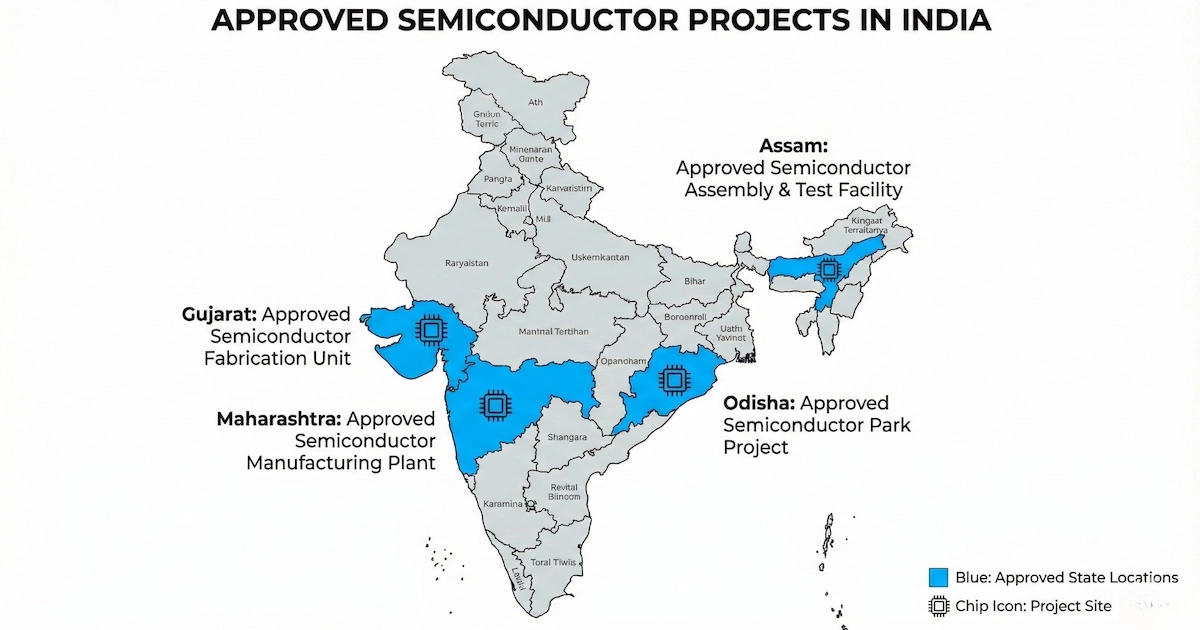
The India Semiconductor Mission has approved 10 projects worth over $18 billion across six states. Tata Electronics is building a ₹91,000 crore fab in Dholera, Gujarat, in partnership with Taiwan's PSMC. Micron's ₹22,516 crore ATMP facility in Sanand is already producing test chips. Prime Minister Modi announced at SEMICON India 2025 that Made-in-India commercial chips will hit the market by end of 2025.
The country has legitimate listed companies with actual AI and semiconductor exposure: TCS, Infosys, HCL Tech (with their AI Force platform), Persistent Systems, Tata Elxsi, and L&T Technology Services all have meaningful AI/chip-adjacent businesses with real revenue, employees, and operations.
RRP Semiconductor isn't part of this story. It's a cautionary tale about what happens when narrative overwhelms reality, when trading mechanics (tiny float, daily limits) amplify price distortions, and when retail enthusiasm meets regulatory gaps.
The Bigger Picture: What This Means for Indian Markets
The RRP Semiconductor phenomenon reflects broader tensions in India's capital markets:
1. The Retail Investor Protection Gap
India added 50+ million new investors in recent years, but financial literacy hasn't kept pace. Social media-driven investing bypasses traditional gatekeepers (advisors, research analysts) who might have flagged obvious red flags.
2. Small-Cap Surveillance Challenges
BSE's surveillance mechanisms—circuit breakers, ASM stages, trading restrictions—clearly failed to prevent a 55,000% rally in a fundamentally broken stock. The question is whether reforms can close these gaps without killing legitimate small-cap trading.
3. The "Semiconductor Scarcity" Problem
India has no major publicly-listed pure-play semiconductor manufacturers. This scarcity creates unhealthy dynamics where any tangentially-related name attracts disproportionate attention. Until Tata, Micron, or others go public with their Indian operations, this gap will persist.
What Experts Disagree On
Regulatory Response: Some analysts believe SEBI's investigation will result in significant penalties and trading bans. Others argue that proving manipulation in thinly-traded small-caps is notoriously difficult, and the outcome may be inconclusive.
Promoter Intent: Whether Chodankar and associates deliberately engineered the rally or simply benefited from circumstances beyond their control remains hotly debated. The company's public warnings to investors suggest an awareness of the disconnect—but those warnings came only after massive gains.
Market Contagion: Whether RRP's eventual correction will impact broader small-cap sentiment—particularly in semiconductor-adjacent themes—is uncertain. Some see it as an isolated anomaly; others view it as the canary in the coal mine for India's retail-driven rally.
The Risks Nobody's Talking About
Lock-in Expiration: If SEBI guidance doesn't extend lock-in periods, approximately 98% of shares held by promoters could eventually become tradeable. Any attempt to sell even a fraction of these holdings into the tiny free float would likely crater prices.
Legal Uncertainty: RRP's appeal against BSE's withdrawal of share sale approval remains pending. An unfavorable ruling could trigger fresh compliance issues and potential delisting scenarios.
Knock-On Effects: If retail investors suffer significant losses, political and regulatory backlash could tighten rules for all small-cap stocks—including legitimate ones.
Should You Invest in RRP Semiconductor?
There's really no polite way to put this: investing in RRP Semiconductor at current valuations requires ignoring virtually every principle of fundamental analysis.
The stock trades at a negative P/E of 6,097x. Its market cap-to-sales ratio exceeds 1,079x (assuming you count reversed sales as zero, which they effectively are). It employs two people. It manufactures nothing. The founder group may be under a securities market ban. SEBI is investigating. Trading is restricted to once per week.
If you're looking for legitimate semiconductor exposure in India, consider companies with:
- Actual employees (thousands, not two)
- Actual revenue (positive, not negative)
- Actual products or services
- Actual regulatory standing
Companies like Tata Elxsi, L&T Technology Services, or even IT giants with growing AI practices (TCS, Infosys, HCL Tech) offer real exposure to India's technology transformation—with the fundamentals to match.
What Happens Next?
The RRP Semiconductor story is far from over. Key dates and triggers to watch:
- SEBI Investigation Outcome: Timeline uncertain, but findings could result in penalties, trading suspensions, or referrals for prosecution
- Securities Appellate Tribunal Ruling: RRP's appeal against BSE's withdrawal of share sale approval; next hearing was scheduled for late 2025
- Lock-in Period Decisions: Whether SEBI extends share lock-ins pending appeal resolution
- Quarterly Results: Future filings will show whether the company can generate any legitimate revenue
We'll update this article as material developments occur.
The Bottom Line (Without the Label)
Every market cycle produces its share of cautionary tales—stocks that capture imaginations, defy fundamentals, and eventually revert to reality. RRP Semiconductor's 55,000% rally will likely be studied in finance courses for years as an example of how narrative, market structure, and regulatory gaps can combine to create extraordinary—and ultimately unsustainable—valuations.
India's semiconductor ambitions are real. The $18 billion in approved investments, the Tata-PSMC fab, the Micron facility, the government's commitment to local chip manufacturing—these represent genuine opportunities that will create actual value over the coming decade.
RRP Semiconductor is not one of those opportunities. It's a reminder that in investing, what a company is called matters far less than what it actually does.
And right now, this company with "Semiconductor" in its name doesn't actually make semiconductors.
Are you following India's semiconductor investments? What other stocks are you watching in this space? Drop your thoughts in the comments below.