
Your Internet Cable Just Got a Quantum Upgrade
Here's something that'll mess with your head: scientists just teleported information through the same fiber optic cables that deliver your Netflix binges and Zoom calls. Not in some pristine, isolated laboratory setup. Through active internet cables. With regular traffic flowing through them.
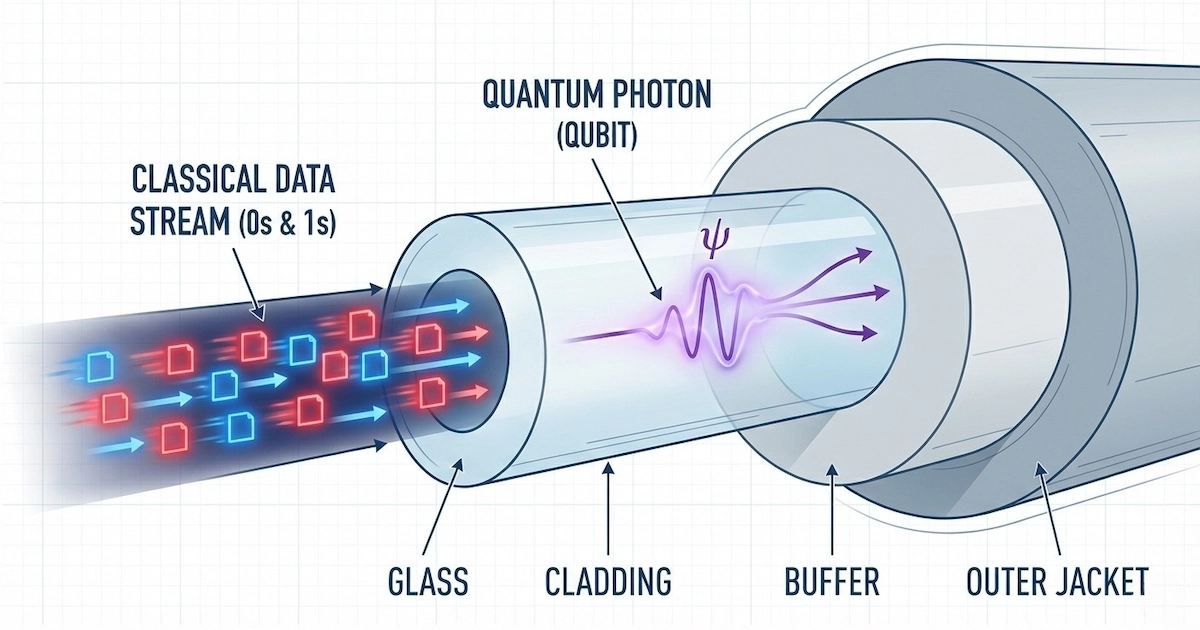
Northwestern University engineers pulled off what the physics community had largely written off as impossible. They successfully demonstrated quantum teleportation—the transfer of quantum information between particles without physically moving anything—over a 30-kilometer fiber optic cable that was simultaneously carrying 400 gigabits per second of conventional internet traffic.
"This is incredibly exciting because nobody thought it was possible," said Prem Kumar, professor of electrical and computer engineering at Northwestern's McCormick School of Engineering, who led the research team. The study was published in the peer-reviewed journal Optica in December 2024.
Wait, What Exactly Got Teleported?
Let's get something straight before your imagination runs wild. This isn't Star Trek. Nobody's beaming atoms across the room.
Quantum teleportation transfers the state of a particle—essentially its quantum information—from one location to another using a phenomenon called quantum entanglement. Two particles become "entangled," meaning their quantum states are intrinsically linked regardless of the distance between them. Measure one, and you instantly know something about the other.
Here's the simplified version: imagine two coins that are magically connected. Flip one in Mumbai and you immediately know what the other coin shows in New York—without looking at it, without any signal traveling between them. That's entanglement in a nutshell (though physicists would cringe at this analogy).
The Northwestern team used this spooky connection to transfer quantum information across 30.2 kilometers of fiber. The quantum state of a photon at one end was essentially "reconstructed" on a photon at the other end, even though the original photon never physically traveled the distance.
Why Everyone Thought This Was Impossible
The conventional wisdom in quantum physics was brutally simple: quantum signals are delicate. Regular internet signals are not.
"In optical communications, all signals are converted to light," Kumar explained. "While conventional signals for classical communications typically comprise millions of particles of light, quantum information uses single photons."
Picture this: you're trying to hear a whisper in a stadium full of screaming fans. That's essentially what sending a single quantum photon through a cable packed with millions of classical photons looks like. The quantum signal should get drowned out, scattered, destroyed.
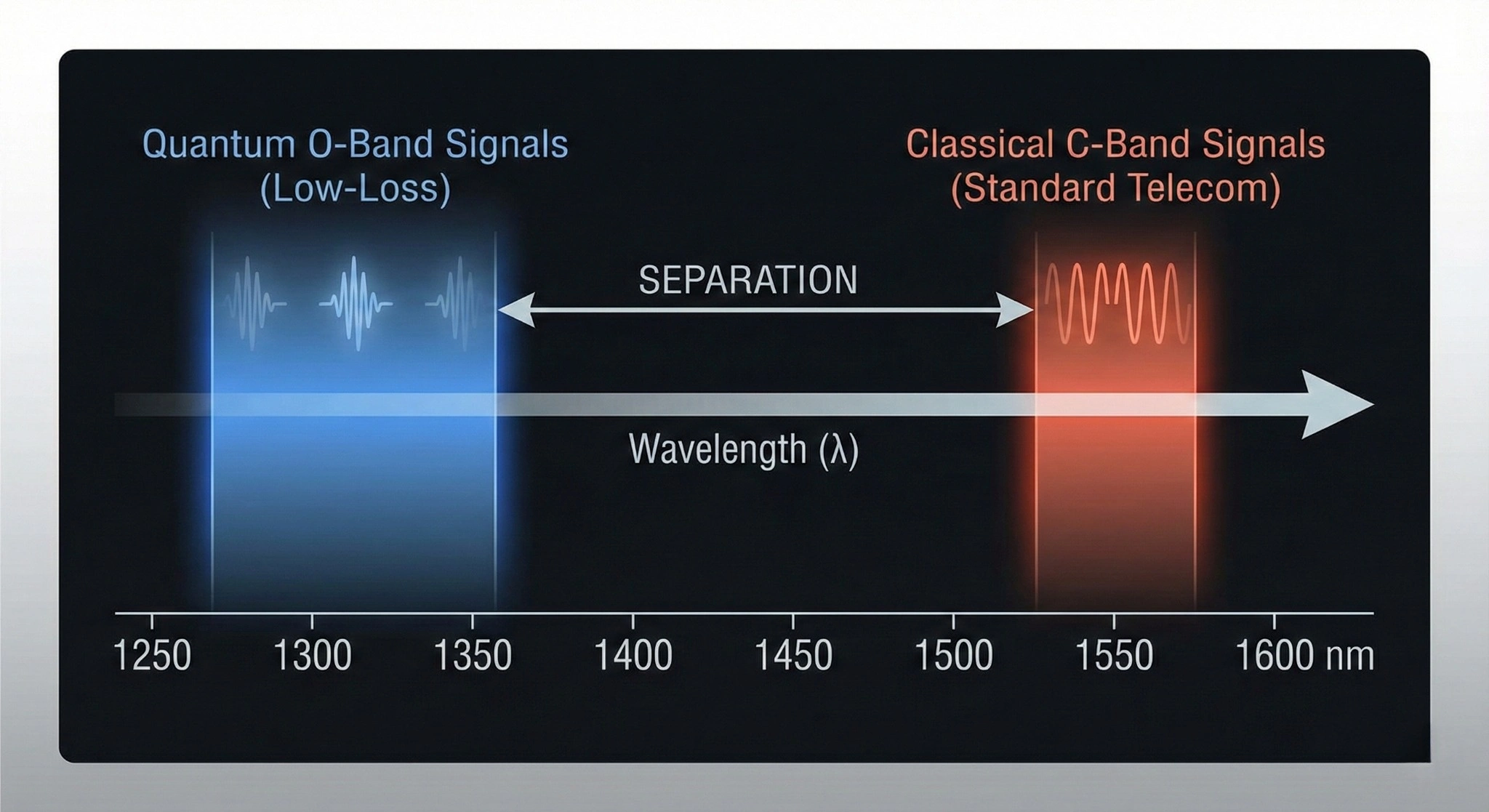
Kumar's team found a clever workaround. They conducted extensive studies on how light scatters within fiber optic cables and identified a less crowded wavelength where their quantum photons could travel relatively undisturbed. The quantum signals operated at around 1290 nanometers in the O-band, while conventional internet traffic blazed through the heavily-used C-band at 1547 nanometers.
They also deployed specialized filters to reduce noise from the classical traffic.
"We carefully studied how light is scattered and placed our photons at a judicial point where that scattering mechanism is minimized," Kumar said. "We found we could perform quantum communication without interference from the classical channels that are simultaneously present."
The Test That Changed Everything
The experiment setup was elegantly straightforward. The team configured a 30.2-kilometer fiber optic cable with entangled photon sources at either end. They then ran the quantum teleportation protocol while simultaneously pushing 400 Gbps of regular internet traffic through the same cable.
The Bell state measurement—the quantum measurement needed to complete the teleportation—was performed at the cable's midpoint. The result? Quantum information successfully teleported, maintaining its integrity despite the digital chaos surrounding it.
Jordan Thomas, a Ph.D. candidate in Kumar's laboratory and the paper's first author, put the significance in perspective: "Although many groups have investigated the coexistence of quantum and classical communications in fiber, this work is the first to show quantum teleportation in this new scenario. This ability to send information without direct transmission opens the door for even more advanced quantum applications being performed without dedicated fiber."
What This Means for You (Eventually)
Let's be real about the timeline here. You're not getting a quantum-encrypted WhatsApp update next year. But the implications of this research are genuinely significant.
Infrastructure economics just changed. The biggest barrier to quantum networks was always the assumption that we'd need to build entirely new, dedicated infrastructure. Quantum-only cables. Specialized repeaters. Billions in investment before a single useful quantum bit could be transmitted. This research suggests that's no longer necessarily true.
"If we choose the wavelengths properly, we won't have to build new infrastructure," Kumar stated. "Classical communications and quantum communications can coexist."
Cybersecurity enters a new era. Quantum key distribution (QKD) uses the principles of quantum mechanics to create theoretically unbreakable encryption. If someone tries to intercept quantum-encrypted communications, the very act of observation disturbs the quantum state—immediately alerting both sender and receiver that the channel has been compromised.
The ability to run QKD over existing fiber networks means this ultra-secure communication could theoretically be deployed much faster and cheaper than previously imagined.
Quantum computing gets networked. One of the major challenges facing quantum computers is that they're essentially isolated machines. Connecting quantum computers—creating a "quantum internet"—would allow them to work together on problems too complex for any single machine. This research brings that vision closer to practical reality.
The Global Quantum Race Heats Up
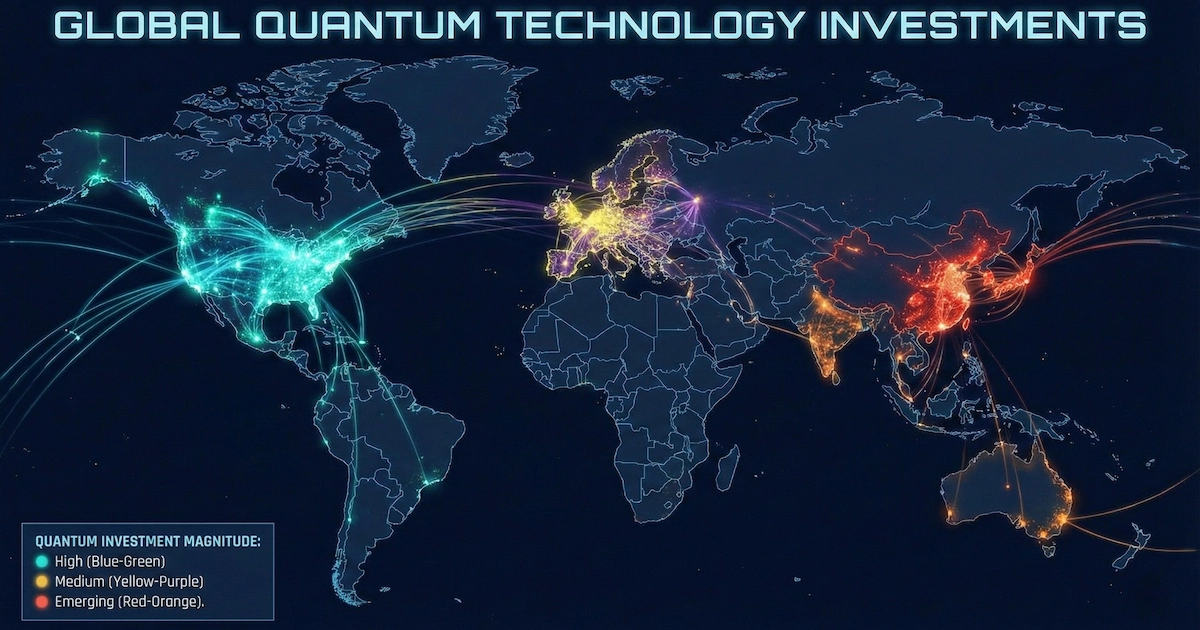
This breakthrough lands in the middle of an intensifying global competition in quantum technology. Government investments worldwide have surpassed $40 billion, with China leading at approximately $15 billion, the European Union collectively at $10 billion, and the United States at around $5 billion in announced public funding.
Private sector investment is equally aggressive. Venture capital funding for quantum companies exceeded $2 billion in 2024, a 50% increase from the previous year. By September 2025, total equity funding had reached $3.77 billion.
India recently released its quantum roadmap targeting leadership among the world's top three quantum economies by 2035, with ambitions to capture more than 50% of the global quantum software and services market. The country's quantum computing market, valued at $68.7 million in 2024, is projected to reach $231.8 million by 2030.
The UK's National Quantum Strategy dedicates £2.5 billion over ten years. Australia committed $620 million to build the world's first utility-scale, fault-tolerant quantum computer. Japan announced a $7.4 billion quantum commitment.
The Security Double-Edge
Here's where things get complicated. Quantum technology is simultaneously the biggest threat to current cybersecurity and its most promising solution.
Current encryption—the stuff protecting your bank accounts, medical records, and government communications—relies on mathematical problems that classical computers can't solve quickly. A sufficiently powerful quantum computer running Shor's algorithm could crack these encryptions almost instantly.
This isn't an abstract future threat. Intelligence agencies and cybercriminals are already conducting "harvest now, decrypt later" operations—intercepting and storing encrypted data today, waiting for quantum computers capable of breaking the encryption tomorrow.
The National Institute of Standards and Technology (NIST) released post-quantum cryptography standards in August 2024, essentially new encryption algorithms designed to withstand quantum attacks. But transitioning the entire internet's security infrastructure to these new standards will take years, possibly decades.
Quantum communication technologies like the one demonstrated by Northwestern offer a different approach: encryption that's secure against any computer, classical or quantum, based on the fundamental laws of physics rather than mathematical difficulty.
What's Next
Kumar's team isn't resting. They're planning to extend experiments over longer distances and test the technology on real underground fiber optic cables rather than laboratory spools. They're also working toward demonstrating "entanglement swapping"—using multiple pairs of entangled photons to relay quantum information across even greater distances.
Other research groups are advancing parallel breakthroughs. In November 2025, physicists at the University of Stuttgart achieved quantum teleportation between photons from two different light sources—another milestone that was once considered nearly impossible.
Meanwhile, more practical developments are emerging. In September 2025, Penn engineers demonstrated quantum networking on Verizon's live fiber network using a silicon "Q-chip" that speaks standard internet protocol.
The Bottom Line
Northwestern's achievement doesn't mean quantum internet is arriving at your home tomorrow. The 30-kilometer distance is still far from the thousands of kilometers needed for practical networks. Quantum repeaters—devices that can extend quantum signals without breaking their delicate states—remain an unsolved engineering challenge.
But what this research demonstrates is that the path to a quantum-enabled internet doesn't require tearing up and replacing our existing infrastructure. The cables are already in the ground. The photons, it turns out, can share the road.
And that changes the economics, the timeline, and the possibilities of everything that follows.