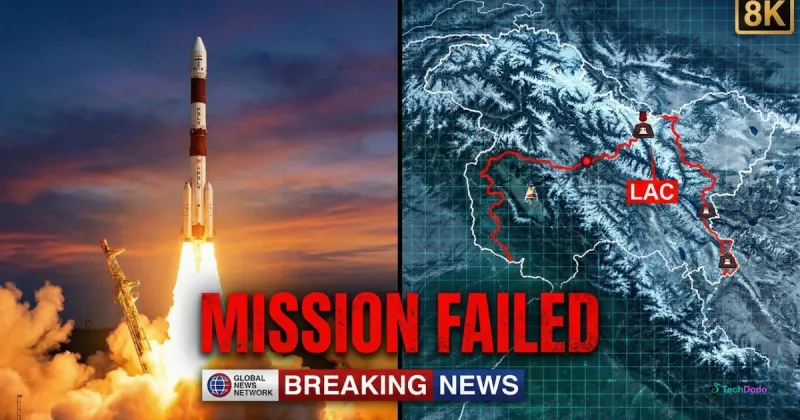
Quick Answer: ISRO's PSLV-C62 mission failed on January 12, 2026, losing India's strategic Anvesha spy satellite designed to detect camouflaged military assets along borders with China and Pakistan. This marks the second consecutive PSLV failure in eight months—a rare crisis for India's most reliable rocket.
India woke up on January 12, 2026, expecting to celebrate. ISRO's PSLV-C62 was supposed to deliver a satellite that could see through camouflage, detect hidden tanks, and spot enemy bunkers that regular satellites miss completely. Eight minutes later, those hopes came crashing down.
The rocket's third stage malfunctioned. Sixteen satellites were lost. And India's border surveillance ambitions took a hit that will sting for months, possibly years.
Here's what happened, why it matters, and what this means for you.
The Eight Minutes That Changed Everything
The launch started perfectly. At 10:18 AM IST, PSLV-C62 lifted off from Sriharikota with textbook precision. First stage separation—clean. Second stage—nominal. Mission control was calm. Then came minute eight.
ISRO Chairman V. Narayanan described what happened next. According to his post-launch briefing, the vehicle experienced a disturbance in roll rates by the end of the third stage. The rocket began spinning on its axis. At 8,000 kilometers per hour, even a slight deviation is catastrophic.
The primary payload, DRDO's EOS-N1 satellite—codenamed Anvesha—never reached orbit. Neither did the 15 other satellites from India, Europe, Brazil, and Nepal.
Business Standard reports that ISRO confirmed the third stage suffered an unexpected drop in chamber pressure, similar to what happened during last year's PSLV-C61 failure. Two identical failures in eight months. That's not coincidence. That's a pattern.
Why Anvesha Was Different From Every Other Indian Spy Satellite
Anvesha wasn't just another camera in the sky. It was India's hyperspectral imaging satellite, built by DRDO specifically for strategic surveillance.
Here's the difference: Regular satellites see the world in a handful of color bands—think of it as seeing in basic RGB. Hyperspectral satellites capture hundreds of narrow light wavelengths, creating what experts call a "spectral fingerprint" for every material on Earth.
According to The Week's pre-launch coverage, space analyst Girish Linganna explained this capability. Enemy tanks hidden under camouflage nets? Anvesha could spot them because metal reflects light differently than fabric—even fabric painted to look like leaves. Troops hiding under forest cover? Their equipment creates unique signatures invisible to normal cameras.
The satellite, weighing around 150 kg per The Print's reporting, was designed to orbit at 600 kilometers with a 12-meter resolution. Not the sharpest eyes in space, but sharp enough to matter when combined with hyperspectral detection.
For India's border security forces monitoring the 749-km Line of Control with Pakistan and the 3,448-km Line of Actual Control with China, this capability was supposed to be transformative.
The Real Cost: Three Strategic Satellites Lost In 12 Months
Let's put this in perspective. India hasn't just lost one strategic satellite. According to The Print's analysis, PSLV-C62 marks the third failure of a strategic satellite mission in the past year.
January 2025: GSLV-F15 failed to place the NVS-02 navigation satellite into orbit. A pyro valve malfunction caused losses estimated at ₹300 crore.
May 2025: PSLV-C61 suffered a mid-flight failure, losing the EOS-09 radar imaging satellite. This satellite was supposed to provide all-weather, day-and-night surveillance. Business Standard estimated losses at ₹850 crore.
January 2026: PSLV-C62 fails, losing Anvesha and 15 co-passengers.
Three strategic assets that India desperately needed. All gone.
What makes this worse? WION reports that ISRO hasn't released the Failure Analysis Committee reports for either the PSLV-C61 or NVS-02 failures. That's a departure from ISRO's traditional transparency culture—and it raises uncomfortable questions about what's happening inside India's space program.
Why This Matters More Than Ever: The Operation Sindoor Wake-Up Call
India's urgency around space-based surveillance isn't academic. It's born from recent experience.
According to Business Standard's defense reporting, during Operation Sindoor in May 2025, India reportedly faced gaps in real-time intelligence gathering. The reliance on older Cartosat satellites and foreign commercial imagery slowed decision-making during critical moments.
More troubling: Pakistan allegedly received satellite intelligence support from China during the operation. Pakistani Defence Minister Khawaja Asif told Arab News that information sharing between Pakistan and China regarding threats is "very normal."
That revelation accelerated India's push for self-reliance in space surveillance. The government approved the SBS-3 (Space-Based Surveillance Phase 3) program—52 satellites, ₹26,968 crore budget, completion targeted by 2029.
The first satellite from SBS-3 was expected by April 2026. With the PSLV fleet now likely grounded pending investigation, that timeline looks optimistic.
Is the 12-Meter Resolution Really Worth ₹850 Crore?
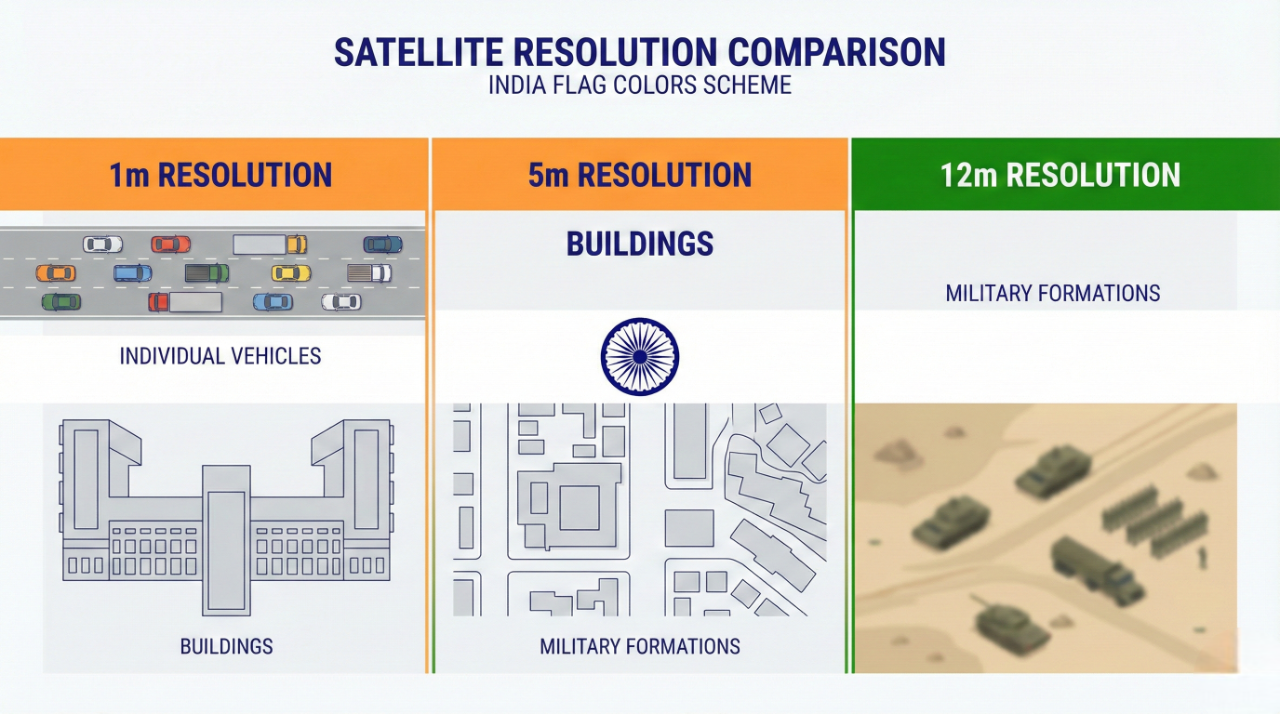
Here's where it gets interesting. Anvesha's 12-meter resolution sounds modest compared to commercial satellites that can see 30-centimeter details. But hyperspectral isn't about sharpness—it's about seeing what's invisible.
According to Geospatial World's analysis of India's surveillance capabilities, the previous HysIS hyperspectral satellite could detect man-made objects on sea surfaces, tanks in deserts, and camouflaged missile launchers—even with relatively low resolution—because their spectral signatures are unmistakable.
Think of it this way: A regular satellite might show you a green blob in a forest. A hyperspectral satellite tells you whether that green blob is actual trees or canvas painted green. At the LAC in Ladakh, where China has been building roads, airstrips, and military outposts at alarming speed, that distinction matters.
Anvesha was supposed to give India's defence planners early warning of unusual construction or troop movements. Without risking soldiers' lives on ground reconnaissance. Without waiting for weather to clear for optical imaging. Without gaps.
Now that capability stays on the wishlist.
What Happens Next: The Uncomfortable Questions
ISRO's immediate problem is figuring out what keeps killing the PSLV's third stage. The PS3 uses solid fuel—a technology that's supposed to be more reliable than liquid-fuel systems because there are fewer moving parts. Yet both recent failures originated there.
Former ISRO scientist Manish Purohit told TFI Post that the Failure Analysis Committee will need to examine every bit of telemetry data and potentially recreate stress conditions on components like the flex nozzle.
The broader implications, according to multiple reports:
The PSLV fleet will likely remain grounded until corrective measures are verified. This affects not just strategic launches but commercial missions—PSLV is NSIL's primary vehicle for rideshare customers.
India's 2026 launch schedule faces disruption. ISRO had at least seven launches planned, including critical Gaganyaan test flights for the human spaceflight program.
Customer confidence in PSLV may suffer. The rocket's 94% success rate over 63 flights was its selling point. Two consecutive failures change that calculation.
The SBS-3 surveillance constellation timeline may slip. Private contractors are supposed to build 31 of the 52 satellites, but they still need ISRO's rockets to reach orbit.
The Bigger Picture: India's Space Security Gap
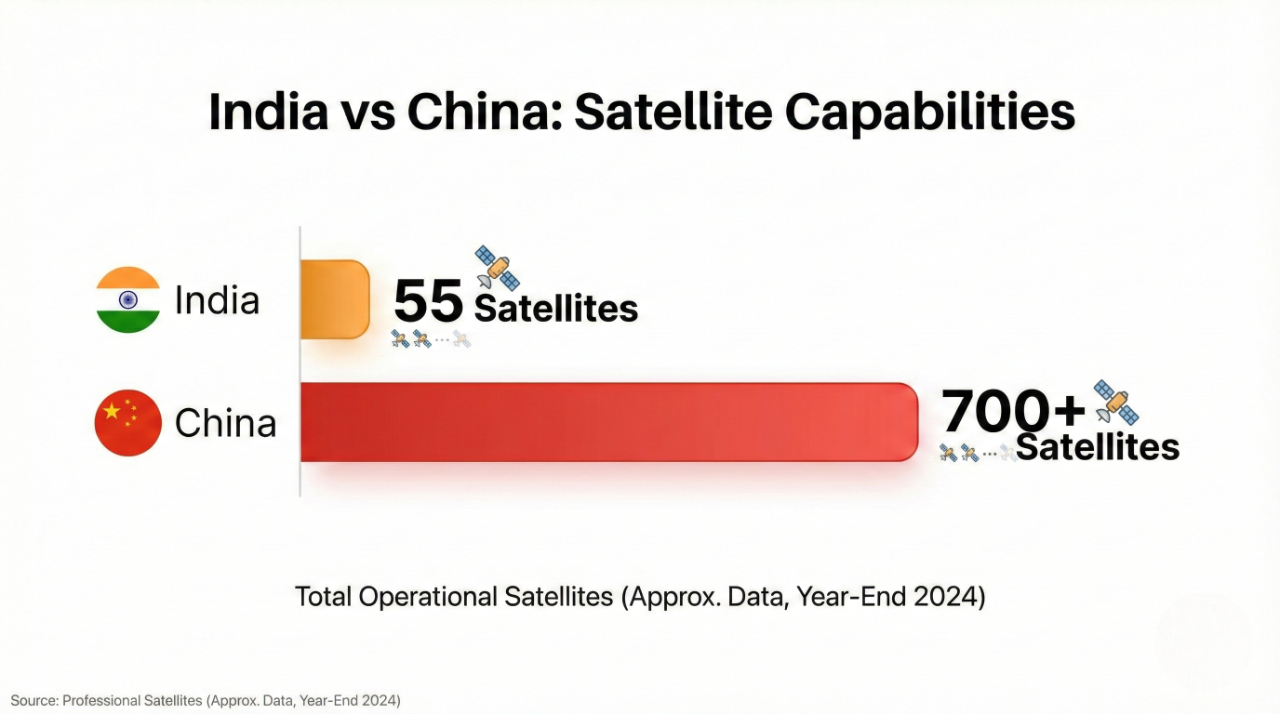
India currently has 55 operational satellites. ISRO Chairman V. Narayanan acknowledged in April 2025 that this isn't sufficient to monitor the country's borders and coastal areas comprehensively.
China, by comparison, has over 700 satellites. Its Yaogan series provides comprehensive surveillance across multiple spectrums. Its Gaofen satellites offer sub-meter resolution imaging. According to Orbital Today's analysis, China's dual-use satellites can monitor troop movements, infrastructure development, and even potentially interfere with enemy space assets.
India isn't trying to match China satellite-for-satellite. But losing three strategic satellites in 12 months while trying to build capability isn't just a technical setback. It's a strategic vulnerability.
The government's response will likely include accelerating private sector involvement in launches. NewSpace India Limited has already begun partnering with HAL and L&T for indigenous PSLV production. The first industry-built PSLV was supposed to launch the EOS-10 mission.
That mission just got more complicated.
The Bottom Line For India
ISRO has recovered from setbacks before. The PSLV failed its inaugural flight in 1993 and went on to become India's most successful rocket, launching Chandrayaan-1, the Mars Orbiter Mission, and setting a world record with 104 satellites in a single flight.
But this moment feels different. Two consecutive failures in the same rocket stage. Three strategic satellite losses in a year. Critical surveillance capability delayed. Commercial reputation at stake. And geopolitical realities that won't wait for engineering investigations to conclude.
The Anvesha satellite was supposed to give India eyes that could see through deception. Instead, its loss reveals something India would rather not see: gaps in its space program that adversaries are watching very closely.
We'll update this story as ISRO releases its investigation findings. For now, India's border surveillance capabilities remain exactly where they were yesterday—insufficient for the challenges ahead.