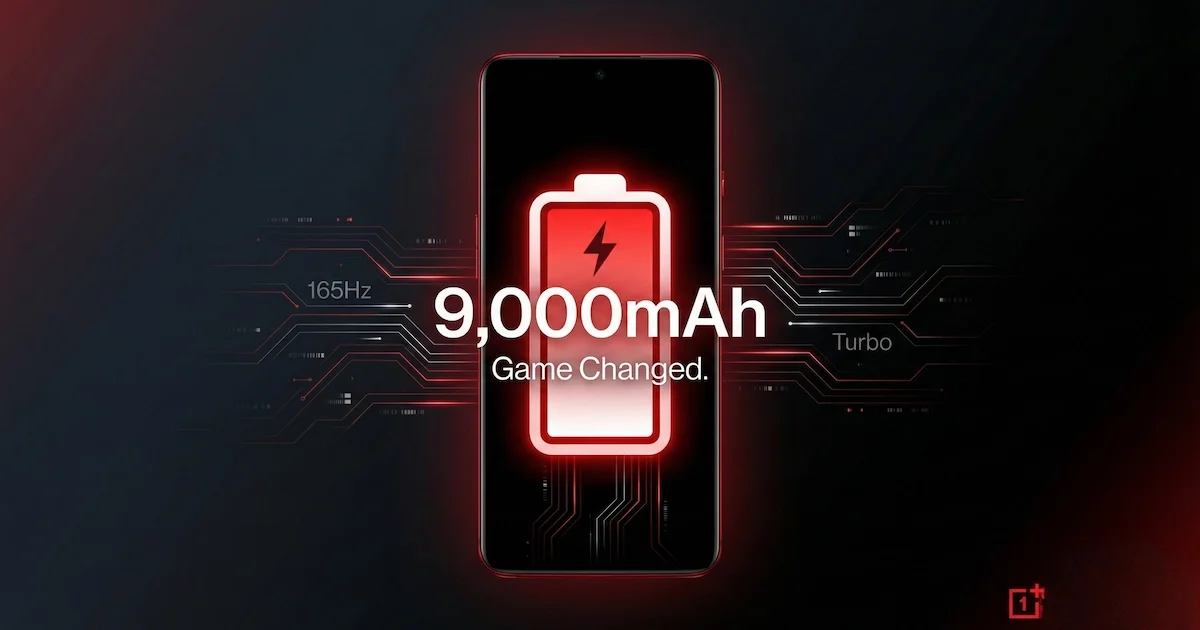
OnePlus Turbo: The 9,000mAh Battery Phone That Changes Everything
OnePlus just dropped a bomb. While everyone was busy dissecting the freshly launched OnePlus 15R, the company's China President Li Jie Louis casually confirmed an entirely new smartphone series on Weibo—the OnePlus Turbo. And the leaked specifications? They're absolutely bonkers.
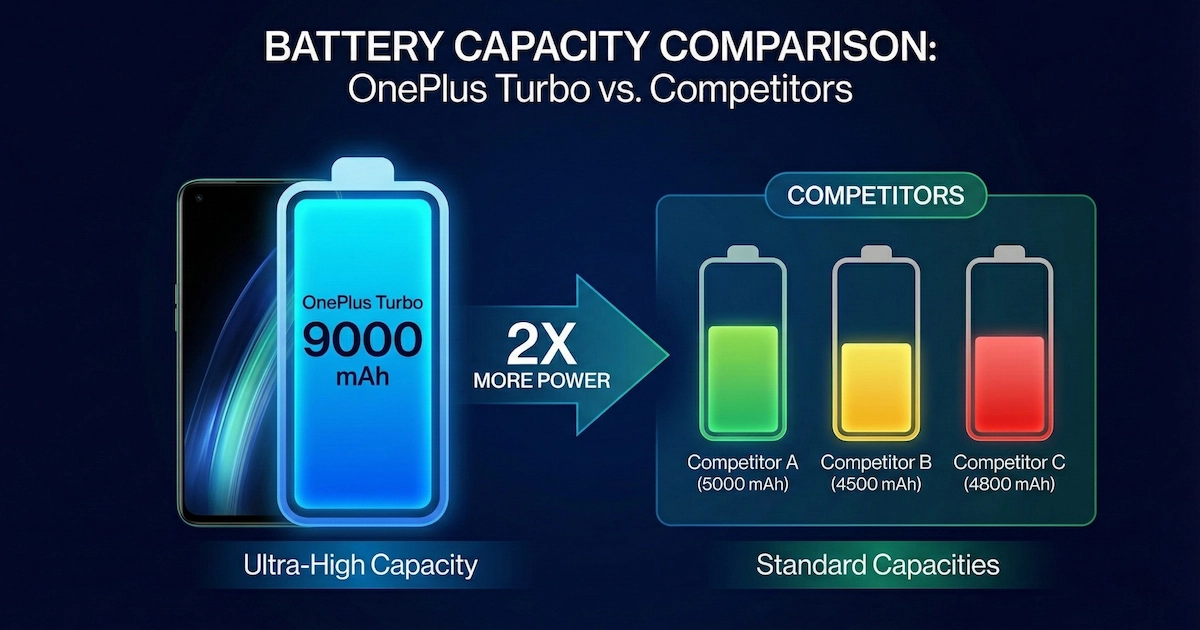
We're talking about a phone with a 9,000mAh battery. To put that in perspective, the iPhone 16 Pro Max has 4,685mAh. The Samsung Galaxy S24 Ultra sits at 5,000mAh. Even OnePlus's own 15R, which just launched in India with what they called a "massive" battery, packs 7,400mAh.
The OnePlus Turbo isn't just iterating. It's leapfrogging.
What We Know: The Leaked Specifications
Here's where things get interesting. Multiple credible leakers—including Digital Chat Station and Smart Pikachu, both with solid track records—have painted a detailed picture of what's coming.
Display: The OnePlus Turbo will reportedly feature a 6.78-inch LTPS OLED panel with 1.5K resolution and a native 165Hz refresh rate. Digital Chat Station specifically notes this is a newly developed panel, not a recycled component from other phones. The display allegedly features redesigned larger rounded corners for improved visual consistency.
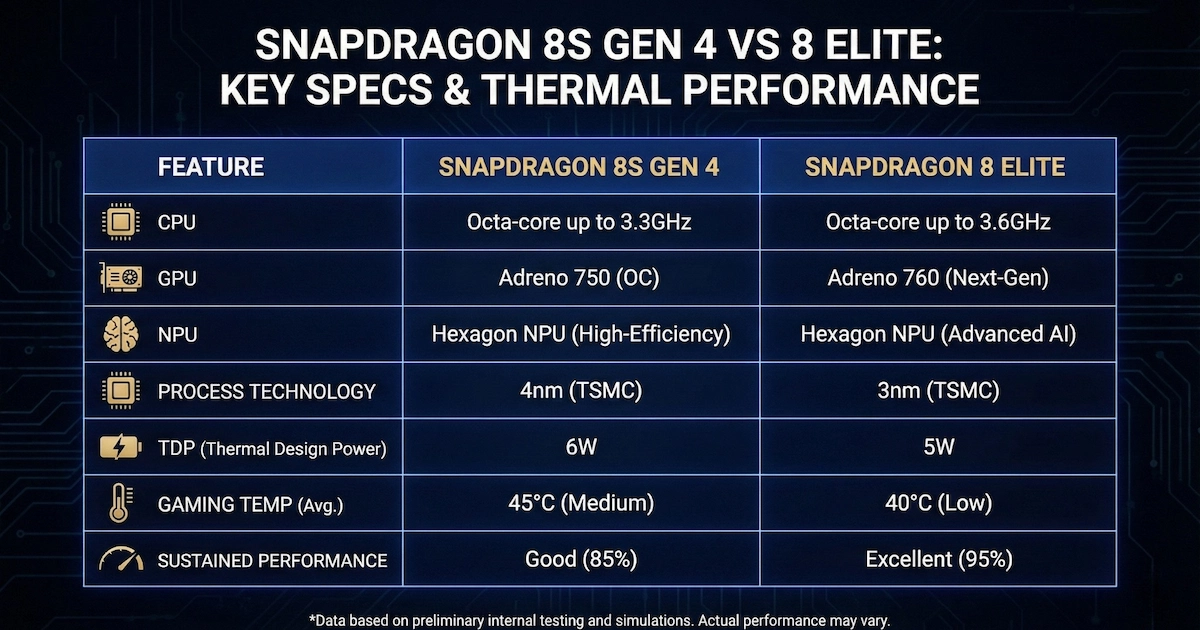
Processor: This is where OnePlus is making a strategic move. Instead of the flagship Snapdragon 8 Elite, the Turbo series will likely run on the Snapdragon 8s Gen 4. This 4nm chip was announced in April 2025 and delivers roughly 31% faster CPU performance and 49% faster GPU performance compared to its predecessor, according to Qualcomm's official benchmarks.
Battery: The headline feature—a 9,000mAh dual-cell battery paired with 100W fast charging. According to Digital Chat Station, this makes the OnePlus Turbo the first device in the entire Oppo-OnePlus ecosystem to breach the 9,000mAh threshold.
Camera: Early leaks suggest a 50MP main sensor with an 8MP ultrawide. Not flagship territory, but serviceable for the expected price segment.
Additional Features: Ultrasonic in-display fingerprint sensor, dual stereo speakers, NFC, X-axis linear motor for precise haptics, and likely ColorOS 16 (Android 16-based) in China.
Why the Snapdragon 8s Gen 4 Choice Matters
OnePlus isn't being cheap here—they're being smart.
The Snapdragon 8s Gen 4 matches or slightly exceeds the Snapdragon 8 Gen 3 in real-world performance. Benchmark tests on devices like the iQOO Neo 10 show AnTuTu scores around 2.1 million and Geekbench 6 multi-core scores of ~6,900. That's flagship-from-2023 territory, which for gaming and daily use, remains excellent.
More importantly, the 8s Gen 4 runs significantly cooler under sustained loads. In CPU throttling tests, it maintained 80% of peak performance over extended periods—compared to the Snapdragon 8 Gen 3's roughly 64% in similar tests. For a phone marketed toward gamers who play BGMI or Genshin Impact for hours, thermal management isn't a nice-to-have. It's the whole point.
The cost savings from using the 8s Gen 4 instead of the 8 Elite also explains how OnePlus can afford to stuff a 9,000mAh battery into what's reportedly a mid-range device.
The Competition Is Already Heating Up
OnePlus isn't operating in a vacuum. The Redmi Turbo 5 is expected to launch around the same timeframe with eerily similar specifications—including its own 9,000mAh battery, 1.5K display, and 100W charging. Xiaomi's device will likely run on a MediaTek Dimensity 8500 Ultra chip.
The Redmi Turbo 5 Pro takes things further with a rumoured Dimensity 9-series processor and the same battery capacity.
Both companies are clearly responding to the same market insight: users are tired of battery anxiety. The smartphone industry spent years obsessing over making phones thinner while users just wanted them to last longer. Someone finally listened.
Expected Competitors Table:
Device | Battery | Processor | Display | Expected Launch |
OnePlus Turbo | ~9,000mAh | Snapdragon 8s Gen 4 | 6.78" 165Hz 1.5K | January 2026 (China) |
Redmi Turbo 5 | ~9,000mAh | Dimensity 8500 Ultra | 6.5" 1.5K | Q1 2026 |
Redmi Turbo 5 Pro | ~9,000mAh | Dimensity 9-series | 6.8" 1.5K | Early 2026 |
Realme Neo 8 SE | TBD | TBD | TBD | 2026 |
India Launch: When and How Much?
Here's the part Indian users need to pay attention to.
OnePlus typically launches Ace-series phones in China before rebranding them for international markets. The pattern suggests the OnePlus Turbo could arrive in India as the OnePlus Nord 6 sometime in Q2 2026—roughly April to June.
Expected India pricing: Based on the Snapdragon 8s Gen 4 positioning and OnePlus's recent pricing strategy, expect the device to land between ₹35,000 and ₹45,000. For context, the Nord 5 launched at ₹29,999 with the Snapdragon 8s Gen 3.
The battery caveat: OnePlus has a history of offering smaller batteries in global variants. The OnePlus 15 (China) packs a 6,300mAh cell while international versions get 6,000mAh. The OnePlus 15R shows a similar trend—8,300mAh in China versus 7,400mAh globally. The India version of the Turbo might ship with a reduced capacity, though it should still exceed anything currently available.
What Experts Disagree On
Not everything about the OnePlus Turbo is settled. Here's where sources conflict:
Processor uncertainty: While most leaks point to the Snapdragon 8s Gen 4, an earlier October 2025 report from GSMArena cited the Snapdragon 8 Gen 5. This could indicate different variants or outdated information. The 8s Gen 4 makes more sense given the expected price positioning.
Battery size: Digital Chat Station says "9,000mAh-class," which suggests the final number could be 8,800mAh or 9,200mAh. OnePlus's official communications have only confirmed "strongest battery life in its class" without specific numbers.
Two devices or one: Leaker Smart Pikachu claims two Turbo phones will launch in January 2026, but OnePlus has only teased the series as a whole, not specific models.
The Risks You Should Know About
China exclusivity risk: As of 19th December 2025 IST, OnePlus has only confirmed the Turbo series for the Chinese market. Global availability remains uncertain.
Price-to-feature trade-offs: That 50MP + 8MP camera setup is decidedly mid-range. If you prioritize photography, the OnePlus 15R (₹47,999) with its superior Sony IMX906 sensor might be the smarter choice despite the smaller battery.
Weight concerns: A 9,000mAh battery doesn't magically disappear. Expect the OnePlus Turbo to weigh well over 220 grams—potentially closer to 240g. That's a significant jump from the OnePlus 15R's 197g.
Software update timeline: OnePlus's R-series and numbered flagships get 4 years of OS updates and 6 years of security patches. The Turbo series, positioned below these, might receive reduced software support.
What This Means for the Indian Market
The timing is deliberate. OnePlus's 40%+ year-over-year growth in 2025 came largely from younger buyers who prioritize performance, battery, and gaming over traditional flagship metrics like camera quality.
The Turbo series directly targets this demographic. It's a phone that says: "Stop worrying about your charger. Just play."
For users currently on phones like the OnePlus Nord 3 or Realme GT Neo series, the Turbo represents a meaningful upgrade in exactly the areas that matter for heavy daily use. The combination of near-flagship processing power, industry-leading battery capacity, and gaming-optimized display creates a compelling package—assuming the price stays competitive.
The Verdict
The OnePlus Turbo isn't trying to be everything to everyone. It's a focused device built around a simple premise: what if your phone never died?
OnePlus is betting that enough buyers will trade a world-class camera system for the freedom of two-day battery life. Given how the mid-range market has evolved—with users spending more time gaming, streaming, and scrolling than taking photos—that bet might pay off.
We'll update this article when OnePlus officially announces specifications and pricing. The January 2026 China launch should reveal everything. Until then, if you're considering a phone purchase in the ₹35,000-50,000 segment, the Turbo is worth waiting for.