The ₹27,000 Question Nobody's Asking
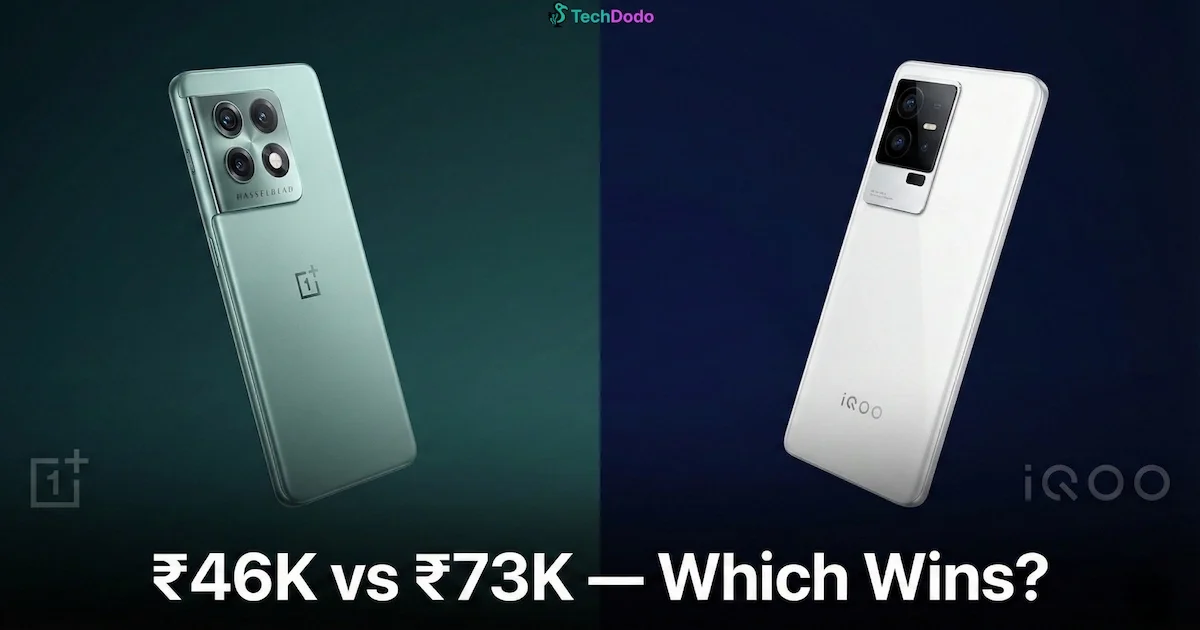
December 17, 2025, marks a fascinating collision in India's smartphone market. OnePlus just launched the 15R—the world's first phone with Qualcomm's Snapdragon 8 Gen 5—at an expected starting price of ₹45,999. Meanwhile, the iQOO 15 has been sitting pretty since November 26 with the more powerful Snapdragon 8 Elite Gen 5, commanding ₹72,999 (effectively ₹64,999 after launch offers).
Both brands have built their reputations on the "flagship killer" promise. Both target the same buyer: someone who wants top-tier performance without the ₹1 lakh sticker shock. But here's the uncomfortable truth nobody's addressing—these phones compete for entirely different wallets.
So which one actually wins? The answer depends on what you're willing to sacrifice.
Performance: The Chip Story Gets Complicated
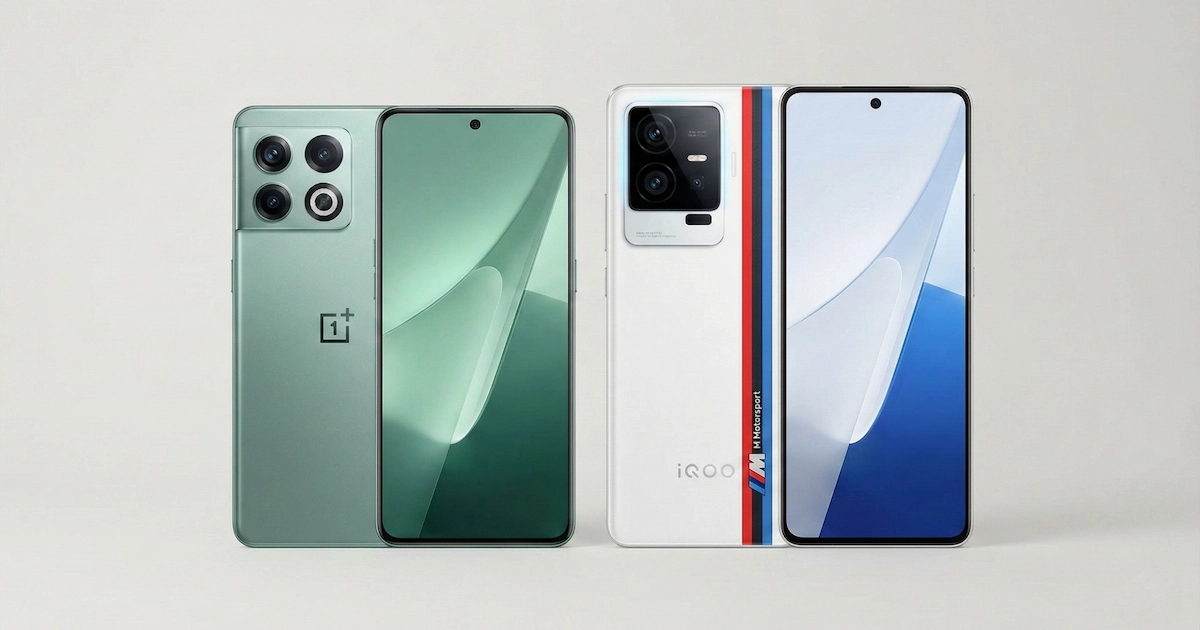
The OnePlus 15R debuts globally with the Snapdragon 8 Gen 5, featuring Qualcomm's third-generation Oryon CPU cores. The iQOO 15 runs on the Snapdragon 8 Elite Gen 5, which sounds like a minor naming difference until you look at the numbers.
Benchmark Reality Check:
Metric | OnePlus 15R (8 Gen 5) | iQOO 15 (8 Elite Gen 5) | Difference |
Geekbench Single-Core | ~2,784 | ~3,563 | -22% |
Geekbench Multi-Core | ~9,329 | ~10,503 | -11% |
AnTuTu V11 (Expected) | ~3.4 million | ~3.7 million | -8% |
Prime Core Clock | 3.8 GHz | 4.6 GHz | -17% |
The 8 Gen 5 uses the same third-gen Oryon cores as the Elite variant but runs them at significantly lower clock speeds—800 MHz slower on the prime cores. The GPU situation mirrors this: both use Adreno 840, but the Elite version has a higher boost frequency and 18MB of High-Performance Memory that the standard chip lacks.
What does this mean practically? The iQOO 15 will handle sustained gaming loads better, render video faster, and maintain peak performance longer. The OnePlus 15R won't embarrass itself—it's still faster than last year's Snapdragon 8 Elite—but it's clearly the junior sibling.
OnePlus pairs its chip with a G2 Gaming Chip and Touch Response Chip for input latency optimization. iQOO counters with its Q3 Supercomputing Chip, which enables hardware-accelerated ray tracing in titles like Genshin Impact—a first for smartphones in India.
Performance verdict: iQOO 15 wins, but the gap narrows significantly in daily tasks. Heavy gamers should lean toward the iQOO; everyone else might not notice the difference.
Display: Resolution vs. Refresh Rate
The spec sheet divergence here tells an interesting story.
Specification | OnePlus 15R | |
Size | 6.83 inches | 6.85 inches |
Panel | LTPS AMOLED | Samsung M14 LTPO AMOLED |
Resolution | 1.5K (2376 x 1080) | 2K (3168 x 1440) |
Refresh Rate | 165 Hz | 144 Hz |
Peak Brightness | 3,600 nits | 6,000 nits |
Touch Sampling | Not disclosed | 3,200 Hz (instant) |
HDR | HDR10+ | HDR10+, Dolby Vision |
OnePlus prioritizes smoothness over sharpness, opting for a 165 Hz panel with lower 1.5K resolution. iQOO goes the opposite direction: 2K resolution with 144 Hz. The iQOO 15's Samsung M14 panel is genuinely excellent—the same panel family used in flagship Samsung devices.
Here's where it gets interesting. OnePlus claims 3,600 nits peak brightness, which is impressive until you see iQOO's claimed 6,000 nits. Real-world testing from GSMArena measured the iQOO 15 at around 2,730 nits full-screen, which suggests both brands are using marketing-friendly "peak" measurements.
The iQOO 15's LTPO technology allows variable refresh rates from 1 Hz to 144 Hz, which should translate to better battery efficiency during static content. OnePlus's LTPS panel can switch between fixed rates (60/90/120/165 Hz) but lacks the granular control.
Display verdict: iQOO 15 takes this round with sharper resolution, better HDR support, and superior panel technology. Gamers who prioritize motion clarity might appreciate the OnePlus 15R's extra 21 Hz, but it's a marginal advantage.
Camera: Where the Price Gap Shows
This comparison reveals the starkest difference between budget allocation philosophies.
OnePlus 15R Camera System:
- Main: 50MP Sony IMX906 (1/1.56"), f/1.8, OIS
- Ultrawide: 8MP IMX355
- Front: 32MP with autofocus, 4K@30fps
- Video: Up to 4K@120fps (main camera)
iQOO 15 Camera System:
- Main: 50MP Sony IMX921 (1/1.56"), f/1.9, OIS
- Telephoto: 50MP Sony IMX882 (1/1.95"), 3x optical, OIS
- Ultrawide: 50MP Sony ISOCELL JN1
- Front: 32MP Galaxycore, 4K@60fps
- Video: Up to 8K@30fps (main), 4K@60fps (all cameras)
The OnePlus 15R drops the telephoto lens entirely—a downgrade from the OnePlus 13R, which had a 2x telephoto option. This is cost-cutting made visible. The 8MP ultrawide is also notably weaker than the competition.
The iQOO 15 delivers a proper flagship camera array with three 50MP sensors, including a legitimate 3x periscope telephoto that uses the excellent Sony IMX882. Hands-on testing shows the telephoto captures impressive portrait shots with natural perspective compression, and the 100x hybrid zoom remains usable up to about 20-30x.
However, OnePlus invests in software: the DetailMax Engine debuts on the 15R, using multi-frame stacking to output 26MP images with enhanced dynamic range. The Clear Night Engine handles low-light processing. Whether software can compensate for missing hardware is the question.
Camera verdict: iQOO 15 wins decisively. The missing telephoto on the OnePlus 15R is difficult to overlook at any price point, and the triple 50MP system on the iQOO offers genuinely superior versatility.
Battery and Charging: The Surprise Winner
OnePlus pulls ahead in raw capacity.
Specification | OnePlus 15R | iQOO 15 |
Battery Capacity | 7,400 mAh | 7,000 mAh |
Wired Charging | 80W SUPERVOOC | 100W FlashCharge |
Wireless Charging | Not confirmed | 40W |
Full Charge Time | ~45 minutes (estimated) | ~40 minutes |
The OnePlus 15R houses a 7,400 mAh battery—the largest OnePlus has ever shipped, beating even the flagship OnePlus 15's 7,300 mAh cell. Combined with the lower-resolution display and potentially more efficient Snapdragon 8 Gen 5 (thanks to TSMC's N3P process), expect two-day battery life under moderate use.
iQOO's 7,000 mAh cell isn't small, but the 2K display and higher clock speeds will draw more power. The trade-off comes in charging: iQOO offers 100W wired and 40W wireless, while OnePlus sticks with 80W wired and no confirmed wireless option for the 15R.
Both use silicon-carbon battery technology for improved energy density without proportional size increases.
Battery verdict: OnePlus 15R edges ahead on endurance; iQOO 15 wins on charging speed and wireless convenience. Call it a draw, depending on your priorities.
Software and Features: The Ecosystem Question
OnePlus 15R runs OxygenOS 16 based on Android 16, featuring:
- Plus Mind AI for contextual suggestions
- Dedicated Plus Key for AI quick access
- IP66/IP68/IP69/IP69K ratings (yes, all four)
- TÜV Rheinland Intelligent Eye Care 5.0 certification
iQOO 15 debuts with OriginOS 6 on Android 16:
- 5 years Android updates, 7 years security patches
- Monster Halo RGB notification light
- Q3 Gaming Chip with ray tracing support
- IP68/IP69 ratings
- Wet touch screen support
Both companies promise extended software support, though iQOO's explicit 5+7 year commitment is clearer. OnePlus's quadruple IP rating is marketing theater—IP69K (high-pressure hot water resistance) is genuinely impressive, but IP66 is actually a lower standard than IP68 and its inclusion is redundant.
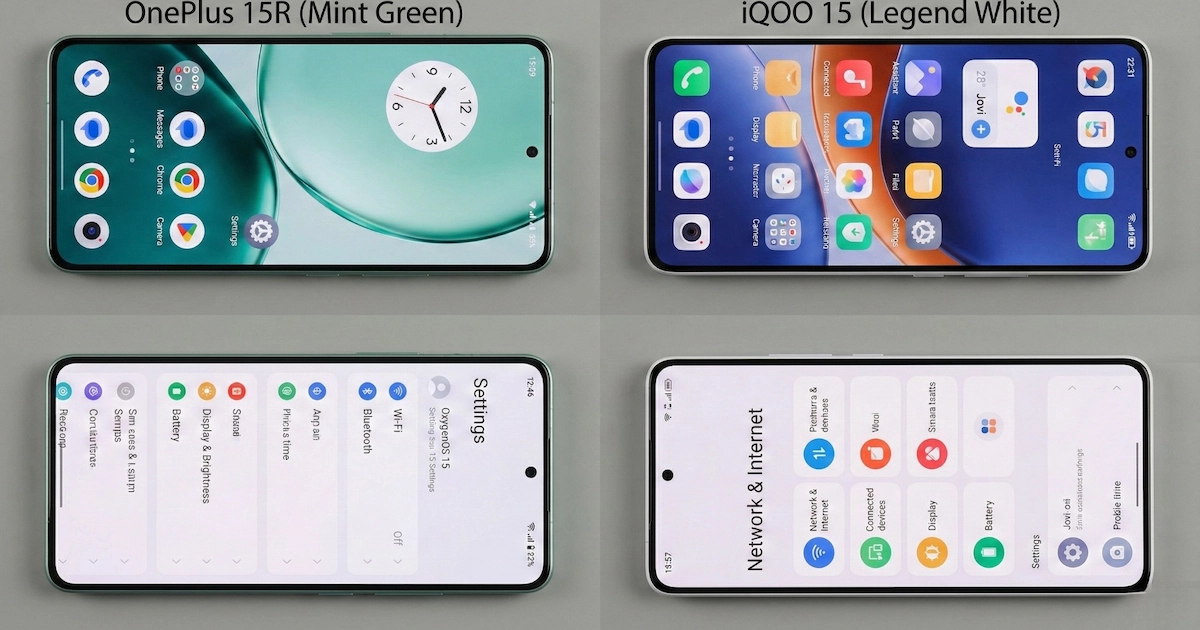
OxygenOS remains closer to stock Android with thoughtful customization. OriginOS is more heavily skinned but has matured significantly—it's no longer the bloatware-laden experience it once was.
Software verdict: Slight edge to OnePlus for cleaner software, but iQOO's update commitment and gaming features balance the scales.
What Experts Disagree On
The chipset debate: Some argue the Snapdragon 8 Gen 5's newer 3nm process node (N3P vs N3E) makes it more efficient despite lower clocks. Early thermal testing is inconclusive—the OnePlus 15R hasn't been stressed tested in real-world conditions as of December 17.
Gaming relevance: The iQOO 15's Q3 chip enables ray tracing in Genshin Impact, but this remains a niche feature. Most mobile gamers prioritize frame rates over graphical fidelity, and the OnePlus 15R's 165 Hz display and gaming chip optimizations might deliver a smoother experience in competitive titles.
Camera processing: OnePlus claims the DetailMax Engine can produce flagship-quality images from the IMX906. Initial samples from the Ace 6T (the Chinese variant) show good results, but they haven't been tested against the iQOO 15's dedicated telephoto.
The Price Reality
Variant | OnePlus 15R | iQOO 15 |
Base (12GB + 256GB) | ₹45,999 - ₹46,999* | ₹72,999 (₹64,999 after offers) |
Higher Storage (12/16GB + 512GB) | ₹51,999* | ₹79,999 (₹71,999 after offers) |
*OnePlus 15R prices are leaked/expected; official pricing announced at 3:00 PM IST on December 17, 2025.
Effective price difference: ₹18,000 to ₹20,000 after bank offers on the iQOO 15.
That gap buys you: a better processor, sharper display, telephoto camera, wireless charging, and faster wired charging. Whether those upgrades justify a 40% price increase depends entirely on your use case.
Who Should Buy What
Choose the OnePlus 15R if:
- Your budget ceiling is ₹50,000
- Two-day battery life matters more than peak performance
- You primarily shoot with the main camera
- You value clean software over gaming bells and whistles
- You want the first Snapdragon 8 Gen 5 phone globally
Choose the iQOO 15 if:
- You're a serious mobile gamer who wants ray tracing
- Telephoto photography is non-negotiable
- You need wireless charging
- 2K display sharpness matters for media consumption
- You can stretch to ₹65,000 after offers
The Verdict Nobody Wants to Hear
The OnePlus 15R isn't trying to beat the iQOO 15. It's targeting the buyer who would otherwise consider the Realme GT Neo series or last year's flagships—people for whom ₹70,000 was never on the table.
iQOO 15 is the superior phone by every objective measure except battery capacity and price. But "superior" means nothing if it's 40% outside your budget.
For the money, the OnePlus 15R delivers approximately 80% of the iQOO 15's experience at 63% of the price. That math works for most buyers—the missing 20% (telephoto camera, 2K display, ray tracing) won't affect typical smartphone usage.
But if you're reading this comparison seriously, you're probably not a typical user. And for power users, gamers, and camera enthusiasts, the iQOO 15 remains the smarter long-term investment.