
The $160M 'Smuggling' Ring That Just Put Nvidia’s $5T Future on Notice
Let’s be honest: Nvidia has been having the kind of run that makes other companies look like they’re moving in slow motion. We’re talking about a valuation that cruised past $4 trillion and is currently eyeing $5 trillion like it’s a foregone conclusion. Jensen Huang is signing chests, the H100 is the new gold standard, and everyone from Bangalore to the Bay Area is trying to buy a shovel in this AI gold rush.
But there’s a problem. A very expensive, very illegal problem.
While Nvidia has been printing money, a shadow economy has been printing shipping labels. Last week, the US Department of Justice (DOJ) blew the lid off a massive smuggling ring that was funneling hundreds of millions of dollars worth of restricted AI chips into China.
If you think this is just some "compliance issue" that lawyers will fix over a golf game, you aren’t paying attention. This is a mess of contradictions involving fake companies, warehouse raids, and a sudden, confusing policy pivot from the White House that has left everyone—including Indian investors and techies—scratching their heads.
Here is what we know as of today, December 12, 2025.
The "Sandkyan" Hustle: How to Steal $160 Million in Chips
First, let's look at the crime itself. This wasn't a couple of guys stuffing GPUs into their carry-on luggage at JFK. This was a corporate-level operation.
According to unsealed court documents from the DOJ, a network of distributors and shell companies—specifically a Houston-based outfit called Hao Global LLC—managed to move (or attempt to move) over 7,000 Nvidia H100 and H200 chips to China between October 2024 and May 2025.
The Scheme:
- The Front: They allegedly used a fake company called "Sandkyan" to buy the chips.
- The Switch: Workers in US warehouses were caught stripping the original Nvidia serial labels and slapping on generic "computer part" stickers.
- The Route: The chips weren't shipped to Beijing directly. They were routed through "intermediary" countries—specifically Malaysia and Thailand—before vanishing into the Chinese mainland.
Why does this matter?
Because the H100 and H200 are the nuclear weapons of the AI age. The US government banned their export to China to prevent them from being used for military AI. Smuggling 7,000 of them isn't a leak; it's a flood. The total value of the bust? A cool $160 million (approx. ₹1,350 Crore).
Note: For context, that’s enough compute power to train a massive LLM (Large Language Model) from scratch. This isn't about gaming; it's about geopolitical dominance.
The Double Bind: Jail for Smugglers, Taxes for Sales?
Here is where the story gets weird. And by weird, I mean "regulatory whiplash" weird.
At the exact same time the DOJ is threatening people with 20 years in prison for shipping chips to China, the political winds in Washington just shifted 180 degrees.
Earlier this week (December 8-9), President Trump announced a new policy that effectively says: "Actually, go ahead and sell the chips."
The Trump Pivot:
- The Rule: Nvidia can now sell the powerful H200 chips to "approved" customers in China.
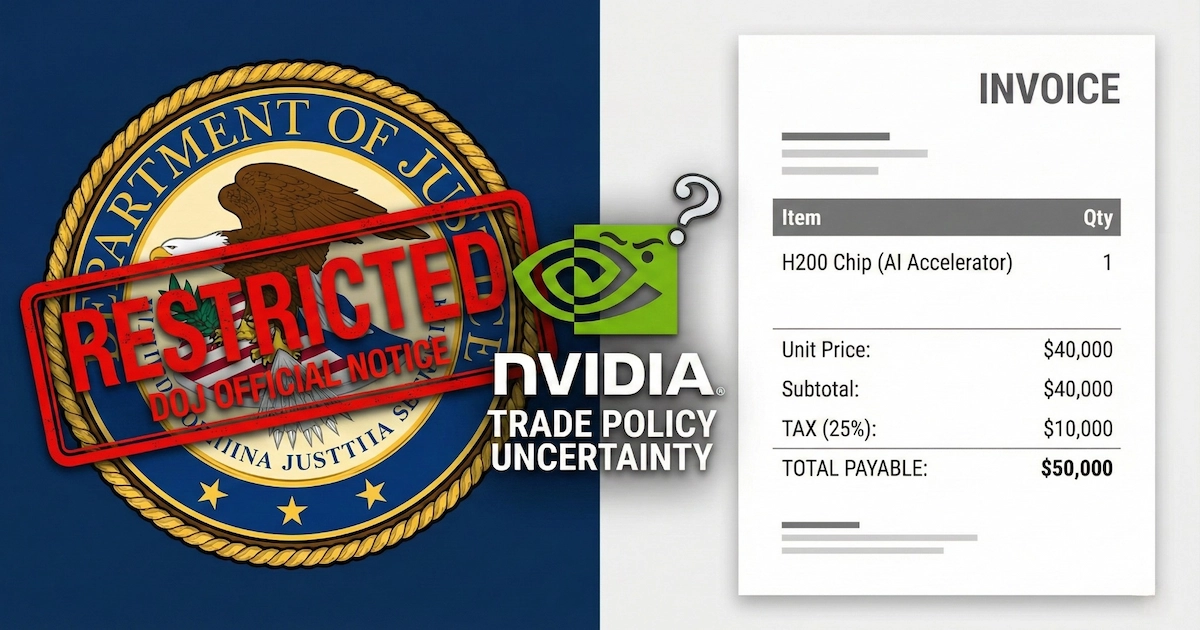
- The Catch: There is a 25% tariff/revenue share payable to the US government.
- The Reaction: Nvidia shares jumped about 2% initially, but the confusion is palpable.
The Contradiction:
Imagine being a compliance officer at Nvidia right now. On one hand, the DOJ is arresting people for shipping chips to China because it's a "national security threat." On the other hand, the White House is saying, "It's fine, as long as we get a 25% cut."
This creates a chaotic environment. If the "legal" channel is open but taxed heavily (25%), the black market doesn't disappear—it just adjusts its prices. If the black market price is cheaper than Official Price + 25% Tariff, smuggling continues.
The "So What" for You (and India)
"Okay," you say. "I don't live in Beijing and I don't run a shipping container business in Houston. Why do I care?"
1. The Supply Chain Shock
Every chip that gets smuggled or seized is a chip that didn't go to a legitimate buyer. India’s AI startups and data centers (like Yotta or Reliance Jio’s upcoming facilities) are in a desperate queue for these H100s.
- The Reality: If 7,000 chips were sitting in a smuggler's warehouse, that’s 7,000 chips that weren't powering legitimate innovation in Bangalore or Hyderabad.
- The Risk: Enhanced scrutiny means every shipment leaving the US is now going to be double-checked. Expect delays. If you're ordering enterprise-grade hardware, "customs clearance" just became a dirty word.
2. The Verification Nightmare
To stop the smuggling, Nvidia is reportedly rolling out "Location Verification" tech. Think of it like "Find My iPhone" but for $30,000 server chips.
- The chips might eventually "brick" themselves if they detect they are in a prohibited location (like a restricted Chinese server farm).
- The Downside: This adds a layer of software complexity (and potential failure points) to hardware that is already incredibly complex.
3. The Stock Volatility
Nvidia is priced for perfection. It is priced for $5 Trillion. It is not priced for a messy geopolitical trade war where the rules change every Tuesday.
- The Bull Case: The new Trump rule opens up the Chinese market again (legally), adding billions in revenue.
- The Bear Case: The 25% tax makes Nvidia chips too expensive, Chinese tech giants switch to Huawei's Ascend chips permanently, and Nvidia loses its second-biggest market forever.
What Experts Disagree On
The tech world is split on how this plays out.
The Optimists | The Pessimists |
"The Floodgates Open" The 25% tariff is just a cost of doing business. Chinese firms are desperate for CUDA ecosystem chips and will pay anything. Revenue will soar. | "The Huawei Effect" The uncertainty and high costs will force China to perfect their own chips (like Huawei's Ascend 910C). Nvidia loses the market for good. |
"Smuggling Dies" Legal channels kill the black market. Why risk jail when you can just pay a tax? | "Grey Market Thrives" A 25% tax is huge. Smugglers will just undercut the tax. The cat-and-mouse game continues. |
Conclusion: The Party Isn't Over, But The Bouncers Are Here
Nvidia isn't going to crash tomorrow. The demand for Blackwell and H200 chips is still insane. But the days of "sell to anyone, ask questions later" are dead.
For the last two years, Nvidia has been operating in a "Wild West" where demand was the only metric that mattered. Now, they are operating in a geopolitical minefield. The $160 million smuggling bust is a warning shot: The US government is watching the hardware flow, and they aren't afraid to kick down doors.
The next few months will decide two things:
- Can Nvidia implement this "Location Verification" without annoying legitimate customers?
- Will the Chinese market pay the "Trump Tax," or will they finally divorce Nvidia for domestic alternatives?
Keep an eye on the January 2026 earnings guidance. That’s when the real bill for this confusion will come due.
What We’ll Do Next: We are tracking the pricing of H100s in the Indian grey market (yes, it exists) to see if these global busts are spiking local prices. We’ll update this piece if we see a surge.