Quick Answer: DLSS 4.5 brings a free image quality upgrade to all RTX GPUs in India, including the popular RTX 4060 (₹27,000-₹36,000) and RTX 4070 (₹55,000-₹62,000). The catch? The headline 4K 240Hz feature is RTX 50 series exclusive.
NVIDIA just made your mid-range GPU obsolete — by making it ridiculously powerful.
That's the marketing pitch, anyway. CES 2026 came with NVIDIA's announcement of DLSS 4.5, promising 4K 240Hz path-traced gaming through something called "Dynamic Multi Frame Generation." According to NVIDIA's official announcement, this tech can generate up to five additional frames for every single frame your GPU actually renders.
Sounds incredible. There's just one problem: if you own an RTX 4060 or RTX 4070 — the GPUs that actually make sense for most Indian gamers — you're not getting that feature.
Let's cut through the hype and figure out what you're actually getting.
What DLSS 4.5 Actually Is (And Isn't)
NVIDIA announced DLSS 4.5 at CES 2026 on January 5th, and it comes with two major components. Understanding the difference is crucial if you're trying to figure out whether this matters to you.
The first component is the 2nd Generation Transformer Super Resolution model. According to NVIDIA, this new AI model uses five times more compute power than the original and has been trained on a significantly larger dataset. The result? Better temporal stability (less flickering on static surfaces), reduced ghosting (no more weird trails when things move fast), and sharper anti-aliasing.
This feature is available now for all RTX GPUs — yes, even the RTX 20 series. NVIDIA has already released it through their app beta, with a full rollout on January 13th.
The second component is Dynamic 6X Multi Frame Generation. This is the headline feature that enables 4K 240Hz path-traced gaming. It dynamically adjusts frame generation between 1X and 6X to match your monitor's refresh rate.
Here's the catch that many headlines are glossing over: according to NVIDIA's official documentation, Dynamic 6X Multi Frame Generation is launching in Spring 2026 exclusively for GeForce RTX 50 Series GPUs. Not RTX 40. Not RTX 30. Only RTX 50.
What RTX 4060/4070 Owners in India Actually Get
If you bought an RTX 4060 somewhere between ₹27,000 and ₹36,000 on Amazon.in or Flipkart, or an RTX 4070 in the ₹55,000 to ₹62,000 range, here's your actual upgrade path.
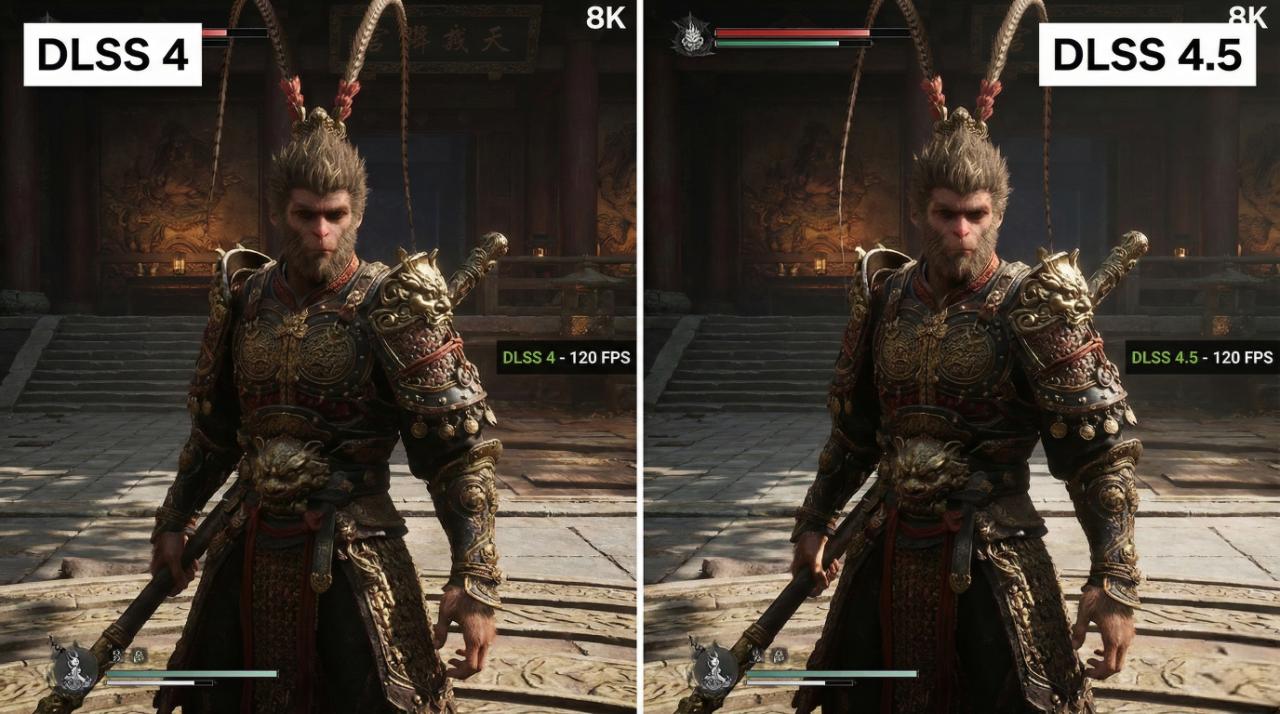
You get the 2nd Generation Transformer Super Resolution model. According to NVIDIA, this delivers noticeably better image quality — particularly in DLSS Performance and Ultra Performance modes, where fewer pixels are being rendered natively. The company claims that Performance Mode is now comparable to, and can even beat, native image quality.
You also get better support for this new model. RTX 40 series GPUs support FP8 precision acceleration in their Tensor Cores, which according to NVIDIA helps offset the increased computational demands of the heavier model. Tom's Hardware reports that this means RTX 40 series cards see a relatively minor performance impact compared to older generations.
But there's a trade-off. Early benchmarks from HotHardware show that the RTX 4060 Ti sees around 15% performance reduction when switching from DLSS 4.0's Model K to DLSS 4.5's Model L preset. According to Wccftech's testing, RTX 40 series cards need 40-53% more VRAM for the new transformer model compared to the previous version.
You can still use the existing DLSS Frame Generation if your games support it — that's the 2X multiplier that's been available since DLSS 3. But you're not getting the new Dynamic mode or the 6X multiplier.
The Performance vs. Quality Trade-Off
NVIDIA's own documentation recommends that RTX 40 series owners might want to pick their DLSS model preset carefully. According to VideoCardz, the company suggests that users who prioritise frame rates might prefer staying on the older Model K preset, while those who want maximum image quality can opt for the new Model M or L presets.
This is actually refreshingly honest from NVIDIA. The new Super Resolution model isn't about making your games run faster — it's about making them look better at the performance levels you're already achieving.
For practical terms: if you're playing Cyberpunk 2077 or Black Myth: Wukong with DLSS Performance mode enabled, the new 4.5 model should deliver noticeably sharper images with less visual artifacts. According to NVIDIA, areas like lighting accuracy, edge definition, and motion clarity all see improvements.
Should You Care? (The India Angle)
Let's talk real numbers for Indian gamers.
An RTX 4060 currently costs between ₹27,000 and ₹36,000 on Amazon.in depending on the brand. According to price tracking data, models like the MSI Ventus and ZOTAC Twin Edge hover around the ₹27,000-₹30,000 mark, while premium variants from ASUS and Gigabyte push higher.
The RTX 4070 sits in the ₹55,000 to ₹62,000 range according to multiple Indian retailers. That's a significant investment for most gamers.
The RTX 5060 and 5070? We don't have India pricing yet, but based on historical patterns, expect a 20-30% premium over current-gen cards at launch — assuming you can even find them in stock.
So here's the value proposition: if you already own an RTX 40 series card, DLSS 4.5 Super Resolution is a genuinely useful free upgrade. You're getting better-looking games without spending a rupee.
But if you're holding off on buying a GPU because you heard "DLSS 4.5 enables 4K 240Hz gaming on mid-range cards" — pump the brakes. That specific feature is RTX 50 exclusive. Your RTX 4060 isn't suddenly becoming an RTX 4090 through software magic.
How to Enable DLSS 4.5
According to NVIDIA, enabling DLSS 4.5 is straightforward. Download the NVIDIA App beta update (full release January 13th), then navigate to Settings and select the "DLSS Override feature - Model Presets" option. Choose "Latest" either globally or for specific games.
The supported game list is extensive — NVIDIA claims over 400 games and apps work with DLSS 4.5 Super Resolution. Major 2025 releases like Battlefield 6, ARC Raiders, and Clair Obscur: Expedition 33 are already supported, and upcoming 2026 titles like 007 First Light, Phantom Blade Zero, and Resident Evil Requiem will launch with full DLSS 4 support.
The Honest Take
NVIDIA's DLSS 4.5 is a genuine improvement — just not the revolution the headlines suggest for most Indian gamers.
If you own an RTX 4060 or 4070, you're getting noticeably better image quality for free. According to multiple hands-on reports, the reduced ghosting and improved temporal stability are visible in demanding games. That's worth the driver update.
But the "4K 240Hz path-traced gaming" dream? That's marketing speak for the RTX 50 series. Your ₹30,000 RTX 4060 isn't suddenly competing with a ₹1.5 lakh RTX 4090. It's just looking a bit better while doing what it already does.
And honestly? That's fine. Not every update needs to be revolutionary. Sometimes "your games look better now" is enough.
We'll update this article when Dynamic Multi Frame Generation launches for RTX 50 series in Spring 2026, and when we have confirmed India pricing for the new generation.