
How Microsoft’s $17.5B Investment Will Drop Cloud Costs for Indian Startups in 2026.
If you’re a startup founder in Bengaluru or a CTO in Gurugram, you probably have a love-hate relationship with your cloud dashboard. You love the scale; you hate that 12% "South Asia Surcharge" and the terrifying realization that your data egress fees cost more than your office rent.
Well, Satya Nadella just walked into the room and dropped a briefcase worth $17.5 billion (approx. ₹1.47 Lakh Crore) on the table.
In what is officially Microsoft’s largest-ever investment in Asia, announced yesterday (December 9, 2025), the Redmond giant has committed to reshaping India’s AI and cloud landscape between 2026 and 2029.
But let’s cut through the "synergy" and "empowerment" PR fluff. What does this massive pile of cash actually mean for your burn rate?
Here is the breakdown of how this investment is set to drop cloud costs for Indian startups by mid-2026.
The News: What Did Satya Actually Buy?
Before we talk money, let's talk metal. Microsoft isn't just "investing"; they are pouring concrete.
- The Headline Figure: $17.5 Billion (₹1.47 Lakh Crore) committed over 4 years (2026–2029).
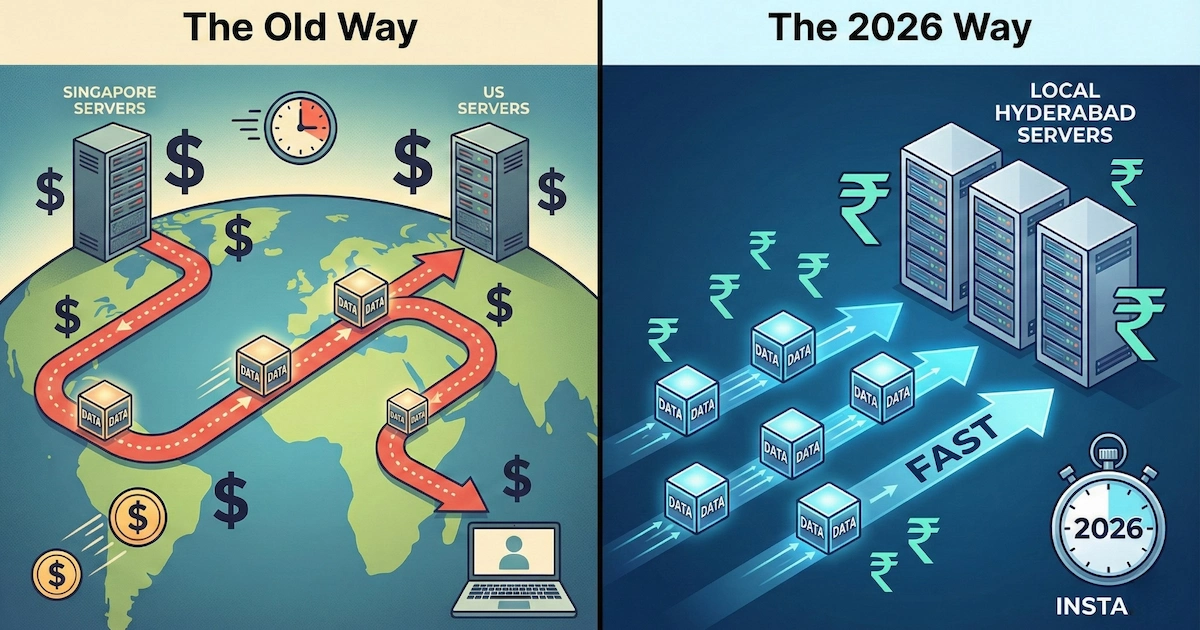
- The Big Hardware: A massive new "India South Central" cloud region in Hyderabad, set to go live in mid-2026.
- The Scale: Microsoft claims this single region will have three availability zones and be roughly the size of two Eden Gardens stadiums combined.
- The Context: This comes on top of the $3 billion investment announced back in January 2025.
1. The "Supply Shock" Will Crush Spot Prices
Economics 101: When supply floods the market, prices drop.
For the last three years, Indian startups have been fighting for GPU scraps. Getting an H100 cluster in the Mumbai region was like trying to get Tatkal tickets on Diwali—impossible or overpriced.
With this investment, Microsoft is creating a massive supply shock.
- The Logic: By dumping massive compute capacity (the "2 Eden Gardens" worth of servers) into Hyderabad, Microsoft creates a surplus of compute power.
- The Outcome: Expect Spot Instance pricing for Azure in India to stabilize and potentially drop by 15-20% compared to 2024 rates.
- The Competitor Effect: AWS and Google Cloud Platform (GCP) cannot ignore this. When the Hyderabad region goes live in mid-2026, expect a price war. AWS will likely discount their Mumbai/Hyderabad zones to stop you from migrating.
Pro Tip: If you are renewing a 3-year Reserved Instance (RI) contract in Q1 2026, wait. You will have significant leverage to negotiate better terms once this hardware starts coming online.
2. The "Sovereignty" Discount (No More Egress Tax)
This is the boring regulatory part that saves you the most money.
The Digital Personal Data Protection (DPDP) Act has made cross-border data transfer a legal nightmare (and a financial one) for fintech and healthtech startups. Until now, many "sovereign" requirements meant you had to buy expensive dedicated hardware or deal with subpar local data centers.
Microsoft’s new "Sovereign Public Cloud" offering changes the math:
- What it is: A public cloud architecture that guarantees data never leaves Indian borders, fully compliant with government regulations.
- The Cost Saver: You stop paying Data Egress Fees (bandwidth costs for moving data out of the region). For a video streaming or heavy-data AI startup, egress fees can be 10-15% of the total bill. Keeping it all in Hyderabad/Pune eliminates the "International Transfer" line item.
3. Latency is the New Currency
Latency isn't just about speed; it's about compute efficiency.
If your user base is in India, but your heavy AI inference happens in us-east-1 (Virginia) because it was cheaper, you are paying a "latency tax"—longer processing times mean your instances run longer, which means you pay more.
- The Shift: With "India South Central" (Hyderabad) going live in mid-2026, you can run high-end AI workloads (like training heavy LLMs) locally.
- The Math: Reducing round-trip time (RTT) from ~250ms (US) to ~20ms (Hyderabad) means your APIs respond faster. Faster response = shorter compute time = lower bills.
What Experts Disagree On
Not everyone is popping champagne. I scoured the analyst reports so you don't have to, and here is the skepticism:
The Bull Case (Optimist) | The Bear Case (Skeptic) |
Price War: AWS and Google will slash prices to compete with Microsoft's new capacity. | Price Fixing: The "Big 3" might just absorb the capacity and keep prices high, treating the investment as margin improvement. |
Talent Surplus: Microsoft skilling 20M Indians means hiring cloud engineers gets cheaper. | Talent War: Building these data centers will suck up all the top senior engineering talent, driving salaries (and your burn rate) up. |
Green Cloud: New regions are more energy-efficient, lowering the carbon tax on compute. | Grid Stress: Can Hyderabad's power grid actually handle "Two Eden Gardens" of GPUs without hiking industrial electricity rates? |
The "Lock-In" Trap: A Warning
Before you migrate your entire stack to Azure to chase these 2026 savings, remember the Hotel California Principle: You can check out any time you like, but you can never leave.
Microsoft is heavily pushing Azure OpenAI Service with this investment. They want you to build your product on their proprietary models (GPT-4o, etc.) running on their local hardware.
The Risk: If you build deep dependencies on Azure-specific tools (like Azure AI Studio or proprietary databases), that cheap pricing in 2026 might become expensive pricing in 2028 when you're too stuck to move.
The Fix: Build cloud-agnostic. Use containers (Kubernetes), open-source models (Llama 3, Mistral) where possible, and treat Azure as a utility provider, not a partner.
Conclusion: What Should You Do Now?
This $17.5B isn't charity; it's a war chest. Microsoft wants to own the Indian AI infrastructure layer for the next decade. For us, that means cheaper chips and faster pings—at least for a while.
Next Step for You:
If you are currently negotiating a cloud contract with AWS or Google for 2026, forward them the news link of this investment. Ask your account manager: "Microsoft is bringing a hyperscale region to Hyderabad in 6 months. What can you do to keep my business?"
You might be surprised how quickly a "fixed" price becomes negotiable.
We will update this article in mid-2026 when the India South Central region officially goes live with benchmarked latency tests.