![Micro RGB vs OLED: The ₹30 Lakh TV Tech Coming for Your Living Room [2026]](https://techdodo.in/storage/articles/micro-rgb-vs-oled-tv-india-2026-comparison_1767339707_695776bbdf6eb_medium.webp)
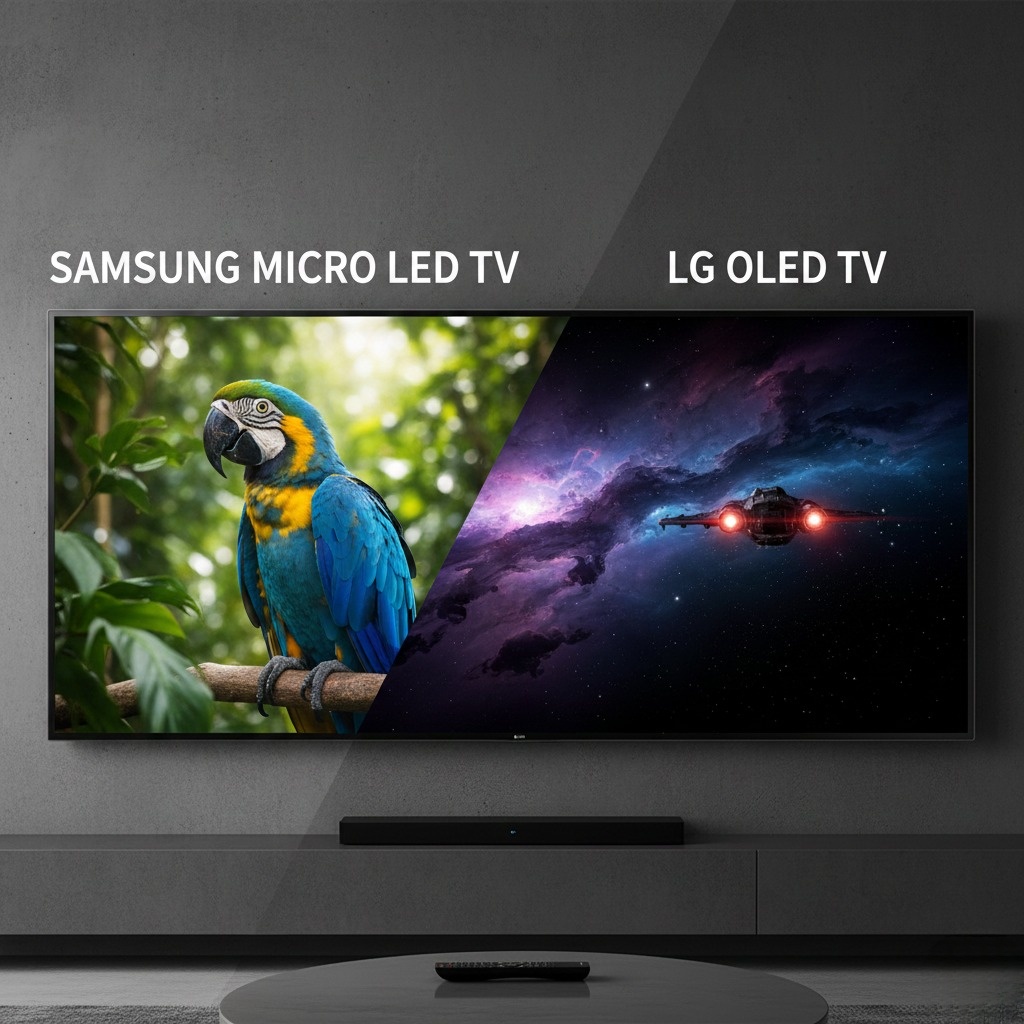
2026 is shaping up to be the year TV acronyms become even more confusing. Just when you'd finally wrapped your head around QLED, Neo QLED, and Mini-LED, Samsung and LG are flooding CES with something called Micro RGB—pitched as the technology that will finally dethrone OLED.
Here's the catch: Micro RGB isn't what you think it is.
Quick Answer: Micro RGB TVs launch globally in 2026 starting at ₹25+ lakh for large screens. For most Indian buyers, OLED remains the smarter choice—proven tech, better gaming performance, and prices from ₹96,000 to ₹3 lakh. Wait on Micro RGB unless you're an early adopter with deep pockets.
What Exactly Is Micro RGB? (Hint: It's Not Micro-LED)
Let's clear up the confusion right away. Despite the name, Micro RGB has nothing to do with Micro-LED—that mythical technology Samsung has been teasing since 2018 with self-emitting pixels and no backlight.
Micro RGB is essentially souped-up Mini-LED backlighting. Instead of white or blue LEDs behind an LCD panel, Micro RGB uses microscopic red, green, and blue LEDs—each under 100 micrometers—that can emit light independently. Think of it as Mini-LED's smarter, more colorful cousin.
Samsung's been calling it a "new premium category" since launching a 115-inch model for $30,000 (roughly ₹25 lakh) in August 2025. Now they're expanding the lineup for 2026 with 55, 65, 75, 85, and 100-inch models—though don't expect the smaller sizes to be cheap.
The Real Differences That Actually Matter
Here's where things get interesting for Indian buyers weighing their options.
Brightness: Micro RGB Takes the Crown
OLED has always struggled in bright rooms. Even the best 2025 OLEDs—like the LG G5 with its four-stack panel—max out around 2,268 nits in peak brightness. Full-screen brightness? Still under 400 nits.
Micro RGB promises significantly higher sustained brightness, making it ideal for sun-drenched Indian living rooms. Samsung claims 100% coverage of the BT.2020 color gamut, which theoretically means more vivid HDR performance. The Samsung S95F OLED, for comparison, achieves about 90% of that gamut—still excellent, but not quite there.
But wait. Here's what nobody's talking about.
Black Levels: OLED Still Wins (And It's Not Close)
Micro RGB, despite all the hype, still uses a backlight. It cannot turn off individual pixels. This means in dark scenes—the moody sequences in your favorite thriller, the inky blacks of space in sci-fi films—Micro RGB will show some blooming and halo effects around bright objects.
OLED turns off each pixel completely. Infinite contrast ratio. True blacks. Nothing else comes close for cinematic viewing, and no amount of RGB dimming zones can replicate that.
Is the Camera Worth ₹25 Lakh? Wait, Wrong Heading—Is Micro RGB Worth the Premium?
Feature | Micro RGB | OLED |
Brightness | ✅ Superior (ideal for bright rooms) | Good (improving yearly) |
Black Levels | Good (backlight dependent) | ✅ Perfect (pixel-level control) |
Burn-in Risk | ✅ None | Low (with mitigations) |
Color Gamut | 100% BT.2020 claimed | ~90% BT.2020 |
Response Time | Slower (LCD-based) | ✅ 0.1ms (ideal for gaming) |
Lifespan | ✅ Longer (inorganic materials) | 50,000-100,000 hours |
India Availability 2026 | ❌ Unlikely | ✅ Wide range |
Price (55-65") | ₹2-5 lakh expected | ✅ ₹96,000 - ₹1.6 lakh |
The numbers tell a clear story. Unless you're specifically dealing with a sun-facing living room or plan to display static content like news tickers for hours, the Micro RGB premium is hard to justify.
Gaming: OLED Isn't Giving Up Its Throne
Here's where OLED buyers can relax. Micro RGB, for all its color accuracy claims, is still fundamentally LCD technology. Response times are measured in milliseconds, not the near-instantaneous 0.1ms that OLED delivers.
For competitive gaming—where every millisecond matters in Valorant or FC 25—OLED remains the only serious option. Features like VRR up to 144Hz, G-Sync, and FreeSync are standard on premium OLEDs from LG and Samsung. The LG C5, starting around ₹1.4 lakh for the 55-inch model, remains the benchmark for gaming TVs in India.
Samsung's QD-OLED panels, used in the S95F (around ₹1.45 lakh for 55-inch in India), combine OLED's instant response with quantum dot brightness enhancement—giving you the best of both worlds without waiting for Micro RGB to mature.
India Pricing Reality Check: What You'll Actually Pay
Let's talk rupees. Samsung hasn't announced Indian pricing for Micro RGB, and frankly, don't hold your breath for 2026 availability.
Current OLED prices in India (December 2025):
- LG OLED C4/C5 48-inch: ₹96,760
- LG OLED B4 55-inch: ₹1,24,990
- Samsung S90D 55-inch: ₹1,20,475
- Samsung S95F 55-inch: ₹1,45,490
- LG OLED G5 55-inch: ₹1,55,300
- Sony Bravia 8 65-inch: ₹2,97,340
LG Display panels are expected to drop below $500 per 65-inch unit by late 2026, which means OLED prices will continue falling. The 55-inch sweet spot could hit ₹80,000-90,000 by Diwali 2026.
Micro RGB? Samsung's "affordable" 55-inch model will likely launch at premium Mini-LED pricing—think ₹2-3 lakh at minimum. For reference, the current 115-inch Micro RGB costs ₹25 lakh.
People Also Ask
Will Micro RGB replace OLED?
Not anytime soon. Micro RGB and OLED serve different use cases. Micro RGB excels in brightness and longevity, making it ideal for bright commercial spaces or well-lit living rooms. OLED dominates in contrast, black levels, and gaming performance. Both technologies will coexist, much like how QLED and OLED have competed for years.
Which TV brand is best for Micro RGB in India?
Samsung is currently leading Micro RGB development with the widest lineup (55-115 inches for 2026). LG is launching Micro RGB evo models in 75, 86, and 100-inch sizes. However, India availability for either brand's Micro RGB TVs is unconfirmed for 2026.
Is OLED burn-in still a problem in 2025?
Modern OLEDs have largely mitigated burn-in through pixel-shifting, logo dimming, and panel refreshing technologies. In RTINGS' accelerated 3-year longevity test, Samsung's OLED panel showed the least burn-in damage. For typical home viewing (varied content, reasonable brightness), burn-in is no longer a major concern.
Should I wait for Micro RGB or buy OLED now?
Buy OLED now if you want a premium TV in 2026. Micro RGB is 2-3 years away from mainstream pricing and Indian availability. OLED technology is mature, prices are falling, and you'll enjoy superior gaming and movie-watching experiences today rather than waiting for unproven technology at inflated prices.
The Verdict: Don't Believe the Hype (Yet)
Micro RGB is genuinely impressive technology. Samsung's claims of 100% BT.2020 color gamut and zero burn-in aren't marketing fluff—they're real advantages that matter for specific use cases.
But for Indian buyers shopping in 2026? OLED is still the answer.
The technology is proven. The prices are dropping. The gaming performance is unmatched. And you can actually walk into a Croma or order from Amazon.in and have one in your living room next week.
Micro RGB will have its day—probably around 2028 when production scales up and a 55-inch model doesn't cost as much as a Maruti Baleno. Until then, let the early adopters with ₹25 lakh to spare do the beta testing.
Best OLED Picks for Indian Buyers in 2026:
- Budget: LG OLED B4/B5 55-inch (₹1-1.2 lakh)
- Sweet Spot: Samsung S90D/S90F 55-inch (₹1.2-1.45 lakh)
- Premium Gaming: LG OLED C5 65-inch (₹1.8-2 lakh)
- No-Compromise: LG OLED G5 or Sony Bravia 8 65-inch (₹2.5-3 lakh)
We'll update this guide once Samsung and LG reveal Micro RGB pricing and India launch plans at CES 2026 (January 6-9). For now, your OLED upgrade doesn't need to wait.