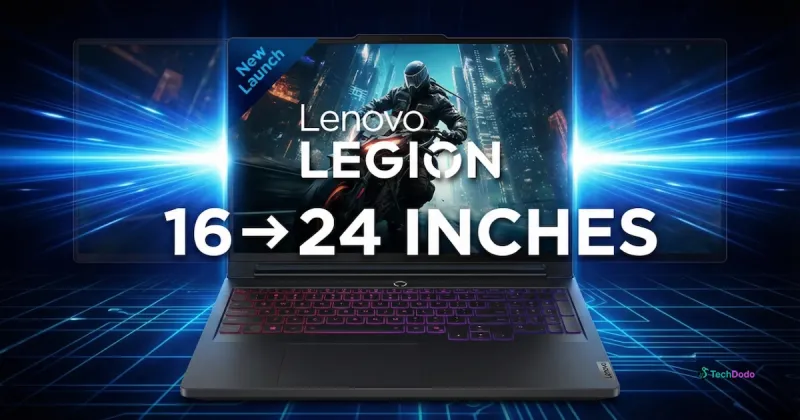
Quick Answer: The Lenovo Legion Pro Rollable is a concept gaming laptop with a 16-inch OLED screen that physically expands to 24 inches. Best for esports professionals and enthusiasts watching future laptop tech. The catch: it's a proof-of-concept with no confirmed price or launch date.
Your gaming laptop just got a growth spurt — from 16 to 24 inches at the press of a button.
At CES 2026, Lenovo did something nobody expected. They took the rollable display technology from their ThinkBook line and asked a simple question: what if we made it horizontal instead of vertical? And what if we made it for gamers?
The result is the Legion Pro Rollable — a concept that starts as a standard 16-inch gaming laptop and physically expands to 23.8 inches (Lenovo rounds up to 24) when you need the extra screen real estate. According to Lenovo's official press release, this is aimed squarely at "esports athletes who need to train for high-level competitions around the world."
Sounds wild. But here's the thing: Lenovo has pulled off rollable displays before. The ThinkBook Plus Gen 6 Rollable launched in mid-2025 at around ₹2.73 lakh in India and $3,499 in the US. It works. People bought it. So this isn't just a flashy concept that'll disappear — there's a decent chance you'll actually be able to buy something like this within the next couple of years.
How Does the Screen Actually Expand?
The Legion Pro Rollable uses what Lenovo calls a "dual-motor, tension-based design." According to hands-on reports from Engadget and Tom's Hardware, the Lenovo PureSight OLED panel unrolls from both ends simultaneously — left and right — keeping the display taut and preventing the dreaded wrinkles that plague flexible screens.
Lenovo has identified three distinct modes:
Focus Mode (16 inches): Your standard laptop setup. Portable, familiar, nothing fancy. Lenovo positions this for "refining precision mechanics and improving reflexes."
Tactical Mode (21.5 inches): Partially expanded. The company suggests this is ideal for "peripheral awareness, rotation drills, and team coordination." Basically, you get more screen without going full ultrawide.
Arena Mode (24 inches): The full expansion. Lenovo's pitch is that esports athletes typically compete on 24-inch monitors at tournaments, so this lets them train on the same setup while travelling. According to Yanko Design, this mode offers a 24:9 aspect ratio, replicating an ultrawide experience.
The mechanism itself appears smooth based on CES floor demonstrations. Windows Central reported the expansion happens with "a quiet hum that sounds more refined than experimental." Engadget noted that despite being a prototype, Lenovo "did a halfway decent job of eliminating any huge panel gaps or empty spaces."
That said, multiple hands-on reports mention minor cosmetic issues — light wrinkles at the roll-out edge, some superficial marks. Lenovo has acknowledged these and says they'll be addressed before any commercial release.
What's Under the Hood?
This is where Lenovo didn't cut corners. The Legion Pro Rollable concept is built on the Legion Pro 7i platform — already one of the best gaming laptops you can buy.
According to Lenovo's official specifications, the concept features:
- GPU: NVIDIA GeForce RTX 5090 Laptop GPU (the most powerful mobile gaming graphics available)
- CPU: Intel Core Ultra processors (likely the Core Ultra 9 275HX, according to NotebookCheck speculation)
- Display: Lenovo PureSight OLED with rollable mechanism
- AI Features: Lenovo AI Engine+ with real-time Scenario Detection and Smart FPS
The hardware also includes Lenovo's AI-powered gaming features. AI Scene Detection identifies the game you're playing and zooms in on key areas — useful for FPS or MOBA titles. There's also Adaptive AI Lighting that changes the RGB based on in-game events.
What we don't know yet: RAM, storage capacity, battery size, weight, and exact thermals. These specs weren't disclosed for the concept.
The Real Question: Will This Actually Launch?
Here's where you need to temper your expectations.
Lenovo is explicitly calling this a "proof-of-concept" — not a product announcement. There's no price. There's no launch date. There's no confirmation it'll ever reach retail shelves.
But here's why I'm cautiously optimistic. Lenovo showed the ThinkBook Plus Rollable as a concept at CES 2025. By mid-2025, it was a real product you could buy. The company has a pattern of showcasing wild concepts and then actually delivering them.
VideoCardz makes a fair point: Lenovo's first rollable laptop (the ThinkBook Plus Gen 6) costs around $3,299 with just integrated graphics. A Legion version with RTX 5090, larger cooling, and a bigger rollable OLED? Expect a significantly higher price tag.
For Indian context, the ThinkBook Plus Gen 6 Rollable is expected around ₹2.73-3 lakh. A gaming version with this hardware could realistically hit ₹4-5 lakh or more — firmly in "enthusiast who doesn't care about budgets" territory.
What This Means for Indian Gamers
Let's be real: you're not buying this laptop in 2026. Probably not in 2027 either.
But that's not the point.
The Legion Pro Rollable represents where gaming laptops are heading. The eternal problem with gaming on the go has always been screen size — you sacrifice immersion for portability. This concept offers a potential solution: carry a 16-inch laptop, play on a 24-inch screen.
Lenovo has a strong presence in India's gaming laptop market. The Legion series sells well here, and the company has established service infrastructure. If the Legion Pro Rollable ever becomes a retail product, India would likely be a priority market.
For now, this is one to watch. Lenovo has rated their rollable displays for up to 25,000 cycles according to TechLusive. The technology is maturing. The question isn't whether rollable gaming laptops will happen — it's when, and at what price.
The Bottom Line
The Lenovo Legion Pro Rollable is the most interesting gaming laptop concept at CES 2026. It's not just a spec bump or a new chassis design — it fundamentally rethinks what a gaming laptop screen can be.
Is it practical? For esports professionals who travel constantly and need tournament-sized displays on the go, absolutely. For the average gamer in Bangalore or Mumbai? This is future tech worth watching, not buying.
Lenovo's track record suggests they'll turn this concept into a real product eventually. When they do, expect premium pricing that makes the ₹2.73 lakh ThinkBook rollable look like a budget option.
We'll update this article when Lenovo announces availability or pricing for India.