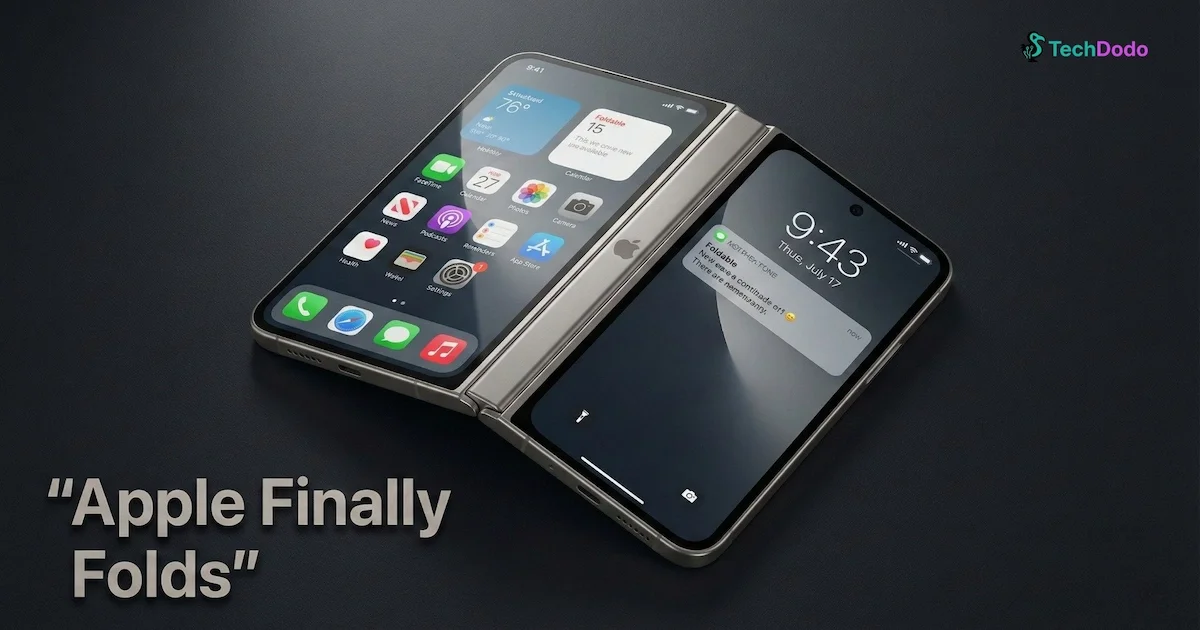
Apple's First Foldable iPhone Is Finally Coming—And It's Not What You'd Expect
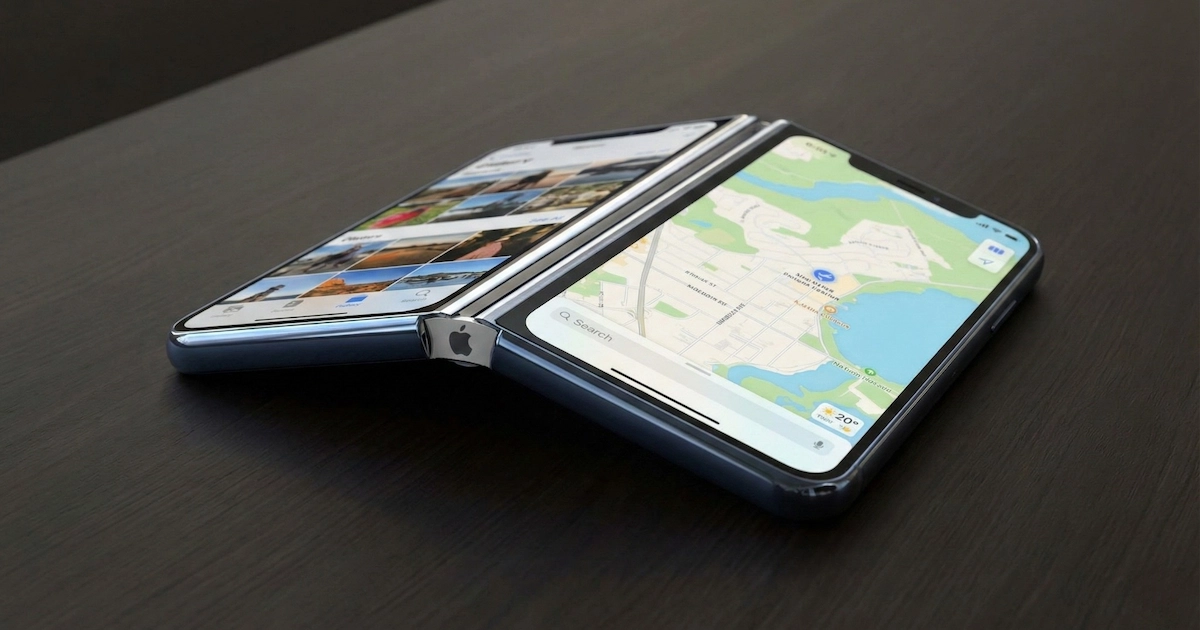
After a decade of patents, prototypes, and "any year now" predictions, Apple appears to be genuinely ready to enter the foldable smartphone arena. Multiple credible sources—including Bloomberg's Mark Gurman, supply chain analyst Ming-Chi Kuo, and JP Morgan equity research—now converge on the same timeline: Fall 2026, alongside the iPhone 18 series.
The device, reportedly codenamed "V68" internally, won't arrive quietly. Apple is betting on three breakthrough features to justify showing up seven years after Samsung's original Galaxy Fold: an industry-first high-resolution under-display camera, a virtually crease-free inner screen, and what could be the thinnest unfolded thickness of any foldable ever made.
Whether that's enough to justify an expected price tag north of ₹1.75 lakh remains the central question. Let's break down what the leaks actually tell us.
The Hidden Camera That Changes Everything
The headline feature isn't the folding mechanism—it's what Apple plans to hide behind the inner display.
According to a November 2025 JP Morgan equity research report seen by MacRumors, the iPhone Fold will feature a 24-megapixel under-display camera built into the 7.8-inch inner screen. For context, most Android foldables currently use 4MP to 8MP under-screen cameras because the technology struggles with light transmission through display layers.
Apple's jump to 24MP—with six plastic lens elements according to the same report—suggests a genuine breakthrough in optics. The outer display will use a traditional punch-hole camera, giving users the best of both worlds: an uninterrupted inner canvas for media consumption and video calls, plus a higher-quality selfie option when the device is folded.
The rear camera setup reportedly consists of dual 48MP sensors, matching the base iPhone 17's configuration. Bloomberg's Gurman corroborated this in August 2025, confirming four total cameras: one front, one inner (under-display), and two rear.
Design: Thin Enough to Make Engineers Nervous
Apple isn't just matching Samsung—it's attempting to leapfrog on thinness.
Industry analyst Ming-Chi Kuo estimates the iPhone Fold will measure 9 to 9.5mm when folded and an astonishing 4.5 to 4.8mm when unfolded. For perspective, the current 12.9-inch iPad Pro measures 5.1mm thick. If accurate, each half of the unfolded iPhone Fold would be thinner than any iPhone Apple has ever shipped.
Gurman described the design as resembling "two titanium iPhone Airs side-by-side" in his Power On newsletter, calling it "super thin and a design achievement."
The frame will reportedly combine titanium and aluminum alloys, with the hinge mechanism utilizing liquid metal—a die-casting material Apple has employed before to address durability concerns. This choice directly targets the crease problem that has plagued every Samsung foldable to date.
Chinese supply chain site UDN reported in November 2025 that Apple has "solved the crease problem" and entered engineering validation, with the inner display achieving a nearly invisible crease. Whether "nearly invisible" translates to consumer satisfaction won't be known until hands-on reviews arrive.
Touch ID Returns, Face ID Stays Home
Here's where compromises begin.
Both Kuo and Gurman confirm the iPhone Fold will skip Face ID entirely, opting instead for a Touch ID sensor embedded in the side power button—the same approach Apple uses on current iPad Air and iPad mini models.
The reason is physics, not preference. The TrueDepth camera system required for Face ID simply cannot fit within a 4.5mm-thick enclosure. Apple apparently decided that extreme thinness mattered more than facial recognition consistency.
This trade-off will frustrate users who've grown accustomed to Face ID's convenience, particularly for Apple Pay authentication. Whether Touch ID's resurgence feels like a regression or a reasonable engineering compromise likely depends on your muscle memory.
Specifications: What the Leaks Suggest
Based on consolidated reports from MacRumors, Bloomberg, JP Morgan, and analyst Jeff Pu, here's the current specification picture:
Specification | Rumored Detail | Confidence Level |
Inner Display | 7.8-inch OLED, 2713 × 1920 resolution | Confirmed by multiple sources |
Outer Display | 5.5-inch OLED, 2088 × 1422 resolution | Confirmed by multiple sources |
Thickness (Folded) | 9–9.5mm | Announced by Kuo |
Thickness (Unfolded) | 4.5–4.8mm | Announced by Kuo |
Rear Cameras | Dual 48MP (wide + ultrawide) | Rumored via Digital Chat Station |
Inner Camera | 24MP under-display | Rumored via JP Morgan |
Outer Camera | Punch-hole (resolution TBD) | Confirmed by Gurman |
Battery | 5,000–5,500 mAh | Rumored via Korean sources |
Modem | Apple C2 (in-house, 2nd gen) | Confirmed by Gurman |
Authentication | Touch ID (side button) | Confirmed by Kuo, Gurman |
SIM | eSIM only, no physical slot | Confirmed by Gurman |
RAM | 12GB | Rumored |
Storage | 256GB / 512GB / 1TB | Rumored |
Colors | Black, White | Confirmed by Gurman |
What's notably absent: LiDAR, optical image stabilization on cameras (per JP Morgan), and any telephoto lens. Apple appears to have prioritized thinness over Pro-level camera features.
The Price Problem: ₹1.75–2.15 Lakh
Let's address the elephant in the room.
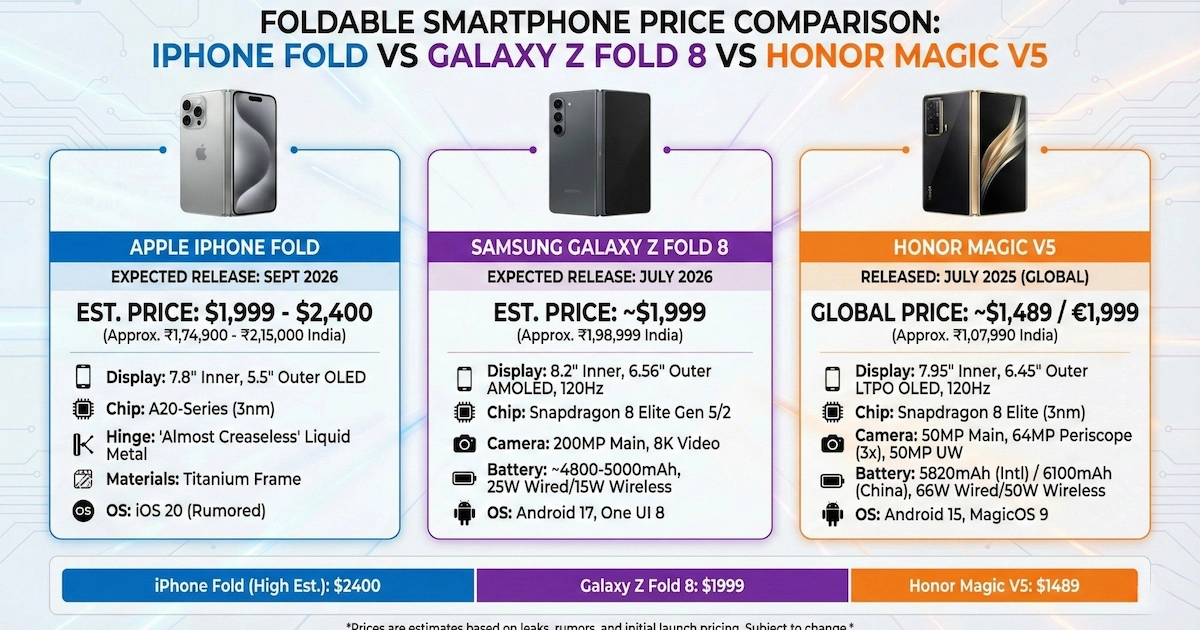
Analyst estimates place the iPhone Fold between $1,800 and $2,400 in the United States. In India, that translates to approximately ₹1,75,000 to ₹2,15,000 depending on final configuration and Apple's regional pricing strategy.
For comparison, the Samsung Galaxy Z Fold 7 launched at $1,999 (roughly ₹1,68,000 in India). Fubon Research's latest estimate suggests the iPhone Fold could land at $2,399—a 20% premium over Samsung's established alternative.
IDC projects the iPhone Fold could capture 22% of the global foldable market share and 34% of market value in 2026, largely because Apple's entry will expand consumer interest in the category. But that market capture depends heavily on whether first-generation buyers tolerate the premium for an unproven form factor from Apple.
The value proposition becomes clearer when you consider what the iPhone Fold attempts to replace: a flagship iPhone and potentially an iPad mini. Whether it succeeds at either role—or awkwardly fails at both—remains the central risk for early adopters.
Launch Timeline: Fall 2026 Is the Target
According to analyst Jeff Pu, the iPhone Fold entered New Product Introduction (NPI) phase at Foxconn in March 2025. UDN's November 2025 report confirmed the device has progressed to engineering validation, with mass production gearing up for late 2025 or early 2026.
Gurman expects a consumer launch in Fall 2026, likely during Apple's September event alongside the iPhone 18 Pro lineup. Both Kuo and Pu corroborate this timeline.
However, Mizuho Securities has cautioned that a 2027 delay remains possible if Apple struggles to finalize hinge design decisions or encounters supply chain bottlenecks. Apple's track record with ambitious new categories (see: AirPods, Apple Watch, Vision Pro) suggests delays are far from unprecedented.
What Experts Disagree On
Not all sources align on every detail:
Pricing: UBS estimates $1,800–$2,000 based on Apple's component procurement advantages. Barclays and Fubon Research lean higher at $2,299–$2,399. The gap suggests genuine uncertainty about Apple's margin strategy.
Display crease: UDN claims "crease problem solved." Kuo describes "nearly invisible" creasing. The distinction matters—Samsung's Galaxy Z Fold 7 still exhibits visible creases under certain lighting, and Apple's implementation remains untested outside laboratory conditions.
Camera capabilities: JP Morgan's 24MP under-display claim is single-sourced. Earlier leaks suggested lower resolutions. Until Apple confirms, treat the megapixel count as rumored rather than confirmed.
Launch timing: Gurman clarified in May 2025 that his newsletter discusses products "in market for 2027"—meaning a late 2026 launch with primary sales occurring in 2027. This semantic distinction suggests Apple's internal timeline may remain fluid.
India Market Implications
Apple's foldable timing aligns with the company's broader India manufacturing push. Reports indicate Apple is exploring a pilot production line in Taiwan before scaling to Indian facilities—consistent with the company's strategy to reduce China dependency.
For Indian consumers, the ₹1.75 lakh+ price point places the iPhone Fold firmly in ultra-premium territory, competing less with mainstream smartphones and more with the combined cost of an iPhone 17 Pro Max and iPad mini. The absence of a physical SIM card slot (eSIM only) should pose minimal friction given India's mature eSIM adoption among premium carriers.
The Risks Nobody's Talking About
Every first-generation Apple product carries execution risk. The iPhone Fold's specific vulnerabilities include:
Durability unknowns: Apple has never shipped a device with a folding display. Samsung refined its hinges across seven generations. First-year iPhone Fold buyers are effectively beta testers for Apple's folding mechanisms.
Software optimization: iOS has never adapted to book-style foldable multitasking. While iPad apps theoretically work on larger displays, the transition between outer and inner screens will require new interaction paradigms Apple hasn't demonstrated publicly.
Battery anxiety: Despite rumored 5,000+ mAh capacity, powering two displays and an under-display camera system may stress Apple's efficiency engineering. Gurman noted that high-density battery cells are planned, but real-world performance remains theoretical.
Repair economics: Foldable display repairs are notoriously expensive across all manufacturers. Apple's repair pricing for a folding OLED panel could approach or exceed the cost of a standard iPhone.
Should You Wait or Buy on Day One?
The cautious play is obvious: wait for second-generation refinements. Apple's track record suggests meaningful improvements arrive in Year 2—think AirPods Pro versus original AirPods, or Apple Watch Series 3 versus Series 0.
But if you've been waiting specifically for an iOS foldable, the iPhone Fold offers something no Android device can match: seamless integration with Apple's ecosystem. iMessage, AirDrop, Handoff, and Apple Intelligence features will work as expected. For users already deep in Apple's walled garden, the switch cost to Samsung's Galaxy Z Fold remains prohibitive regardless of hardware maturity.
The honest answer: the iPhone Fold is for Apple loyalists who prioritize ecosystem continuity over first-generation caution—and who can absorb ₹1.75 lakh+ without financial stress.
This article will be updated when Apple officially announces the iPhone Fold. Current information reflects rumored specifications from supply chain analysts and industry reports as of December 2025.