![iPhone 17 Air Worth Buying India? The ₹1.2L Truth [2025 Verdict]](https://techdodo.in/storage/articles/iphone_air_or_iphone_17_pro_1766920839_6951128796cb0_original.webp)
Apple's thinnest iPhone is also its biggest gamble. Three months after launch, the iPhone Air's production has been slashed by over 80%, sales reports describe "virtually no demand," and its resale value is plummeting faster than any iPhone since 2022. At ₹1,19,900 in India, is this design marvel a futuristic masterpiece or an overpriced compromise?
Quick Answer: iPhone Air scores 6.5/10. Best for design-obsessed minimalists who prioritize thinness over everything else. Skip if you travel, shoot video, or plan to resell within 2 years. Worth ₹1,19,900? For most Indian buyers, no — the ₹82,900 iPhone 17 or ₹1,34,900 iPhone 17 Pro offer significantly better value.

The ₹36,400 "India Tax" Nobody's Talking About
Here's the thing most reviews conveniently ignore. The iPhone Air costs $999 in the US — that's roughly ₹83,500 at current exchange rates. In India? You're paying ₹1,19,900. That's a ₹36,400 premium just for having an Indian billing address.
This "India tax" isn't unique to the Air, but it stings more here because you're already paying Pro-tier prices for a device with significant compromises. Factor in the 18% GST, import duties, and Apple's India pricing strategy, and suddenly that "affordable alternative to Pro" narrative falls apart.
But wait. Bank offers can soften the blow. ICICI, IDFC First, and SBI cards currently offer up to ₹4,000 instant cashback, plus exchange bonuses up to ₹6,000 on trade-ins. That brings the effective price down to around ₹1,09,900 — still steep, but more palatable.
Offer Type | Savings | Where to Avail |
ICICI/IDFC/SBI Cashback | Up to ₹4,000 | Authorized resellers, Croma |
Exchange Bonus | Up to ₹6,000 | Trade-in via Cashify/Servify |
No-Cost EMI | 6-month tenure | Select banks |
Maximum Savings | ₹10,000 | Combining all offers |
What Apple Got Spectacularly Right
The iPhone Air isn't a failure of engineering — it's a failure of market positioning. Apple's engineers pulled off something genuinely remarkable here.
The Design Is Genuinely Futuristic
Pick up an iPhone Air and you'll understand why people fall in love with it in Apple Stores. At 5.6mm thin and 165 grams, it feels like holding a piece of the future. The polished titanium frame catches light beautifully, and the Ceramic Shield 2 back glass has a premium feel that the aluminum iPhone 17 can't match.
Remember "bendgate"? The internet was ready to revive those jokes before anyone even held an iPhone Air. They were wrong. JerryRigEverything needed industrial equipment to bend this thing, and even then, the display kept working. Apple executives weren't bluffing when they tossed it around on stage.
Pro Performance in an Impossibly Thin Body
The A19 Pro chip inside the iPhone Air is identical to what powers the ₹1,34,900 iPhone 17 Pro. Gaming performance, AI tasks, video editing — it handles everything the Pro does. Apple didn't compromise on silicon.
The 6.5-inch ProMotion display is gorgeous. 120Hz refresh rate, 2000 nits peak brightness, HDR10 support. It's the sweet spot between the 6.3-inch iPhone 17 and the 6.9-inch Pro Max.
Battery Life That Defied Expectations
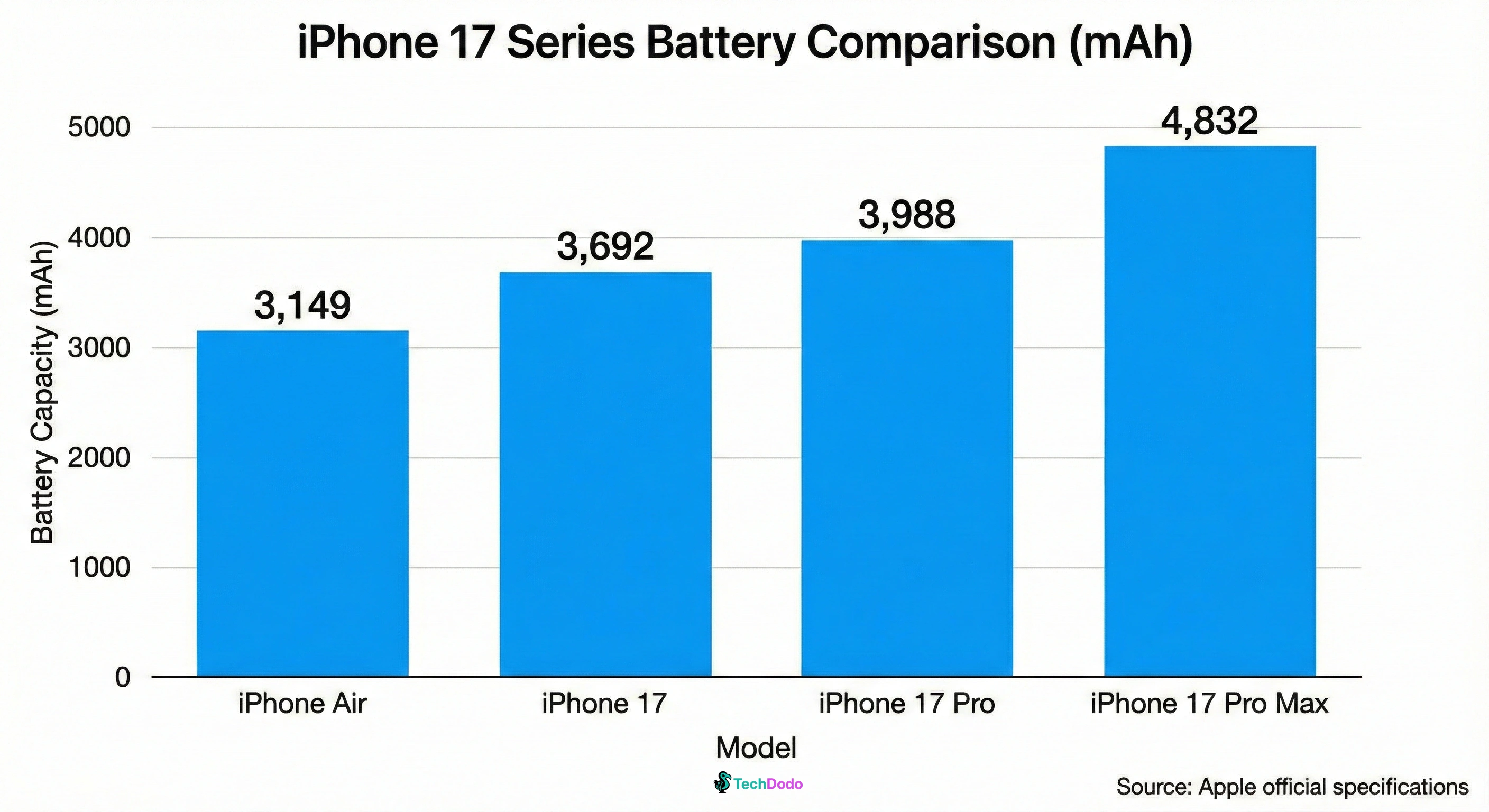
This surprised everyone, including me. Despite having the smallest battery in the lineup (3,149 mAh), the iPhone Air's battery life nearly matches the iPhone 17 Pro in real-world use. Apple's efficiency optimizations actually work.
Users consistently report getting through full days with moderate use. One reviewer took it to Disney World without needing the MagSafe battery pack he brought "just in case." That said, "full day" and "power user day" are different animals.
The Compromises That Killed Sales
Apple didn't just make a thin phone. They made trade-offs that most buyers weren't willing to accept at this price point.
The Camera System Is a Step Backward
Here's where it gets brutal. For ₹1,19,900, you get a single 48MP camera. No ultrawide. No telephoto. No macro photography. No spatial video for Vision Pro. No Cinematic Mode.
The main camera itself is good — it uses the same Sony IMX904 sensor as the iPhone 17. In daylight, you'll get excellent shots. But here's what nobody tells you: that same sensor in the iPhone 17 comes with an ultrawide camera, macro mode, and Cinematic Mode for ₹37,000 less.
Low-light performance is where the compromises really show. DXOMARK testing confirms the iPhone Air's night shots are noticeably worse than the iPhone 17 Pro's. The Pro's larger sensor and computational photography advantages become obvious after sunset.
Thermal Throttling During Extended Shooting
That impossibly thin body has consequences. Extended video recording causes the iPhone Air to heat up and throttle performance faster than the Pro models. The iPhone 17 Pro's vapor chamber cooling system handles heat dissipation far better.
The Microphone Problem Nobody Warned You About
Several reviewers have reported distorted audio in videos — caused by accidentally covering the microphone placement while recording. In a device this thin, there's less room for error in how you hold it.
Single Speaker Sounds... Single
No stereo speakers. In 2025. At ₹1.2 lakh. The audio experience is objectively worse than the iPhone 17, which costs ₹37,000 less.
eSIM-Only Reality Check
The iPhone Air has no physical SIM slot. For metro users with stable carrier relationships, this is fine. For travelers, people in areas with spotty eSIM support, or anyone who likes swapping SIMs, it's a genuine limitation.
The Resale Value Disaster
This is where the iPhone Air's problems become financially painful.
According to SellCell's analysis of 40+ US buyback companies, the iPhone Air has depreciated 44.3% on average in just 10 weeks. The 1TB model? It's lost 47.7% of its value — the worst performance of any iPhone since 2022.
Model | 10-Week Depreciation | Market Position |
iPhone 17 Pro Max 256GB | 26.1% | Best performer |
iPhone 17 Pro 256GB | 32.0% | Strong |
iPhone 17 256GB | 33.0% | Solid |
iPhone Air 256GB | 40.3% | Weak |
iPhone Air 1TB | 47.7% | Worst since 2022 |
For context, the regular iPhone 17 retains 9.7% more value than the Air after the same period. That's not a rounding error — it's a significant financial penalty for choosing the "premium" option.
More concerning: while other iPhone 17 models stabilized around week 10, the Air's depreciation continued falling. This suggests longer-term confidence issues in the secondary market.
If you're the type who upgrades every 1-2 years, this matters. A lot.
iPhone Air vs iPhone 17 Pro: The ₹15,000 Question
Let's do the math Apple hopes you won't.
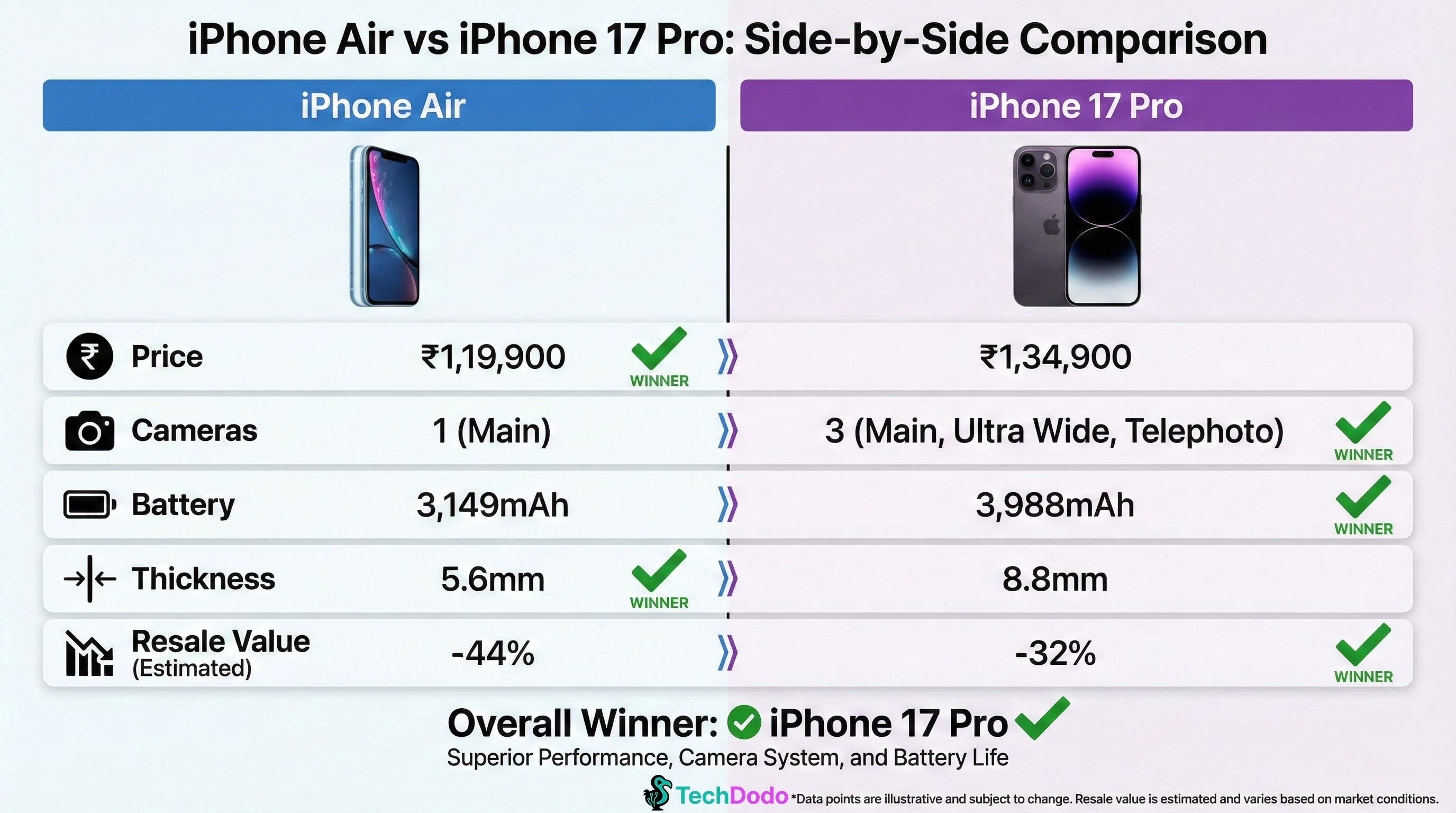
Feature | iPhone Air (₹1,19,900) | iPhone 17 Pro (₹1,34,900) | Winner |
Thickness | 5.6mm | 8.8mm | iPhone Air ✅ |
Weight | 165g | 206g | iPhone Air ✅ |
Display | 6.5" OLED, 120Hz | 6.3" OLED, 120Hz | Tie |
Processor | A19 Pro | A19 Pro | Tie |
Rear Cameras | 1 (48MP) | 3 (48MP × 3) | iPhone 17 Pro ✅ |
Battery | 3,149mAh (~22 hrs) | 3,988mAh (~31 hrs) | iPhone 17 Pro ✅ |
USB Speed | USB 2.0 | USB 3.0 (40Gbps) | iPhone 17 Pro ✅ |
Speakers | Mono | Stereo | iPhone 17 Pro ✅ |
Cooling | Passive | Vapor chamber | iPhone 17 Pro ✅ |
10-Week Resale | -44.3% | -32% | iPhone 17 Pro ✅ |
Overall | Design-first | Feature-complete | iPhone 17 Pro |
For ₹15,000 more, you get triple cameras, 9+ hours more battery life, vapor chamber cooling for sustained performance, stereo speakers, faster USB transfer speeds, and significantly better resale value.
The iPhone Air wins exactly two categories: thinness and weight. If those are your top priorities, nothing else on the market competes. But for everyone else, the Pro is the smarter buy.
What About the Regular iPhone 17?
Here's the plot twist most reviews miss.
The ₹82,900 iPhone 17 might actually be a better choice than the iPhone Air for many buyers. It has dual 48MP cameras (including ultrawide), a larger 3,692mAh battery, stereo speakers, and Cinematic Mode — all features the Air lacks.
Yes, it uses the A19 chip instead of A19 Pro, and it has an aluminum body instead of titanium. But unless you're pushing graphically intensive games or heavy video editing, you won't notice the performance difference in daily use.
The iPhone 17 costs ₹37,000 less than the Air. That's a 31% savings for a more feature-complete device.
The Verdict: Who Should Actually Buy iPhone Air?
Buy iPhone Air if:
- Portability and thinness are genuinely your top priority (not just a "nice to have")
- You're upgrading from iPhone 13 or older and don't use ultrawide/telephoto
- You have MagSafe chargers everywhere and rarely travel with just the phone
- Design and form factor matter more than camera versatility
- You understand and accept the resale value implications
Skip iPhone Air if:
- You travel frequently (the battery will stress you)
- You shoot video regularly (thermal throttling is real)
- You care about resale value (47.7% drop is painful)
- You shoot in low light often (Pro's computational photography wins)
- You want spatial video for Vision Pro
- You're price-sensitive (iPhone 17 offers better value)
Consider iPhone 17 instead (₹82,900) if:
- You want the best value in the lineup
- Dual cameras and Cinematic Mode matter
- You prefer physical SIM flexibility
- ₹37,000 savings sounds appealing
Consider iPhone 17 Pro (₹1,34,900) if:
- You're already spending ₹1.2L anyway
- Triple cameras are non-negotiable
- Battery anxiety is real for you
- Resale value matters in your upgrade cycle
Common Questions About iPhone Air
Is iPhone Air worth buying in India?
For most buyers, no. At ₹1,19,900, you're paying Pro prices for significant camera, battery, and feature compromises. The ₹82,900 iPhone 17 offers better overall value, while the ₹1,34,900 iPhone 17 Pro is only ₹15,000 more for a complete flagship experience.
iPhone Air vs iPhone 17 Pro: Which is better?
iPhone 17 Pro wins for most users. The extra ₹15,000 gets you triple cameras, 9+ hours more battery, vapor chamber cooling, and 12% better resale value. iPhone Air only makes sense if thinness matters more than everything else combined.
What are iPhone Air's biggest problems?
Single camera (no ultrawide/telephoto), smallest battery in the lineup, thermal throttling during extended shooting, no stereo speakers, eSIM-only, and the worst resale value of any iPhone since 2022 (up to 47.7% depreciation in 10 weeks).
Why did iPhone Air sales fail?
The value proposition didn't resonate. At ₹1,19,900, buyers expected more than a single camera and smaller battery. The device sits in "no man's land" — too expensive for mainstream buyers, too compromised for Pro buyers. Production was cut by 80%+ due to weak demand.
The Bottom Line
The iPhone Air proves that Apple can make impossibly thin, impossibly beautiful hardware. It also proves that most people don't want to pay ₹1.2 lakh for thinness alone.
Apple positioned this as a Pro-level device with a revolutionary design. What they delivered is an expensive compromise that satisfies neither the mainstream buyer (who gets more value from the iPhone 17) nor the power user (who gets more features from the iPhone 17 Pro).
The 80%+ production cuts and record-breaking resale value drops tell the story better than any review can. The market has spoken, and it's saying: great engineering, wrong product.
If you've already bought one and love it, you're not wrong — many Air owners report genuine satisfaction with the device. But if you're still deciding, the math strongly favors looking elsewhere in Apple's lineup.
Apple's gamble didn't pay off this time. And at ₹1,19,900, neither should yours.