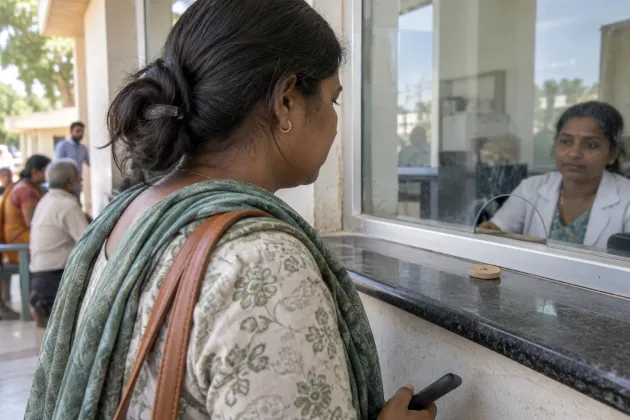
It is 3:17 pm outside a clinic, and your phone labels an incoming call as spam just as the receptionist says the doctor may call from an unfamiliar number. You have seconds to choose between protection and a missed appointment. The red warning feels certain. It is not.
India’s amended anti-spam framework now makes a report tapped inside a caller-ID or call-management app travel into the telecom enforcement system. The uncomfortable truth is that moving a private platform’s signal onto regulated infrastructure does not automatically make the signal fair, accurate or explainable. Your decision is therefore bigger than whether to answer this call: treat the label as a clue, and demand that any system acting on it can show its work.
What changed when the report left the app?
The Telecom Regulatory Authority of India’s third amendment to its commercial-communications rules was announced on 18 September 2026. A call-management app may not offer users a spam or junk reporting button unless it sends the resulting report to the distributed-ledger platform maintained by telecom access providers. The rule turns a report made inside a private app interface into an input that can support action across the wider telecom system.
That is an important distinction. The government summary requires the app to forward the user’s report; it does not say that contact graphs, proprietary reputation databases or detection models must also be transferred. Calling the measure a wholesale handover of a private database would go beyond the text. The real concern is narrower and more durable: a report originates inside a classification interface whose evidence the user may not see, then enters a system with regulatory consequences.
The amendment does not rely on app reports alone; provider detection and complaint thresholds also govern action. Telecom providers must identify calling-line identities that their systems consider highly likely to be used for unsolicited commercial communication and share that information among providers. When a number receives at least three unique complaints within ten days and the provider’s automated system also flags it, the framework can trigger action against the sender. Under that rule, human complaints and automated suspicion must coincide before action is triggered at this threshold.
This hybrid is sensible on paper. A single irritated tap should not disconnect a number, while a network anomaly without a complaint may be benign. But corroboration is only as good as the independence of its inputs. If an app label influences a user’s report and a similar behavioural pattern influences a network model, two matching signals can still be echoes of the same assumption.
Where does a spam label come from?
Different systems build the warning differently. Business Standard reported that Truecaller combines user feedback with automated detection and internal analysis, including report frequency and calling behaviour. The same report said Airtel works at network level with calling behaviour and traffic patterns, while Google’s phone app combines its databases with user submissions. These are reputation systems, not digital eyewitnesses.
A reputation profile is useful because spam is adaptive. Senders rotate numbers, alter call volume and borrow the appearance of legitimate businesses. A rigid blocklist reacts late. A system can instead use repeated reports, calling behaviour or network traffic patterns to warn you before a formal investigation ends.
The cost is opacity. Google’s phone app may display a spam warning during an incoming call. That visible result does not itself explain the signal mix, reporting window, confidence level or last review. One app may use repeated crowd reports; a telecom model may analyse calling behaviour and network traffic; another phone app may combine its databases with user submissions. The same incoming call can therefore acquire different reputations depending on who is looking.
This is where the word profile matters. The immediate object being scored is generally a phone number and its behaviour, not a complete biography of the person holding your phone. Yet a number can be linked to a business, an employee, a delivery worker or an ordinary subscriber. Once the score affects whether calls are answered, filtered or investigated, the operational distinction between profiling a number and judging its user becomes thin.
Careful readers are influenced by the warning too. A warning changes behaviour before you inspect evidence; that is its purpose. It saves attention precisely by asking you not to deliberate. The feature can be protective and still shift power to whoever defines the score.
Why the shortcut is so tempting
The regulator has a genuine scale problem. Official figures say users lodged 31.09 lakh unsolicited-commercial-communication complaints through all channels in 2025, including 17.06 lakh through the DND app. That volume explains why the system wants reports to arrive in structured form and why automated triage is attractive.
An app that accepts manual call reports can reduce the friction of filing one. You do not have to copy a number into a second app, remember a short code or reconstruct the time later. A report can become useful to the provider rather than dying as a private block on one handset. Convenience here is not fake; it may produce earlier evidence against persistent senders.
The amendment also adds a consumer appeal route for the resolution of unsolicited-commercial-communication complaints, with appeals allowed through the DND app, provider channels, calls or messages to 1909. That matters when your complaint is rejected or mishandled. That route concerns a consumer appealing the resolution of a UCC complaint. The government summary cited here does not identify a matching appeal for a person or business contesting an app’s label. The complainant’s route and the labelled caller’s route solve different failures.
Truecaller called the sharing mandate anti-competitive, according to Mint. That objection deserves examination, not automatic acceptance: a company can have a commercial interest in keeping the data advantage that makes its service valuable. Equally, forcing one side to contribute reports while telecom operators retain their own network intelligence could reshape competition. Consumer protection should not become a convenient banner for transferring an informational advantage without reciprocal rules.
The shortcut is tempting because everyone gets something. Users get fewer steps, providers get more reports, and regulators get a larger enforcement feed. The bill is paid in governance: deciding what is transmitted, who may reuse it, how long it stays, and who must correct a damaging error.
The low point: more signals can mean less accountability
The obvious plan is to collect every available signal, combine them and trust the bigger dataset. That can backfire. More inputs can make a system harder to contest because responsibility fragments: the app supplied the report, the user tapped it, the provider’s model corroborated it, and an access provider acted. Each participant can point to the others.
The amendment itself reveals the false-positive problem. Call-management apps cannot blanket-tag or block calls from the designated 140xx, 1600xx and 1601xx series, although an individual remains free to block or filter calls on their own device. The protection exists because regulated promotional, service, transactional and government communications could otherwise be mislabeled.
That carve-out prevents one type of error but creates another risk: a designated series can acquire an aura of safety even when a recipient finds the communication unwanted or a sender misuses the channel. The right answer is not to colour every such call green or red. The interface should tell you what the number range means, what evidence produced the warning, and which choice remains yours.
There is also a privacy mismatch. India’s data-protection framework is built around consent and transparency, purpose limitation, data minimisation, accuracy, storage limitation, safeguards and accountability. Those principles are especially relevant when a report moves from an app into shared telecom infrastructure. A permission to report one call should not silently become permission for unrelated enrichment, indefinite retention or advertising.
The government says individuals can seek access, correction, updating or erasure of personal data under the data-protection framework. Translating those rights into this anti-spam chain is the hard part. A person should not have to guess whether the app, the originating provider, the terminating provider or the ledger operator holds the record that damaged the number’s reputation.
So the counter-intuitive conclusion is that centralising reports can weaken accountability unless the system also centralises responsibility. A bigger ledger is not a clearer decision. Without an audit trail a user can understand and a correction path a labelled caller can find, scale merely makes the mystery travel faster.
What accountable spam enforcement would show
Start with data boundaries. A forwarded report should contain only what enforcement needs: the reported number, the receiving provider, the communication type, the relevant time, the user’s chosen category and a protected reference to the complainant. The public rules should state which fields are mandatory, who can read them, the retention period and whether any field can be used to train another commercial model.
Then separate warning from punishment. An app can display a provisional warning based on its own threshold. Regulatory action should require independently obtained network evidence, a defined complaint threshold and proportional escalation. Re-verification is not disconnection; investigation is not guilt. Interfaces and official notices should preserve those distinctions. A reversible warning can tolerate uncertainty; a penalty that disrupts somebody’s livelihood needs a much higher standard and a named decision-maker.
Every label also needs a compact reason code. “Community reports increased recently” is more useful than a theatrical red screen. “Automated calling pattern detected by provider” tells you that the source is network analysis, not a crowd verdict. Neither explanation must reveal a fraud-detection model in enough detail to help spammers evade it.
Finally, publish performance. Regulators can report how many app-originated complaints were accepted, rejected, appealed and reversed; how often models and users disagreed; and how long corrections took. Aggregate reporting can reveal bias and failure without exposing complainants. Independent audits should test whether one provider, language, region or class of small business is disproportionately mislabeled.
This is not an argument for leaving spam reports trapped inside private apps. It is an argument that interoperability needs due process. If a platform’s convenient button becomes a doorway into enforcement, the rules around that doorway must be at least as visible as the button.
What to actually do
The phone outside the clinic is still ringing. Read the warning, but do not let its colour make the decision alone: decline if you cannot talk, then verify the clinic through the number you already trust and return the call there. The label has done its job by making you cautious; it has not earned the right to decide who is on the other end.
- Treat caller-ID warnings as risk signals, not findings of guilt.
- Report only a call or message you actually received, and choose the most accurate category.
- Use the DND or provider complaint route when you want regulatory action, then keep the reference number.
- Verify banks, clinics, delivery services and government offices through their official published channels before sharing information.
- Ask app makers and telecom providers for the reason, correction route and retention policy behind a disputed label.