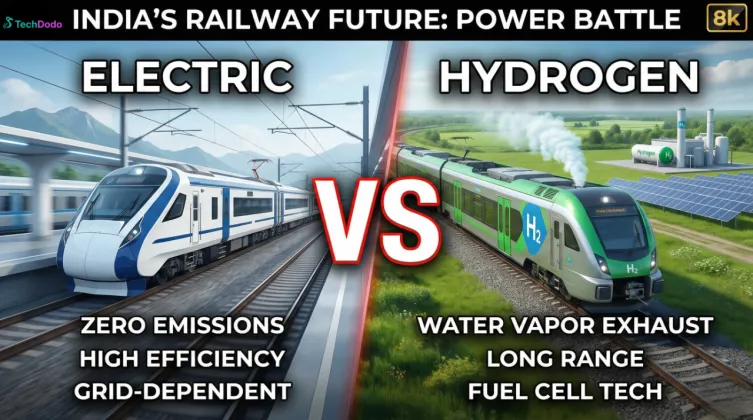
Quick Answer: Electric trains have already won India's rail future with 99.2% network electrification. Hydrogen trains (₹80 crore each) are reserved for UNESCO heritage routes like Kalka-Shimla where overhead wires aren't permitted. The catch: even that niche role faces competition from batteries.
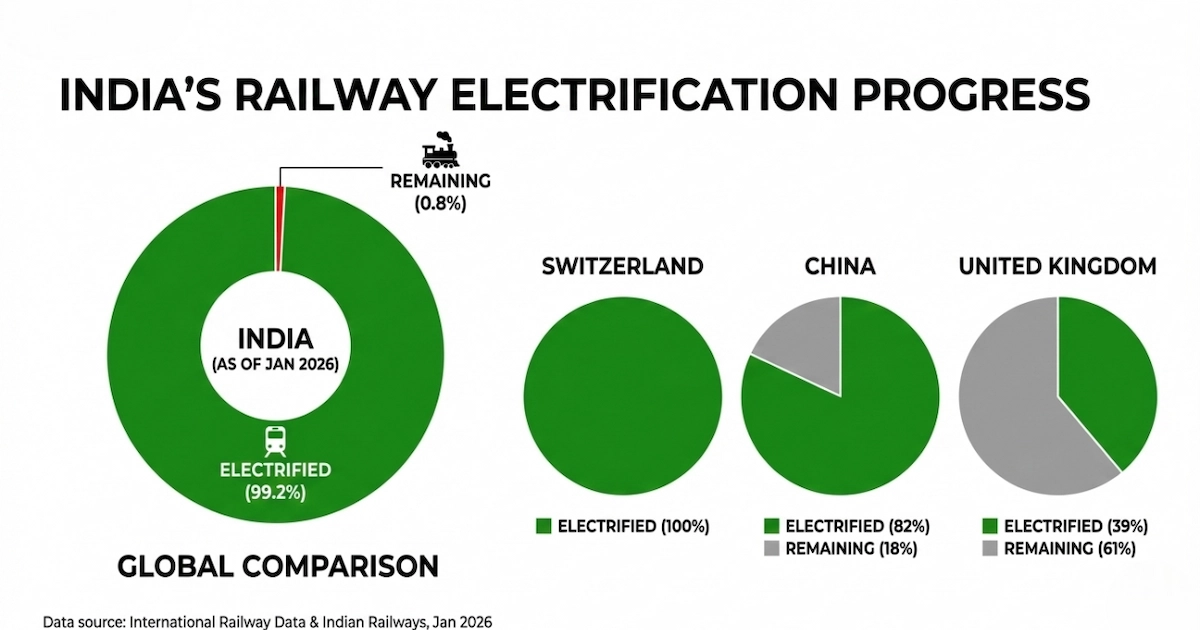
India just achieved something remarkable. As of November 2025, Indian Railways has electrified 99.2% of its broad-gauge network—69,427 kilometres of track humming with electric power. That's higher than China (82%), France (60%), and the UK (39%).
So why is the same government spending ₹2,800 crore on hydrogen trains?
This isn't the contradiction it appears to be. It's actually a masterclass in knowing when each technology makes sense. Let's break down the real competition between hydrogen and electric trains—and why the answer isn't as simple as "pick one."
The Numbers Don't Lie: Electric Has Already Won
Here's the uncomfortable truth hydrogen evangelists don't want to discuss.
Between 2019 and 2025, Indian Railways electrified track at 15 kilometres per day—a tenfold increase from the 1.42 km/day pace between 2004-2014. That's not incremental progress. That's mission-mode execution.
The result? Only 574 kilometres remain unelectrified across just five states: Rajasthan (93 km), Tamil Nadu (117 km), Karnataka (151 km), Assam (197 km), and Goa (16 km). By the time you read this, that number has probably shrunk further.
Operating costs tell an even starker story. Electric traction costs approximately 70% less than diesel. The infrastructure investment, while substantial, pays for itself through reduced fuel bills, lower maintenance, and the ability to tap into India's growing renewable energy grid. Indian Railways has already commissioned 898 MW of solar power, with 70% of that feeding directly into train operations.
Where Hydrogen Actually Makes Sense
If electric has won so decisively, why is India still pursuing hydrogen trains?
The answer lies in three words: UNESCO World Heritage.
India's Mountain Railways—the Darjeeling Himalayan Railway, Nilgiri Mountain Railway, and Kalka-Shimla Railway—are living museums. These narrow-gauge marvels built between 1881 and 1908 can't be electrified without losing their heritage status. Installing overhead catenary wires would alter the visual integrity that earned them UNESCO recognition.
But they still run on diesel. And diesel doesn't fit India's 2030 net-zero target for railways.
Enter hydrogen. The "Hydrogen for Heritage" programme aims to retrofit these routes with zero-emission trains that don't require overhead wires. The first pilot—a 10-coach hydrogen train on the Jind-Sonipat route—is set to begin operations with PM Modi expected to inaugurate it on Republic Day 2026.
The specifications are impressive on paper. This is the world's longest and most powerful hydrogen train on broad gauge: 2,400 kW combined output from two driving power cars, speeds up to 150 km/h, and capacity for over 2,600 passengers. The green hydrogen production facility at Jind spans 2,000 square metres and can store 3,000 kg of hydrogen—enough for multiple round trips.
The Uncomfortable Physics Problem
But here's where hydrogen enthusiasts need a reality check.
Converting electricity to hydrogen and back again is roughly 30% efficient. Electric trains drawing power directly from overhead wires? That's around 90% efficient. You're literally throwing away two-thirds of your energy just by choosing hydrogen over direct electrification.
This efficiency gap explains why hydrogen makes sense only where electrification is impossible—not merely inconvenient.
Consider the costs. Each hydrogen train costs approximately ₹80 crore. Ground infrastructure per route runs another ₹60-70 crore. The 35-train fleet planned under "Hydrogen for Heritage" represents a ₹2,800 crore investment for serving a handful of scenic routes.
Compare that to the millions of daily passengers on the electrified network, and you understand why hydrogen remains a specialised solution rather than a mainstream technology.
What Germany Learned the Hard Way
India isn't the only country experimenting with hydrogen trains. Germany pioneered the technology with Alstom's Coradia iLint—and the results should give India pause.
In December 2024, 18 of 27 hydrogen trains in Germany's largest fleet were withdrawn for urgent repairs. Lower Saxony, which operates the original hydrogen line, has scaled back operations with only a fraction of the original fleet running. In November 2025, Alstom announced it was halting further hydrogen train development entirely.
The problems weren't minor. Fuel cell systems required unexpected maintenance cycles. Hydrogen supply chains proved inconsistent, forcing operators to keep diesel trains on standby. The promised cost savings never materialised at scale.
Railway Minister Ashwini Vaishnaw acknowledged this reality when he told the Lok Sabha that comparing hydrogen train costs to established traction systems "would not present a fair comparison" at this pilot stage. That's diplomatic language for "we don't know if this will be economical yet."
The Battery-Shaped Elephant in the Room
Here's what makes the hydrogen vs electric debate incomplete: batteries.
Across Europe, battery-electric multiple units are increasingly eating hydrogen's lunch. Several hundred battery EMUs are on order in Germany alone from Stadler, Alstom, Siemens, and CAF. These trains charge on electrified sections and run on batteries through non-electrified portions.
For Indian Railways' heritage routes, battery trains could potentially offer a simpler solution. No hydrogen production facilities. No high-pressure storage. No fuel cell replacement cycles. Just bigger batteries doing what batteries increasingly do well.
India hasn't publicly announced battery train trials for heritage routes, but the global trend is clear. When faced with the choice between hydrogen complexity and battery simplicity, operators are choosing batteries.
The Real Strategy: Horses for Courses
The smartest way to understand India's approach is this: different technologies for different problems.
Electric trains win the mainline network—and they've already won it. The 99.2% electrification achievement means this question is settled for 69,427 of India's 70,001 route kilometres.
Hydrogen trains address a genuine niche. Heritage routes that can't accept overhead wires, remote sections where electrification costs are prohibitive, and perhaps eventually certain freight corridors. The ₹2,800 crore "Hydrogen for Heritage" investment isn't competing with electrification—it's solving a problem electrification can't touch.
The net-zero 2030 target ties everything together. Indian Railways aims to eliminate carbon emissions 20 years ahead of India's national 2070 commitment. Electric traction powered by renewable energy handles the bulk. Hydrogen (or possibly batteries) handles the rest.
What This Means For You
If you're booking a ticket on Indian Railways, here's the practical reality.
Your train is almost certainly electric. The Vande Bharat, Rajdhani, Shatabdi, and most other services run on the electrified network. This means quieter operation, better acceleration, and—importantly—a smaller carbon footprint than driving.
If you're taking a heritage route like the Kalka-Shimla toy train, you'll probably see hydrogen (or battery) trains within the next few years. Whether that improves your experience depends on how well India learns from Germany's growing pains.
The bigger picture is encouraging. India is electrifying its railways faster than any major economy in recent history. The hydrogen experiments, whatever their outcome, won't change that fundamental achievement.
Electric has won. Hydrogen has found its niche. And Indian Railways is closer to carbon neutrality than most observers realise.
We'll update this article when Indian Railways announces results from the Jind-Sonipat hydrogen train pilot. The real test isn't whether the train runs—it's whether it runs reliably, economically, and without the maintenance headaches that derailed Germany's programme.