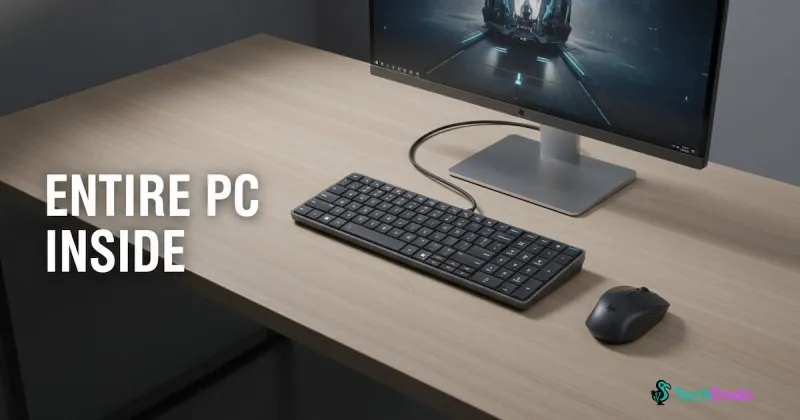
Quick Answer: The HP EliteBoard G1a is a complete Windows 11 Copilot+ PC built entirely into a keyboard. Powered by AMD Ryzen AI 300 processors with up to 64GB RAM and 2TB SSD, it weighs just 750g and launches globally in March 2026. Best for enterprise IT fleets and hybrid workers who want a clutter-free desk. The catch? Pricing remains undisclosed, and India availability isn't confirmed yet.
The Commodore 64 called. It wants its idea back — but with 50 trillion AI operations per second this time.
HP just unveiled the EliteBoard G1a at CES 2026, and it's exactly what it sounds like: an entire Windows PC crammed inside a full-size keyboard. Not a streaming stick. Not a thin client. A proper Copilot+ certified AI PC with AMD Ryzen AI 300 processors, up to 64GB of DDR5 RAM, and 2TB of NVMe storage. All of it hidden beneath the keys you'll type on.
The device won a CES 2026 Innovation Award, and honestly, it deserved one. While everyone else at the show was iterating on the same laptop designs, HP decided to ask a different question: What if the keyboard was the computer?
Is This Actually Usable, or Just a CES Gimmick?
Here's the thing. Keyboard computers have existed for decades — from the Apple II to Raspberry Pi 400. But they've always been hobbyist toys or educational tools. The EliteBoard G1a is neither.
HP built this for enterprise IT teams who are tired of managing bulky desktop towers. The pitch is simple: plug the keyboard into any USB-C monitor, connect the included wireless mouse, and you've got a fully functional Windows 11 workstation. No tower. No dock. No cable spaghetti.
Early hands-on impressions from CES confirm it works. Engadget's reviewer noted the prototype "felt about the same as an entry-level laptop" — which is exactly what HP is going for. This isn't meant to replace gaming rigs or creative workstations. It's meant to replace the boring office computers that IT admins hate deploying.
What's Actually Inside This Thing?
The specs are surprisingly serious for something keyboard-sized:
Component | Specification |
Processor | AMD Ryzen AI 300 Series (AI 5 330 / AI 5 340 / AI 7 350 PRO) |
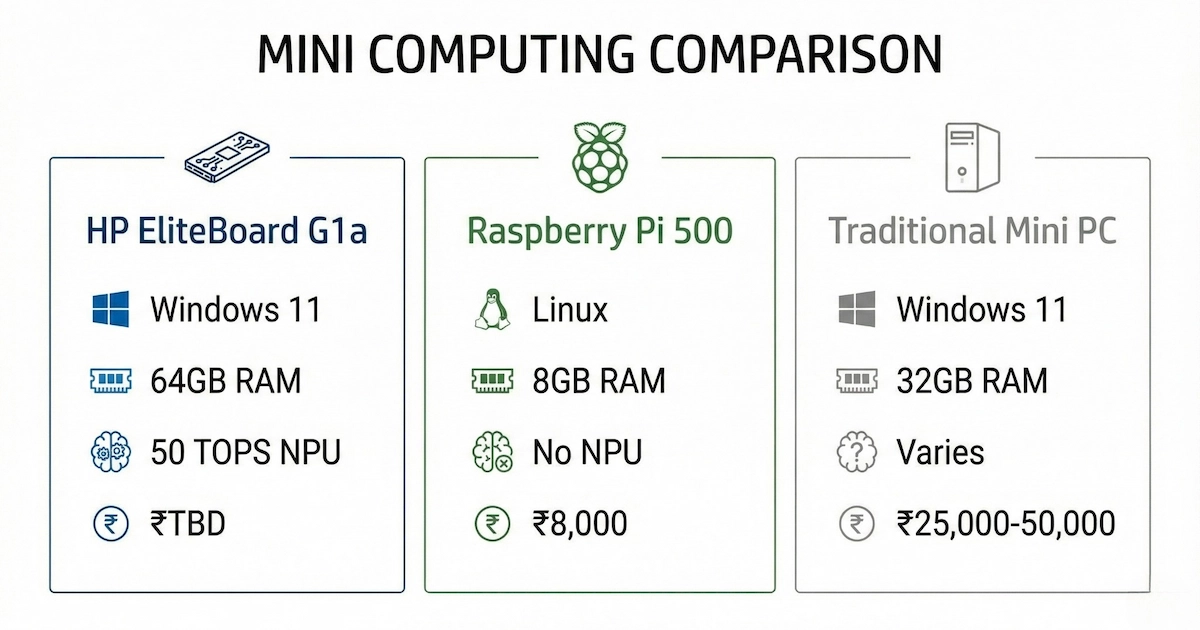
NPU Performance | Up to 50 TOPS (Copilot+ PC certified) |
Graphics | AMD Radeon 800M Series (integrated) |
RAM | Up to 64GB DDR5-6400 (user-upgradable SODIMM) |
Storage | Up to 2TB PCIe Gen4 NVMe SSD (user-upgradable) |
Ports | USB 4.0 + USB 3.2 Gen2 (both support power delivery and video out) |
Wireless | Wi-Fi 7 / Bluetooth 6.0 (or Wi-Fi 6E / Bluetooth 5.4) |
Display Support | Dual 4K @ 60Hz |
Battery | Optional 32Wh (3.5 hours active, 2 days standby) |
Weight | ~750g (lightest config: 676g) |
Dimensions | 12-17mm thin |
The Ryzen AI 300 "Krackan Point" chips are laptop-class processors, which explains why HP could fit everything into a 17mm chassis. The integrated Radeon 800M graphics won't run Cyberpunk, but they'll handle dual 4K displays and basic video editing without breaking a sweat.
But wait.
Why Should Indian IT Managers Care?
Three words: hot desking and repairability.
HP designed this specifically for shared workspace environments. Two versions exist: one with a permanently attached USB-C cable (for fixed desks) and one with a detachable cable plus battery (for hybrid workers who commute between office and home).
The repairability angle is genuinely interesting. Pop off the bottom panel, and you can swap the RAM, SSD, Wi-Fi module, speakers, fans, and even the battery yourself. IT teams can replace components without scrapping the entire device. HP claims the keyboard deck itself is replaceable too — so if someone spills chai on the keys, you don't lose the whole PC.
For Indian enterprises dealing with high device churn and repair costs, this could meaningfully reduce total cost of ownership. The question is whether HP prices it competitively against traditional mini PCs and thin clients.
The Catch: Pricing and India Availability
HP hasn't disclosed pricing yet. They've promised to announce it "closer to March 2026 availability."
Here's what we can infer:
- Raspberry Pi 500 costs $90 (~₹7,500) but runs Linux and maxes out at 8GB RAM
- Raspberry Pi 500+ with mechanical keyboard and NVMe costs $200 (~₹17,000)
- HP EliteBook laptops with similar AMD Ryzen AI 300 chips start around ₹80,000-90,000 in India
- Enterprise thin clients typically range ₹25,000-50,000
My educated guess? Expect the base EliteBoard G1a somewhere between ₹50,000-80,000 for enterprise bulk orders. Consumer pricing (if HP offers it) would likely be higher.
India availability: Not confirmed. HP India typically follows global launches by 1-3 months for enterprise products. Expect an announcement by Q2 2026 if the global rollout goes smoothly.
Who Should (and Shouldn't) Wait for This?
Makes sense for:
- IT teams managing call centers, co-working spaces, or hot-desking environments
- Enterprises that want standardised, easy-to-deploy Windows endpoints
- Companies experimenting with desk-light office designs
- Anyone who hates cable clutter and desktop towers
Skip if:
- You need a mechanical keyboard (the EliteBoard uses scissor switches with 2mm travel — fine, but not clicky)
- You require dedicated GPU power for gaming or heavy creative work
- You're an individual consumer looking for a home PC (this is enterprise-first)
- Budget is tight — this won't compete with ₹30,000 laptops
Our Take: Bold Idea, Execution TBD
The HP EliteBoard G1a is the most interesting PC form factor we've seen in years. It takes a concept that's been stuck in hobbyist territory (keyboard computers) and gives it enterprise-grade specs, Windows compatibility, and genuine repairability.
But here's the catch.
Success depends entirely on pricing. If HP positions this at ₹50,000-60,000 for enterprise buyers, it could genuinely disrupt how offices deploy desktops. Price it at ₹80,000+, and it becomes a niche curiosity that loses to cheaper thin clients and laptops.
We'll update this article when HP announces India pricing and availability. For now, the EliteBoard G1a is one to watch — not buy.