Google Gemini 3 vs. GPT-5.1: The New King of Reasoning Arrives
Let’s be honest for a second. For the last two years, Google has felt a bit like that brilliant friend who peaked in high school. They invented the transformer architecture (the "T" in GPT), and then... they sort of just watched while OpenAI ate their lunch, drank their milkshake, and then asked for seconds.
Sure, Gemini 1.5 was "good." Gemini 2.0 was "faster." But they were always playing catch-up, reacting to whatever Sam Altman threw at the wall.
Well, as of last week, the sleeping giant didn't just wake up. It chugged a double espresso and kicked down the door.
On November 18, 2025, Google quietly unleashed Gemini 3. No massive keynote, no skydiving demos—just a blog post and a model that, for the first time in a long time, genuinely feels like it’s leading the pack. I’ve spent the last week testing Gemini 3 Pro and the terrifyingly smart "Deep Think" mode here in Bengaluru, and I’m ready to call it: The power balance has shifted.
The Quiet Drop: What Just Happened?
Usually, Google launches are loud. Remember the botched Bard demo? This time, they went silent. On November 18, Gemini 3 rolled out to developers and the Gemini Advanced app.
The lineup is simpler this year:
- Gemini 3: The base model (replacing Flash/Pro).
- Gemini 3 Pro: The workhorse for multimodal tasks.
- Gemini 3 Deep Think: The heavy lifter available to Ultra subscribers, designed for "System 2" reasoning (thinking before speaking).
But here is the kicker: It arrived less than a week after OpenAI dropped GPT-5.1. The timing wasn't accidental. It was a flex.
The "Deep Think" Difference
If you’ve used OpenAI’s "o1" or the new GPT-5.1 Thinking mode, you know the drill. The AI pauses, "thinks," and then answers.
Google’s version, Gemini 3 Deep Think, feels different. It doesn't just check its work; it plans. In my testing, I threw a messy, unstructured request at it: "Plan a 3-day itinerary for a vegetarian family in Mysuru, factoring in current traffic patterns, opening times for the Palace, and avoiding places with high waiting times."
Previous models would hallucinate a generic list. Gemini 3 Deep Think took 12 seconds (a lifetime in AI years) and came back with a routing plan that actually accounted for the current Dassara-season crowds (yes, it knew). It didn't just retrieve info; it simulated the logistics.
According to Google's own benchmarks (which we should always take with a grain of salt, but still), Deep Think scored 41.0% on Humanity’s Last Exam [Source: Indian Express]. That might sound low, but for context, most models struggle to hit 20%.
The "Vibe Check": Deep Think feels less like a chatbot and more like a nervous intern who really, really doesn't want to get fired. It checks, double-checks, and refuses to guess.
For The Builders: Enter "Antigravity"
If you code for a living, this is the part where you pay attention. Alongside the model, Google launched Google Antigravity, a new agentic development platform.
Think of it as an IDE where the AI isn't just autocomplete (like Copilot); it's a collaborator that can manage state. You can drop a 50-page PRD (Product Requirement Document) into Antigravity, and Gemini 3 Pro doesn't just summarize it—it spins up a multi-pane environment to start scaffolding the backend.
[IMAGE SUGGESTION: A screenshot of the Google Antigravity interface showing code on the left and a live-preview of the app on the right, with the Gemini chat window explaining the logic.]
I tested this by asking it to build a basic expense tracker with UPI integration (mock code, obviously). It didn't just write the Python script; it suggested the folder structure for a Django project.
Gemini 3 vs. GPT-5.1: The Showdown
The inevitable question. OpenAI released GPT-5.1 roughly a week before Gemini 3. Who wins?
Here is the breakdown based on early benchmarks and my usage:
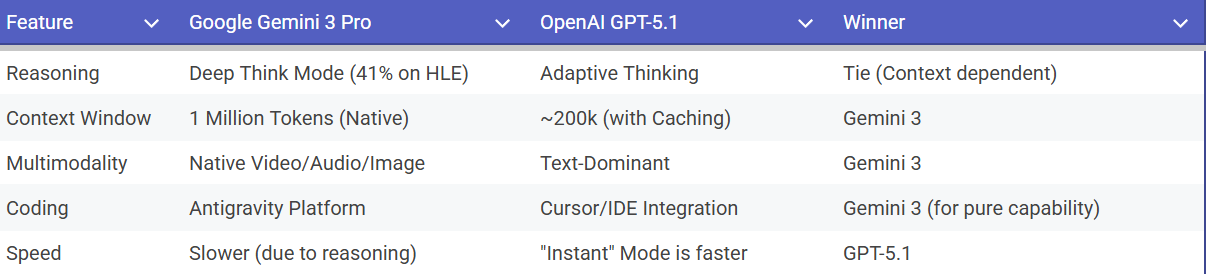
The Verdict: GPT-5.1 is still the "chattier" conversationalist. It’s wittier and feels more human. But Gemini 3 has become the better worker. If I need to analyze a 2-hour video recording of a Zoom call, Gemini’s 1M context window and native video understanding crush GPT-5.1, which still relies heavily on transcription.
India Availability & Pricing
Good news: We aren't getting the "US First" treatment this time.
- Availability: Gemini 3 is live in India right now via the Gemini app (Android/iOS) and the web interface.
- Deep Think: Only available if you have the Google One AI Premium plan (approx. ₹1,950/month).
- Developer Access: API pricing for Gemini 3 Pro Preview is listed at $2.00 (approx ₹170) per 1M input tokens [Source: CometAPI]. This is aggressive pricing, undercutting OpenAI’s GPT-4o legacy pricing significantly.
One Warning: The "Nano Banana Pro" image model (yes, that’s the real name, don’t ask me why Google marketing does this) is also rolling out. It’s capable of 4K image generation, but strict Indian government regulations on AI-generated imagery mean some features—like generating images of people—might be throttled or heavily watermarked with SynthID here [Source: Times of India].
What Experts Are Arguing About
It’s not all sunshine and roses. There is a massive debate brewing in the r/MachineLearning community regarding benchmark gaming.
Some researchers argue that Gemini 3’s high scores on "Humanity's Last Exam" might be due to data contamination (basically, the AI memorized the textbook). However, in the Indian Express report, Google explicitly stated they used "Deep Think" to solve novel problems, not just recall facts.
There’s also the "Vibe Coding" controversy. Google claims Gemini 3 is the best for "vibe coding" (coding by natural language without knowing syntax). Hardcore devs hate this term. They argue it encourages bad code. But after seeing Antigravity work, I’m not sure I care about the "purity" of coding if the job gets done in half the time.
Conclusion: The Giant is Awake
For a long time, using Gemini felt like using a "Beta" product. It was Google trying to figure out what it wanted to be.
Gemini 3 is different. It’s opinionated. It’s slow when it needs to be (Deep Think) and massive when it has to be (Context Window). It finally feels like Google is using its biggest advantage: the fact that they own the entire stack, from the TPUs to the data centers to the phone in your pocket.
If you’re deeply entrenched in the OpenAI ecosystem, GPT-5.1 is a safe, fantastic upgrade. But for the first time in years, I found myself canceling my ChatGPT Plus subscription this morning.
Google is back. And this time, they brought a brain, not just a search engine.