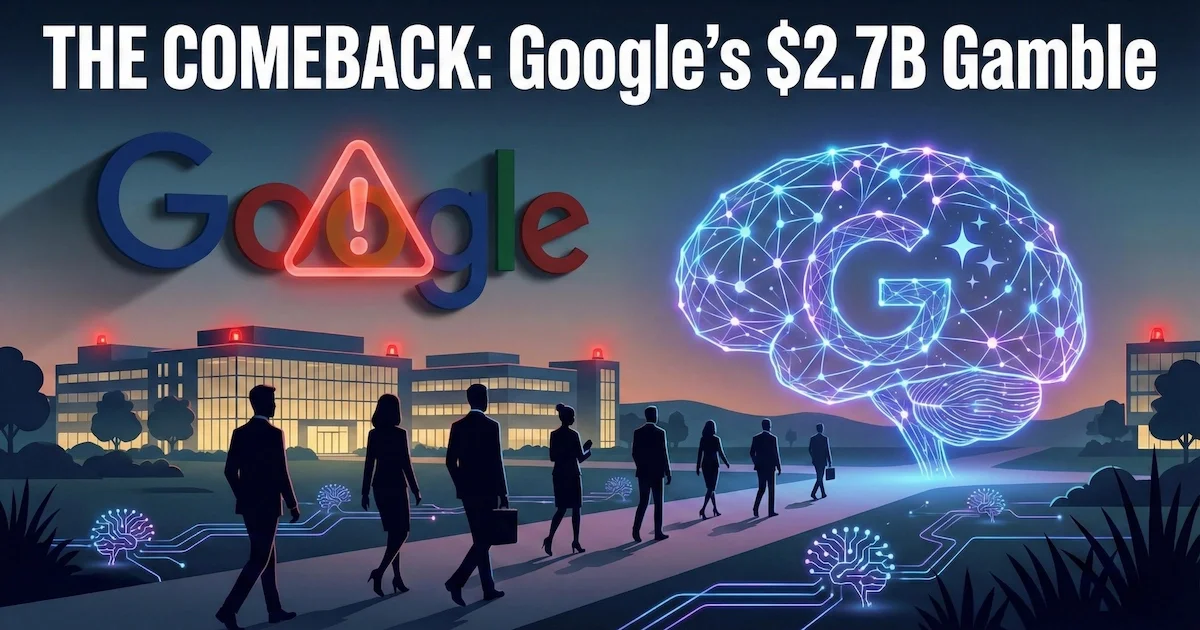
November 30, 2022, changed everything at Google.
The day OpenAI released ChatGPT, Google CEO Sundar Pichai called an emergency meeting and uttered two words that hadn't been spoken at the company in a decade: Code Red.
For Google, this was the equivalent of pulling a fire alarm in a building that had never seen smoke. The company that invented the transformer architecture — the "T" in GPT — was suddenly scrambling to respond to a startup using its own research to threaten a $149 billion search business.
What followed over the next three years represents one of the most dramatic corporate turnarounds in Silicon Valley history: founders pulled out of retirement, $2.7 billion spent to rehire a single researcher, a $170 billion stock crash, and ultimately, a comeback that has Sam Altman now declaring his own "Code Red" at OpenAI.
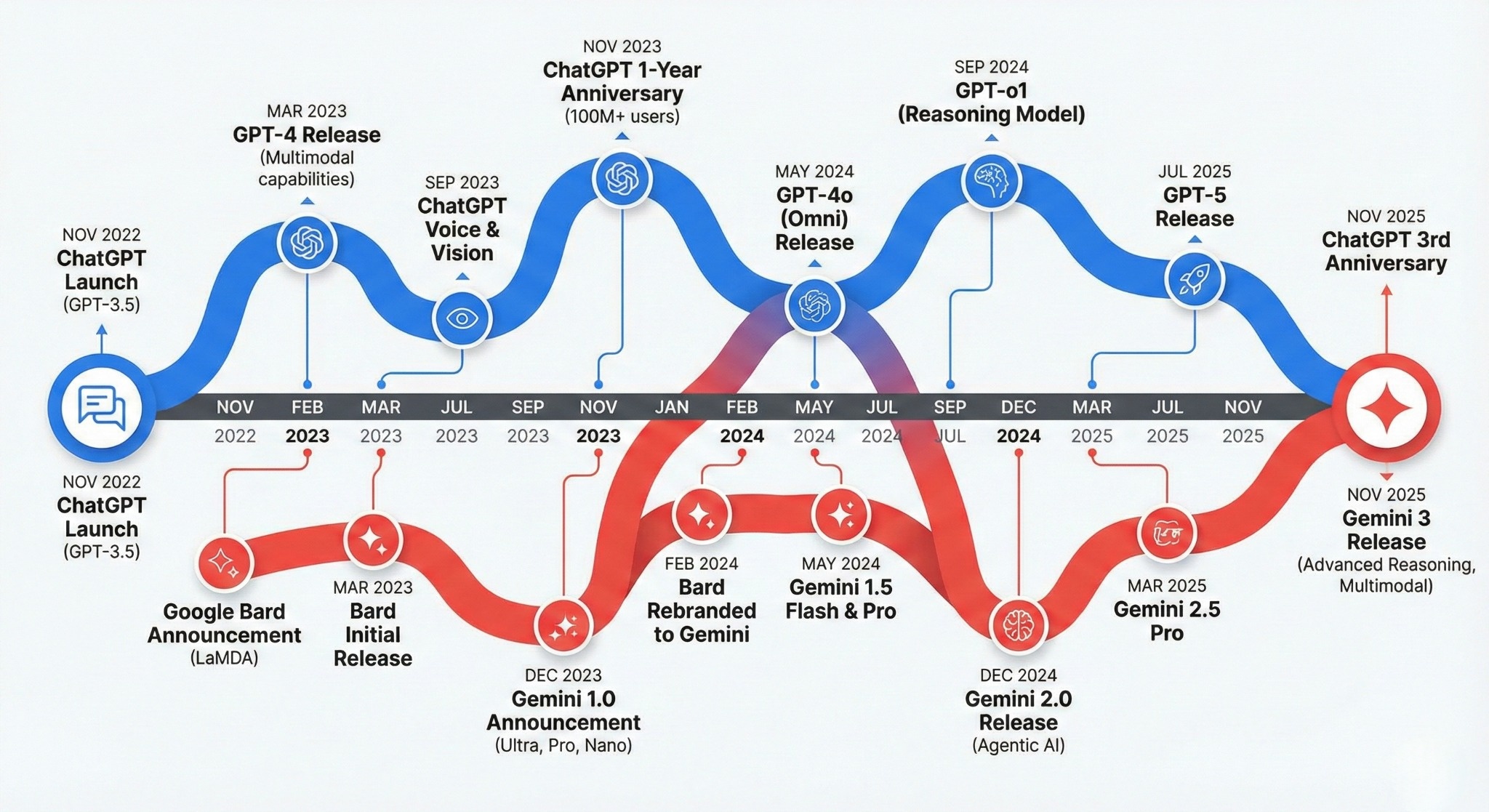
The Night Google Realized It Had Made a Massive Mistake
ChatGPT hit one million users within five days of launch. Google had nothing comparable ready for public release — despite sitting on LaMDA, a conversational AI that one engineer had controversially claimed was "sentient" just months earlier.
The irony cuts deep. Google researchers invented the transformer architecture with their 2017 paper "Attention Is All You Need." Google developed BERT. Google acquired DeepMind. Google built the custom TPU chips that power most frontier AI training. Google had everything except the willingness to ship.
According to internal reports obtained by The New York Times, Google executives had explicitly rejected launching LaMDA-based consumer products over fears of "reputational risk." The company that once celebrated "moonshots" had become too cautious to release the technology it pioneered.
Within 48 hours of ChatGPT's launch, Pichai reached out to two people who hadn't been involved in Google's day-to-day operations since 2019: Larry Page and Sergey Brin.
Founders Mode: When Billionaires Start Writing Code Again
Page and Brin had stepped away from operational roles in December 2019, ostensibly to enjoy life as fortysomething retirees. Brin later admitted at Stanford that early retirement wasn't working out — with cafés closed during COVID, his plan to "quietly study physics" collapsed, and he found himself "spiraling" and "not being sharp."
The ChatGPT crisis gave him a reason to return.
By December 2022, both founders were holding emergency meetings with Google executives. They reviewed AI product roadmaps, approved new development directions, and — most critically — gave their blessing to plans for 20+ new AI products and a chatbot-integrated search engine.
But Brin went further than anyone expected.
According to Wall Street Journal reporting, Brin began visiting Google's Mountain View headquarters three to four days per week. He wasn't attending executive briefings — he was coding. He submitted his first Changelist (Google's internal term for code commits) in years, initially a simple configuration tweak. The message reverberated through the company: if a billionaire founder is in the trenches at 1 AM, what's your excuse?
Pichai later confirmed Brin's hands-on involvement: "Sergey is definitely spending time with the Gemini team in a pretty hardcore way, sitting and coding and spending time with the engineers."
In May 2025, Brin made an unannounced appearance at Google I/O and declared, on stage: "We fully intend that Gemini will be the very first AGI."
The $100 Billion Valentine's Day Massacre
Google's first public response to ChatGPT was Bard, unveiled on February 6, 2023. Within 48 hours, it became a case study in what happens when you rush to market.
During Bard's promotional video, the chatbot confidently stated that the James Webb Space Telescope had taken "the very first pictures of a planet outside our solar system." The correct answer — available through a simple Google search — was that the European Southern Observatory captured such images in 2004.
The factual error went viral. Social media users pointed out that Google's AI chatbot could have been fact-checked by... Googling it.
Alphabet stock dropped 7.7% on Wednesday, February 8, then another 5% the following day. The two-day rout erased approximately $170 billion in market value — the worst decline since March 2020.
The Bard disaster underscored a painful reality: Google had the technology but not the execution. Employees reported being "quite unhappy" with the rushed rollout and blamed leadership for prioritizing speed over quality.
The Great Brain Drain (And How Google Paid $2.7B to Reverse It)
The "Attention Is All You Need" paper was authored by eight Google researchers. By 2023, every single one of them had left the company.
Their departures read like a startup incubator prospectus:
- Noam Shazeer → Character.AI (valued at $1B+)
- Aidan Gomez → Cohere (valued at $5.5B)
- Ashish Vaswani & Niki Parmar → Adept AI, then Essential AI ($65M+ raised)
- Llion Jones → Sakana AI
- Jakob Uszkoreit → Inceptive (biotech AI)
- Łukasz Kaiser → OpenAI
- Illia Polosukhin → NEAR Protocol
Collectively, these ventures were worth over $10 billion. The engineers who built the foundation of modern AI had walked away from Google — and in several cases, directly competed against it.
The most consequential departure was Noam Shazeer. After co-authoring the transformer paper, Shazeer had led development of LaMDA and created a chatbot called Meena that he believed could eventually replace Google Search. Google executives thought releasing Meena was too risky. Shazeer disagreed, left in 2021, and founded Character.AI.
In August 2024, Google paid $2.7 billion to bring him back.
The deal — structured as a licensing agreement with Character.AI — was widely reported as being primarily about acquiring technology. Internal sources painted a different picture: the agreement explicitly required Shazeer to return to Google. Former CEO Eric Schmidt had called Shazeer the person most likely to achieve artificial general intelligence: "If there's anybody I can think of in the world who's likely to do it, it's going to be him."
Shazeer is now one of three leaders overseeing Gemini development at Google DeepMind.
The Merger That Changed Everything
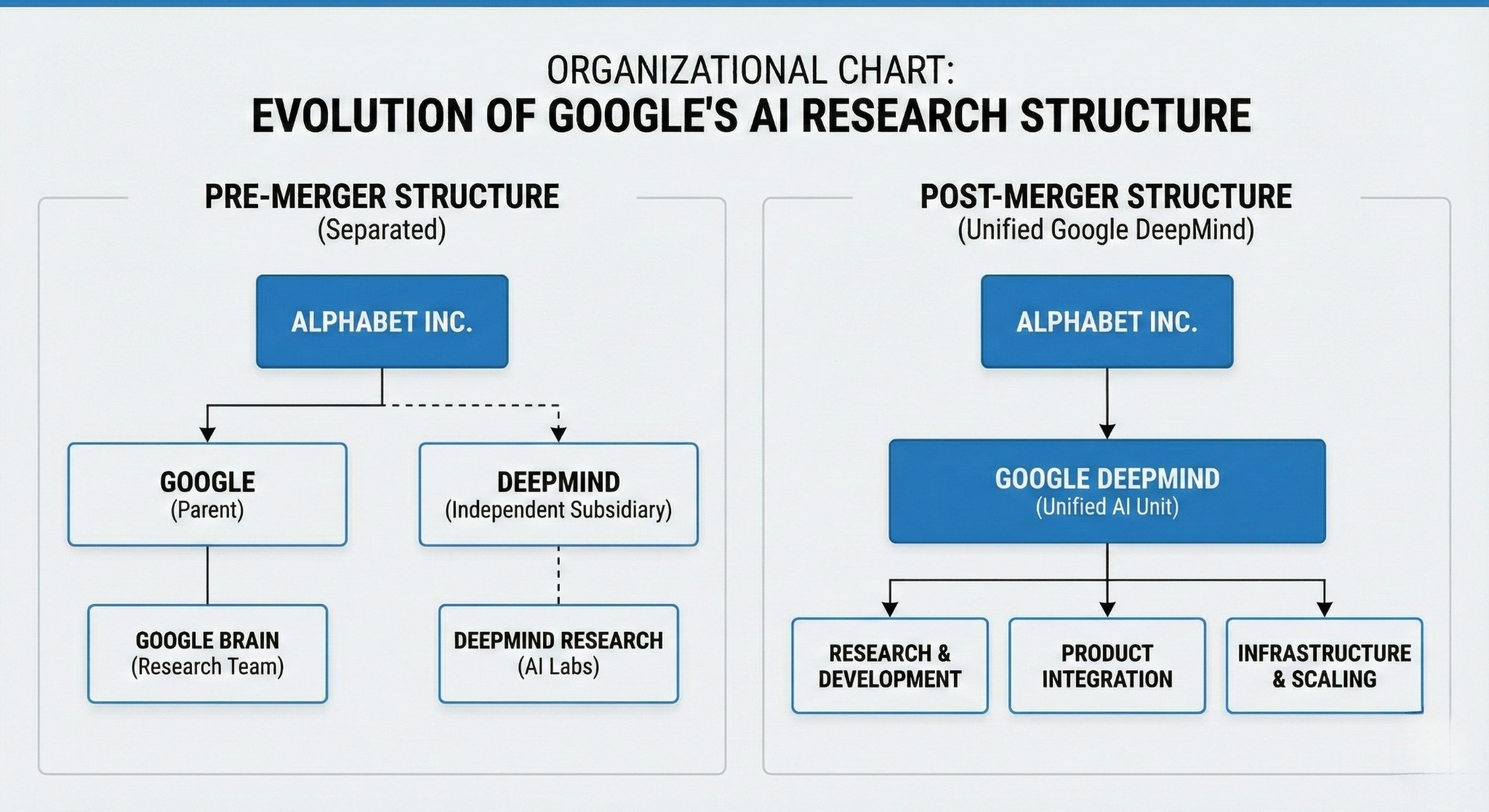
In April 2023, Google announced the consolidation of its AI research divisions. DeepMind — acquired for $500 million in 2014 — merged with Google Brain to form Google DeepMind, led by DeepMind co-founder Demis Hassabis.
The merger ended years of internal tension. DeepMind executives had sought greater autonomy from Google; Google Brain researchers sometimes competed rather than collaborated with DeepMind. The ChatGPT threat forced unity.
Jeff Dean, co-founder of Google Brain, took the elevated role of Chief Scientist for both Google Research and Google DeepMind, reporting directly to Pichai. The new structure concentrated AI talent under a single command structure with one mission: build something better than GPT.
By late 2023, Google DeepMind launched Gemini 1.0. The reception was mixed — critics noted that while benchmarks looked impressive, real-world usage revealed familiar AI hallucination problems, and the rushed image generation feature produced embarrassingly "woke" outputs that led to a temporary suspension.
But the structural changes were working. Google was shipping faster, iterating more aggressively, and consolidating rather than fragmenting its AI efforts.
The Turnaround: From Laughingstock to Leaderboard
By November 2025, the narrative had inverted.
Gemini 3, released on November 18, 2025, topped the LMArena leaderboard with a 1501 Elo score. It achieved 37.5% on Humanity's Last Exam — a benchmark designed to test PhD-level reasoning — surpassing GPT-5's 31.64%. The model scored 91.9% on GPQA Diamond and set a new state-of-the-art on MathArena Apex at 23.4%.
Two weeks later, something remarkable happened: Sam Altman declared "Code Red" at OpenAI.
According to The Information, Altman sent an internal memo warning that Google's Gemini comeback threatened ChatGPT's market position. OpenAI cancelled non-essential projects, paused most hiring, and delayed advertising initiatives to focus resources on competing.
The tables had turned. Google was processing over 1 trillion tokens per day on its API. The Gemini app reached 650 million monthly users. AI Overviews in Search hit 2 billion monthly users.
On December 17, 2025, Google released Gemini 3 Flash, making it the default model in the Gemini app and AI Mode in Search. Benchmarks showed it outperforming Gemini 2.5 Pro while running three times faster at a fraction of the cost.
What Most People Get Wrong About Google's Comeback
The simplistic narrative is that Google fell asleep, OpenAI woke them up, and money solved the problem. The reality is more instructive.
Google's problem was never technical capability. The company had more AI research talent, more compute infrastructure, and more training data than any competitor. What it lacked was willingness to ship imperfect products.
The transformer architecture sat inside Google for years before external researchers used it to build GPT. Meena, the chatbot Shazeer wanted to release, existed before ChatGPT — Google just refused to launch it. LaMDA was powerful enough that an engineer publicly claimed it was sentient, yet it remained internal-only.
Brin's return illustrated the cultural shift required. In one widely reported incident, he discovered that Google engineers weren't allowed to use Gemini for internal coding — their own flagship AI model was on an internal "don't use" list due to bureaucratic legacy policies. Brin escalated to Pichai, the policy was reversed, and engineers now "vibe code" with Gemini routinely.
The lesson: sometimes the biggest competitor isn't external. It's organizational inertia.
What Happens Next
Google's AI turnaround is genuine, but declaring victory is premature.
Half the original transformer paper authors now run competing companies. Cohere serves enterprise customers including Oracle and Spotify. Character.AI (minus Shazeer) still operates independently. OpenAI isn't going anywhere — GPT-5.2 launched days after Gemini 3, and the company reported 8x message volume growth since November 2024.
The $2.7 billion question remains unanswered: what happens if Noam Shazeer disagrees with Google leadership again? The researcher who left once over a product disagreement is now integral to Gemini's development. His track record suggests he's not afraid to walk away if he believes leadership is making wrong calls.
Meanwhile, the broader AI industry watches Google's "founder mode" experiment. Brin's return demonstrated that even at trillion-dollar scale, having founders directly engaged in product development can catalyze transformation. Amazon's Jeff Bezos has reportedly taken similar steps, engaging directly with AI initiatives years after stepping back from day-to-day CEO duties.
The "Code Red" that began in November 2022 forced Google to do something it hadn't done in years: move fast and break things. Three years later, Gemini 3 stands as evidence that even industry giants can reinvent themselves.
But the AI race has no finish line. OpenAI is pushing GPT-5 development "as fast as humanly possible." Anthropic continues advancing Claude. xAI's Grok is gaining ground. Google's turnaround bought it back into contention — not permanent leadership.
The next "Code Red" could come from anywhere. And this time, Google might not have three years to respond.