
The Mouse House Meets The Matrix: Disney Drops $1B on OpenAI
Wait, didn’t Disney just sue someone over AI? Yes. But they also just bought a VIP seat at the table.
If you thought Disney was going to sit back and let the AI revolution happen to them, you haven't been paying attention to Bob Iger's playbook. In a move that feels equal parts "inevitable" and "wait, really?", The Walt Disney Company has officially invested $1 billion in OpenAI.
But this isn't just a boring backend stock purchase. This is a full-blown content merger. Disney is opening its vault—specifically the doors to Marvel, Star Wars, and Pixar—to Sora, OpenAI’s hyper-realistic video generation model.
Here is everything you need to know about the deal that just changed the future of fan fiction forever.

The Billion-Dollar Handshake
As of December 11, 2025, Disney confirmed a $1 billion equity investment in OpenAI. This mirrors their strategy with Epic Games ($1.5 billion) earlier this year. The goal? To ensure that when the next generation of entertainment platforms gets built, Disney owns the bricks.
The headline feature is the Sora integration.
For the uninitiated, Sora is OpenAI’s text-to-video model that scared the living daylights out of Hollywood when it debuted. Now, instead of fighting it, Disney is licensing 200+ characters to be officially usable within the platform.
The "Official" Fan Fiction Era
Starting early 2026, users of Sora (and ChatGPT Images) will be able to generate short-form videos featuring official Disney IP.
- Who is invited: Mickey, Minnie, Darth Vader, Iron Man, Buzz Lightyear, and roughly 195 others.
- The Limit: You can't just make a full-length Avengers 7. The clips are short (likely 20-60 seconds) and designed for social sharing.
- The Kicker: Disney+ will actually stream a curated selection of these user-generated videos. Yes, your weird little 30-second clip of Yoda breakdancing could technically end up on the same platform as The Mandalorian.
The "So What": This legitimizes AI video creation. Until now, using Spider-Man in an AI video was a copyright minefield. Disney is essentially saying, "You can play with our toys, but only in our sandbox."
What You Can (And Can't) Do
Before you start writing prompts for Thor vs. Godzilla: The RomCom, you need to know the rules. Disney didn't get to be a century-old empire by being reckless with its IP.
The "No-Go" Zones
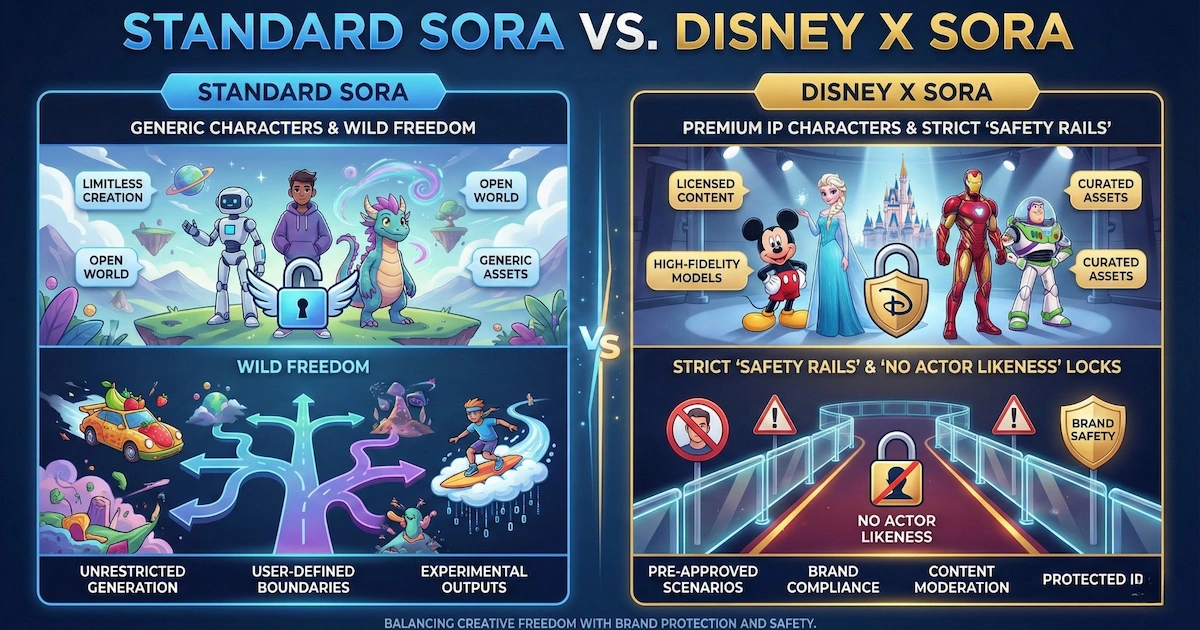
- No Voices/Likenesses of Real Actors: You will likely get "Iron Man" (the suit/CGI character), not Robert Downey Jr.'s face or voice. The deal explicitly excludes talent likenesses to avoid a massive war with SAG-AFTRA (the actors' union).
- Strict "Brand Safety" Rails: If you think you’re going to generate a horror version of Frozen or an R-rated Toy Story, think again. The guardrails on this specific Sora instance will likely be tighter than Fort Knox.
- No "Crossovers" (Maybe): While not explicitly banned in the press release, Disney historically hates unlicensed crossovers. Don't expect to easily mix Batman (DC/Warner Bros) into your Star Wars clip unless OpenAI strikes a deal with WB too.
The "Yes" Zones
- "Masked and Creature" Characters: This is the sweet spot. Stormtroopers, Droids, Pixar characters, and masked superheroes are fair game.
- Iconic Environments: You can generate scenes set in the Death Star, Wakanda, or Andy's Room.
The "Walled Garden" Strategy
Why is Disney doing this? Two reasons: Control and Data.
By partnering with OpenAI, Disney creates a "clean" data supply chain. They sent a Cease & Desist letter to Google the same week this deal was announced, accusing Google of training on Disney data without permission.
The message is clear: You can't steal our data, but we will sell it to the highest bidder.
Feature | Disney x Epic Games ($1.5B) | Disney x OpenAI ($1B) |
Focus | Interactive / Gaming | Generative Video / Storytelling |
User Role | Player / Avatar | Director / Creator |
Output | Fortnite Islands / Games | Sora Videos / Social Clips |
Launch | Active | Early 2026 |
The Catch: Risks & The "Slop" Factor
It’s not all sunshine and rainbows. There are massive risks here that experts are already debating.
1. The "AI Slop" Problem
Internet culture has a term for low-effort, low-quality AI content: "Slop." By inviting millions of users to generate Disney content, Disney+ risks diluting its premium brand with thousands of mediocre, hallucinated clips. If the curation isn't perfect, the "Disney Standard" takes a hit.
2. The Artist Backlash
While Disney says this "respects creators," many animators and VFX artists see this as the ultimate betrayal. A union backlash is almost guaranteed. If Sora makes it easy to generate a "good enough" background scene or character animation, does Disney cut down on junior animator roles in the future?
3. The "Uncanny Valley"
Sora is good, but is it Pixar good? Not yet. Seeing a Mickey Mouse that moves slightly wrong or a Spider-Man with physics glitches could damage the immersion fans expect.
Conclusion: The genie is out of the lamp
Disney has realized that AI video is coming whether they like it or not. Their choice was simple: let the pirates own the technology, or buy the ship.
They bought the ship.
For tech enthusiasts, this is the first real test of "authorized" GenAI. Can a controlled, corporate-approved AI tool actually be fun? Or will the safety filters make it too boring to use? We’ll find out in 2026.
What we’ll be watching: The first time a user-generated Sora clip goes viral for the wrong reasons, and how Disney handles it.