![ChatGPT vs Google Gemini: The AI Market Shift India Should Watch [2026]](https://techdodo.in/storage/articles/chatgpt-vs-google-gemini-ai-market-shift-india-2026_1768033692_69620d9cd5ba9_medium.webp)
Quick Answer: ChatGPT's market share dropped from 87% to 68% in 2025, losing 19 points to competitors. Google Gemini tripled its share to 18.2%. For Indian users, this means cheaper subscriptions (₹199-399/month), better local language support, and more choice. The catch: AI isn't crashing—it's just becoming a real market.
Remember when ChatGPT felt inevitable? When every tech conversation assumed OpenAI had won the AI race before anyone else even laced up their shoes?
Those days are over.
New data from Similarweb tells a story that should make you rethink everything you assumed about AI chatbots: ChatGPT's grip on the generative AI market has slipped dramatically. We're talking a 19-percentage-point drop in market share—from a commanding 87.2% to 68%—in just twelve months. Meanwhile, Google's Gemini has tripled its position, climbing from 5.4% to 18.2%.
But here's where it gets interesting for India: this isn't a story about AI dying. It's a story about AI becoming a real, competitive market. And Indian users are right in the middle of it.
The Numbers Don't Lie (But They Do Need Context)
Let's be clear about what's happening. ChatGPT isn't collapsing. It still has 800 million weekly active users—roughly the population of Europe. OpenAI still processes over a billion queries daily.
But growth has stalled. Between August and November 2025, ChatGPT's monthly active users grew by just 6%. During the same period, Gemini's user base exploded by 44%, jumping from 450 million to 650 million monthly active users.
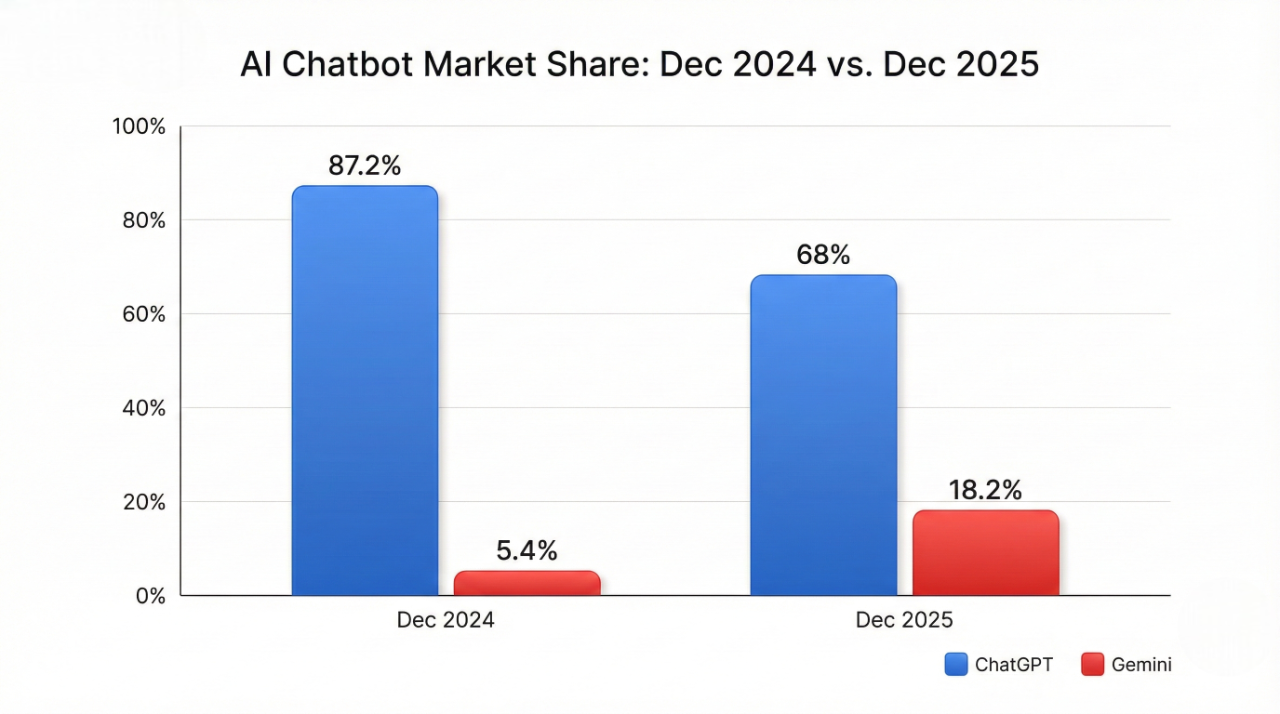
The referral traffic numbers are even more telling. When users click through from ChatGPT to external websites, that traffic grew 52% year-over-year. Sounds decent, right? Gemini's referral traffic grew 388% in the same period.
Here's the uncomfortable truth for OpenAI: when you're the market leader, losing ground at this pace triggers alarm bells. And those bells are ringing loudly—Sam Altman reportedly issued a "code red" memo to staff in December, specifically addressing competitive pressure from Google.
Why This Happened (And Why India Matters)
Three forces are reshaping the AI chatbot market, and they all converge in India.
First: Distribution wins. Google doesn't need you to download an app or visit a website. Gemini is baked into Android, Chrome, Gmail, Docs, Sheets, and YouTube. When you own the operating system running on 70% of the world's smartphones, you don't need marketing—you need patience. And Google has plenty of both.
In India specifically, Gemini captured 52% of AI chatbot downloads in 2024, compared to ChatGPT's 32%. That's a complete reversal from the previous year when ChatGPT dominated with 67% share. The secret? Local language support. Gemini works in nine Indian languages natively. ChatGPT doesn't.
Second: The multimodal war. Google's Nano Banana Pro image generator solved a problem that plagued every AI image tool: text rendering. You can now generate images with legible text directly embedded—something that made users tear their hair out with previous models. This drove significant adoption in late 2025.
Third: Price wars are good for consumers. Both Google and OpenAI are throwing freebies at Indian users like it's Diwali every month. OpenAI launched ChatGPT Go—basically the premium tier without the Pro label—free for a year to Indian users. Google countered with AI Plus at ₹199/month for six months (then ₹399/month). Perplexity partnered with Airtel to give its Pro plan free to all subscribers.
You're the prize. Act accordingly.
Is The AI Hype Cycle Actually Crashing?
Here's where the opinion piece begins, so buckle up.
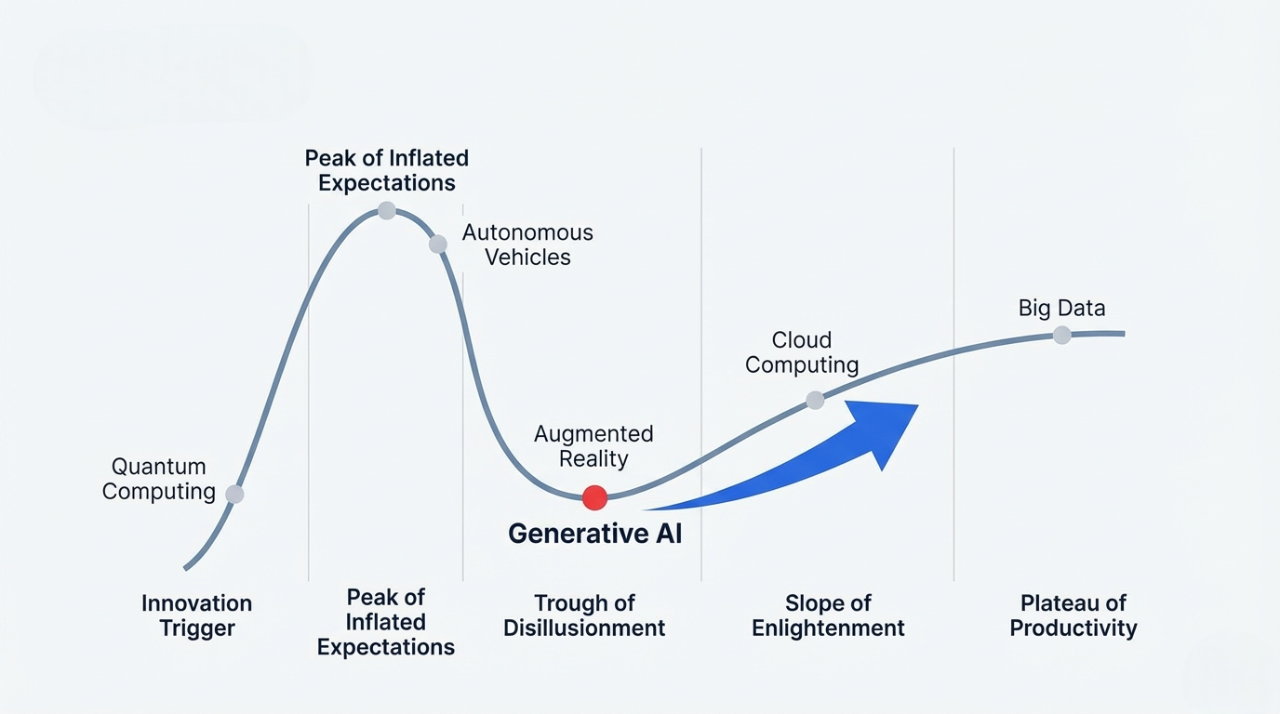
Gartner's 2025 Hype Cycle places Generative AI squarely in the "Trough of Disillusionment." This sounds dramatic, but it's actually healthy. Every transformative technology goes through this phase—the period when inflated promises meet implementation reality.
The numbers back this up. According to an MIT study from July 2025, 95% of businesses that tried implementing AI found zero measurable value from it. McKinsey's 2024 AI survey found that while 65% of enterprises piloted GenAI, fewer than 12% scaled it to production.
But—and this is crucial—this doesn't mean AI is dying. It means AI is maturing.
Think of it this way: The dot-com crash of 2000 didn't kill the internet. It killed the companies that thought "adding .com to our name" was a business strategy. The survivors—Amazon, Google, eventually Meta—built actual businesses on actual technology.
We're watching the same thing happen with AI. The companies that treat GenAI as magic pixie dust will fail. The ones integrating it into actual workflows, with measurable outcomes and realistic expectations, will thrive.
What This Means for You (The Indian User)
Let's get practical.
If you're paying for ChatGPT Plus at ₹1,650/month: Question that decision. Gemini's AI Plus at ₹399/month offers comparable features with better Google Workspace integration. The gap in quality has narrowed significantly. Unless you need specific ChatGPT-only features (like certain plugins or GPT-5's latest capabilities), the premium pricing is harder to justify.
If you're not paying for anything: This is actually the best position. The free tiers of both ChatGPT and Gemini are surprisingly capable. The freebies war means you get features today that cost ₹1,500+/month a year ago.
If you're a student or developer: India is testing AI-powered commerce through ChatGPT with UPI integration. NPCI partnered with OpenAI and Razorpay to enable shopping directly within chatbots. Gemini and Claude integrations are coming. This isn't just about asking questions anymore—AI chatbots are becoming transaction interfaces.
If you run a business: Stop waiting for the "winning" AI platform. There won't be one. The future is multi-platform, and the smart play is ensuring your brand appears in AI responses across ChatGPT, Gemini, Perplexity, and Claude. Think of it like SEO was in 2010—you needed to rank on Google, but also Yahoo, Bing, and Ask Jeeves (okay, maybe not Ask Jeeves).
The Real Story Here
The headline says ChatGPT is dropping. The data says competition is arriving. These are different things.
ChatGPT's daily active users in India hit 7.3 crore (73 million) as of December 2025—a 607% year-over-year increase. That's not a company in crisis. That's a company facing genuine competition for the first time.
And competition makes everything better. Prices drop. Features improve. Local language support expands. The India price war alone has made AI accessible to millions who couldn't afford ₹1,650/month subscriptions.
Is the AI hype cycle crashing? No. It's correcting. The impossible promises are being replaced by practical applications. The monopoly assumptions are being replaced by market competition. The "one AI to rule them all" narrative is being replaced by a toolkit approach.
That's not a crash. That's maturity.
The real question isn't whether you should abandon ChatGPT for Gemini or vice versa. It's whether you're prepared for a world where AI assistants are as common—and as differentiated—as smartphones. Some will prefer Android, some will prefer iOS, and most will use whatever works for the task at hand.
We'll update this story as the India-specific features roll out. For now, try both. Pay for neither (unless you genuinely need premium features). And stop treating any single AI as the answer.
The hype was always going to end. What comes next is more interesting.