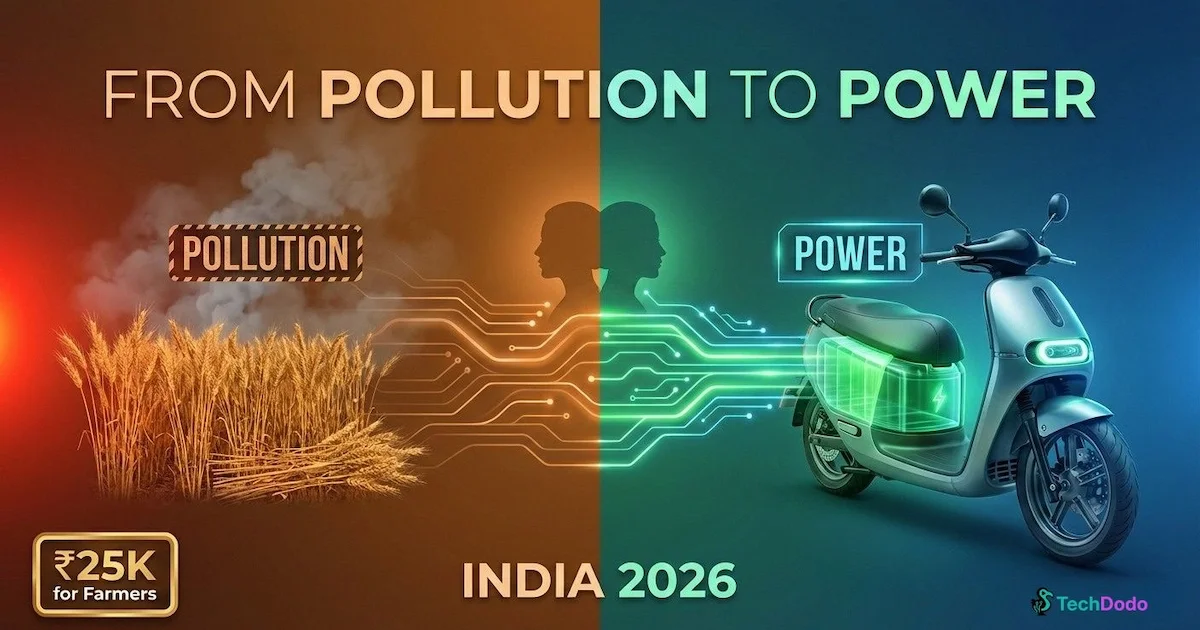
Every October, satellite images of northern India look like a war zone. Thousands of red dots — each one a farmer burning crop stubble — scatter across Punjab and Haryana. The smoke drifts southeast, and Delhi chokes.
Quick Answer: Nexus Power makes biodegradable EV batteries from crop residue at 30-40% less than lithium-ion cost. Commercial launch planned for 2026 in India. Farmers earn ₹25,000 extra per 100 batteries by selling stubble instead of burning it.
Here's the thing: what if that "pollution fuel" could power your next electric scooter?
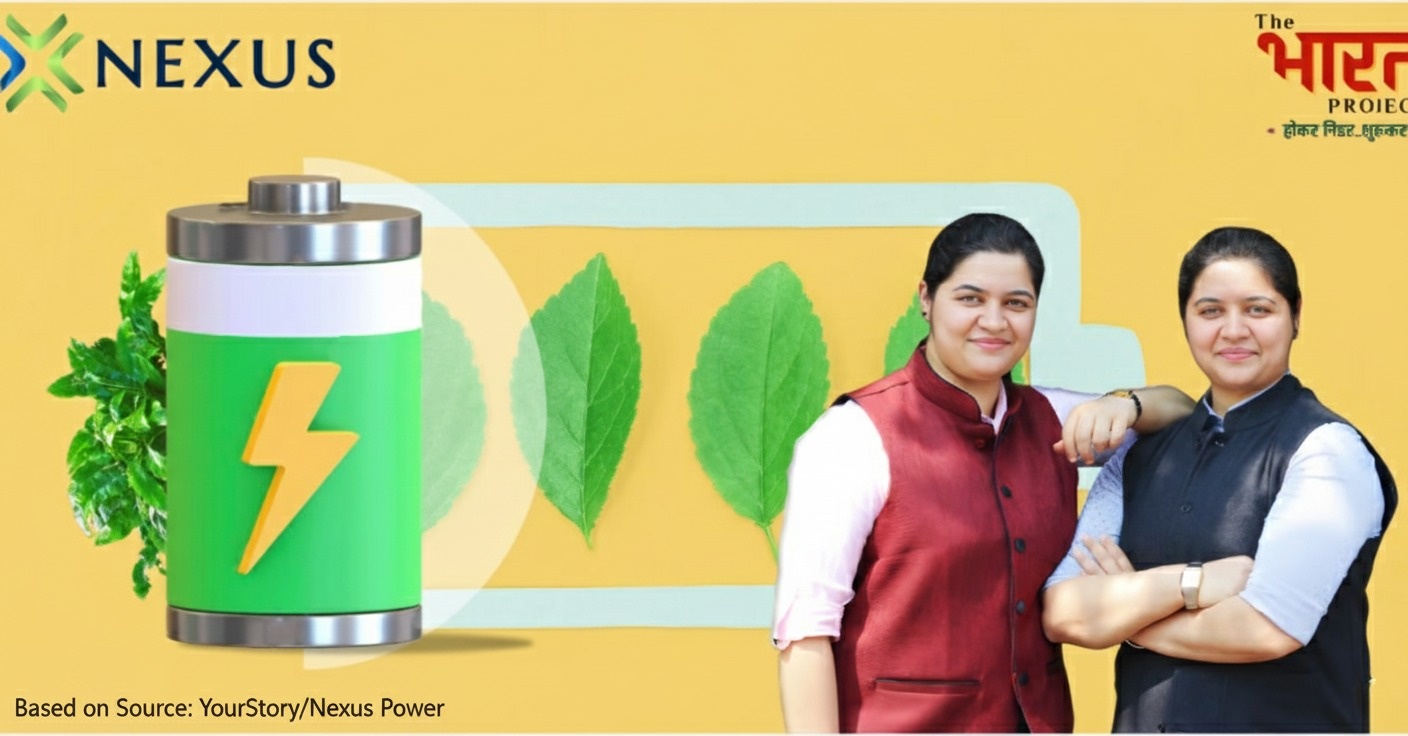
That's exactly what twin sisters Nishita and Nikita Baliarsingh figured out. Their Bhubaneswar-based startup, Nexus Power, has developed rechargeable batteries made entirely from agricultural waste. No lithium. No cobalt. No toxic disposal problem. And they claim it costs 30-40% less than what's currently in your phone or EV.
The Problem Nobody Wanted to Solve
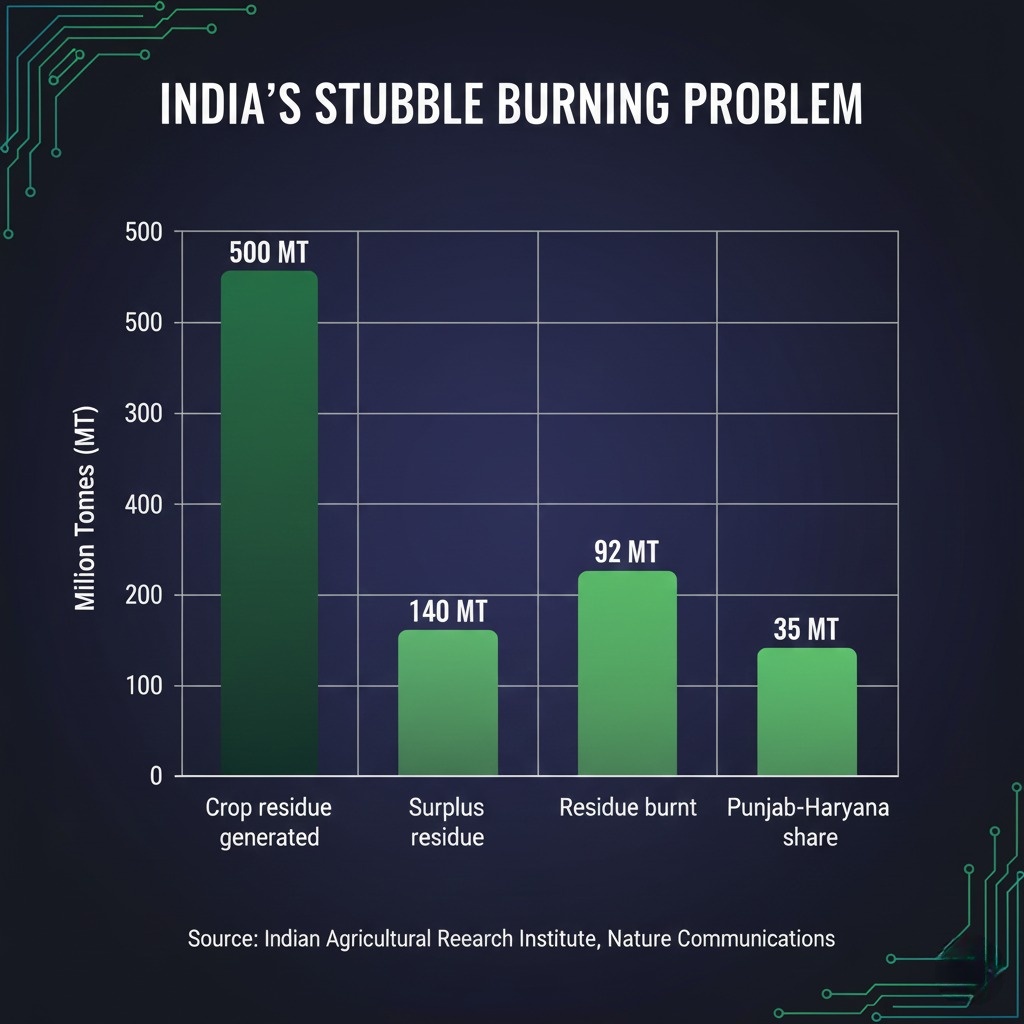
India generates around 500 million tonnes of crop residue annually. Roughly 92 million tonnes of this gets burned in the fields — mostly in Punjab, Haryana, and Uttar Pradesh. The result? Between 44,000 and 98,000 premature deaths every year from PM2.5 exposure, according to a 2022 study published in Nature Communications.
But here's where it gets interesting.
The government has tried everything — fines, subsidies for alternative equipment, awareness campaigns. Stubble burning persists because it's the cheapest, fastest way for farmers to clear fields before the next planting cycle. They have a 20-day window between harvest and sowing. Burning takes hours. Any alternative needs to be equally fast and economically viable.
How Twin Sisters From Odisha Cracked the Code
The Baliarsingh sisters weren't battery engineers by training. Nishita studied corporate finance. Nikita did mass communication. But they'd grown up around entrepreneurship — their parents ran businesses — and both had a fascination with sustainability.
"We initially wanted to manufacture electric vehicles," Nikita told YourStory. "But our research revealed that consumers didn't prefer EVs because of long charging times, expensive cars, and toxicity hazards. The battery was the core problem."
That's when things got nerdy.
Nishita went back to school for battery thermal management at IIT Kharagpur and innovation strategy at IIM Bangalore. Nikita studied nanomaterials for energy storage at IIT Roorkee. They weren't just reading about batteries — they were reverse-engineering what made lithium-ion dominant and where it fell short.
The breakthrough came from an unlikely source: a line in a research paper suggesting certain proteins could serve as effective battery electrolytes.
"During the COVID lockdown, our first home experiment successfully produced a 5V cell from chickpeas and kidney beans," Nishita recalled in an interview with Electronics For You. "Something so raw and basic, abundantly available in Indian households."
They'd accidentally discovered that protein-rich organic matter could store and discharge energy. The question became: what's the most protein-rich waste material that India has too much of?
Crop stubble.
The Tech: How Farm Waste Becomes Battery Power
Here's where most explainers get it wrong. They'll tell you it's "green" or "sustainable" — vague terms that mean nothing.
Let me break down what Nexus Power actually does:
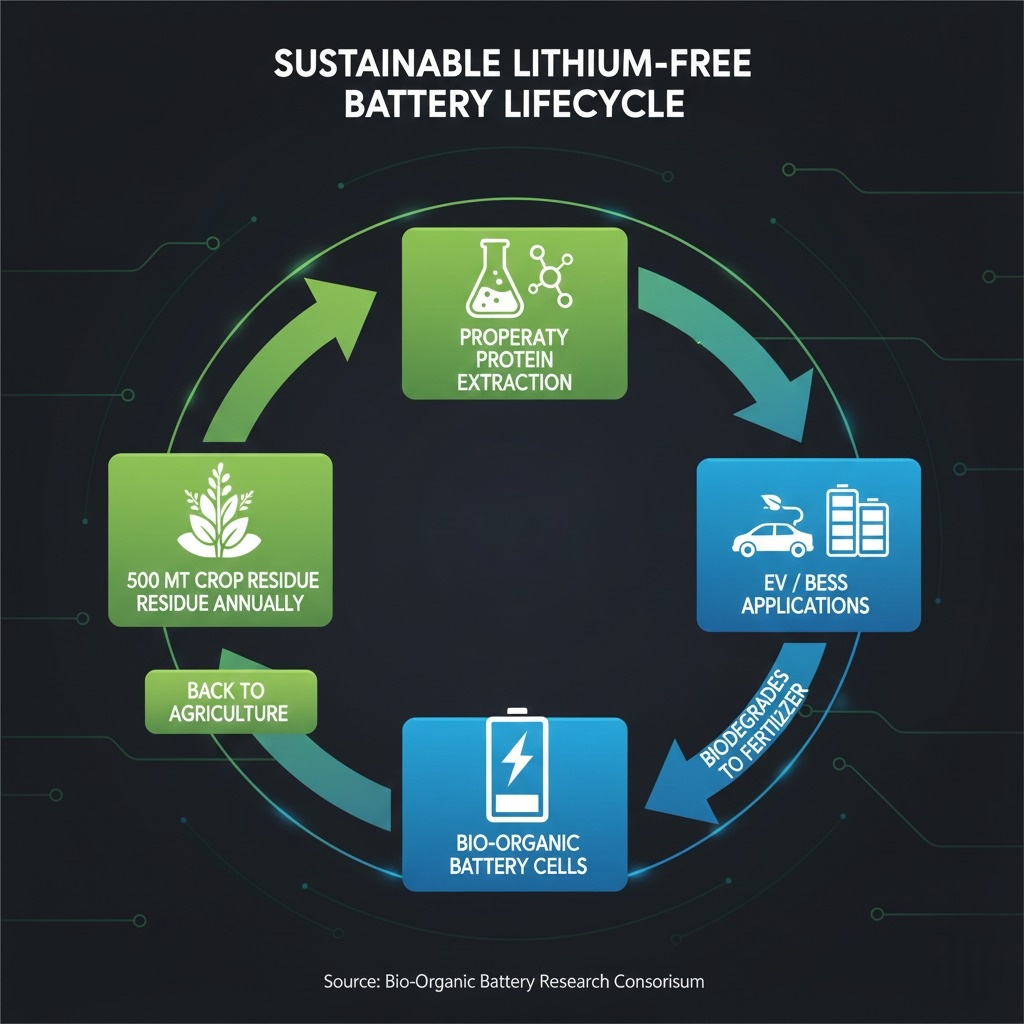
Step 1: Procurement They buy unburnt crop residue from farmers. This gives farmers an alternative income stream — reportedly ₹25,000 per 100 batteries worth of material.
Step 2: Extraction A proprietary filtration process extracts nano-proteins from the crop waste. These proteins have specific electrochemical properties that allow them to function as battery materials.
Step 3: Cell Construction The extracted materials form all three core battery components:
- Cathode (positive electrode)
- Anode (negative electrode)
- Electrolyte (the medium that allows ion transfer)
Step 4: Pack Assembly Multiple cells are combined into IoT and AI-enabled battery packs with thermal management systems — similar to how lithium-ion packs work in current EVs.
Step 5: End of Life Here's the twist: when the battery dies, the organic components can be composted. They literally turn into fertilizer.
The Numbers: Does It Actually Compete With Lithium?
Let's cut through the marketing and look at specs.
Specification | Nexus Power | Lithium-Ion (LFP) |
Cost | 30-40% cheaper | Baseline |
Charge Cycles | 1,800-2,000 | ~2,000 |
Lifespan | 4.5-5 years | ~5 years |
Biodegradable | Yes (turns to fertilizer) | No (toxic e-waste) |
Raw Material | Crop residue (abundant) | Lithium (100% imported) |
Drop-in Replacement | Yes | N/A |
Status | Pre-commercial (2026 target) | Commercially available |
The performance claims match LFP chemistry — the type used in many modern EVs. Nexus Power says they're now working toward NMC-level performance (higher energy density) for future iterations.
But here's what the specs table doesn't show: India currently imports 100% of its lithium. Li-ion battery imports jumped from $384 million in 2018-19 to $2.8 billion in 2022-23. That's a massive supply chain vulnerability, especially with China controlling 60-70% of global lithium refining.
A domestically-sourced alternative isn't just cheaper — it's strategically important.
What Nexus Power Has Actually Achieved (Not Just Promised)
Startups love to talk about potential. Here's what Nexus Power has done:
Verified Milestones:
- 35 tonnes of crop waste upcycled
- 300+ farmers engaged in the supply chain
- ₹4.5 lakh in direct rural income generated
- Prototype tested with EV manufacturers for two-wheelers
- 25-member team with materials science and engineering expertise
Recognition:
- Forbes India 30 Under 30 (2021)
- PMI Global Future 50
- Entrepreneur Magazine's "Shepreneur — Women to Watch"
- Vogue India's "Women at the Workplace" special edition
Funding & Support:
- Government grants from Department of Science and Technology
- Ministry of Biotechnology backing
- Incubated at KIIT-TBI, BITS PIEDS, IIM Udaipur
- Backed by JITO Angel Network
This isn't vapourware. They have working cells, tested prototypes, and a clear path to commercialisation.
The 2026 Roadmap: What's Coming
Nexus Power plans to roll out in phases:
Phase 1 (2026): Battery packs for electric two-wheelers, three-wheelers, and Battery Energy Storage Systems (BESS)
Phase 2 (Post-2026): Four-wheelers, commercial vehicles, drones, consumer electronics
Phase 3 (2028 Target): Scale to 2,80,000 kWh production capacity, create 170 jobs
There's also an interesting byproduct angle. During the extraction process, Nexus Power produces ethanol as a co-product. This can be sold to the oil, pharmaceutical, and beverage industries — creating an additional revenue stream and reinforcing the circular economy model.
The Catch: What Could Go Wrong
Let's be realistic about the challenges.
Regulatory Approvals: Battery certifications (BIS, AIS, IEC) take time. Hardware startups move slower than software for a reason.
Supply Chain Building: Crop residue comes from a fragmented market. Creating a reliable, year-round supply chain from thousands of small farmers is operationally complex.
Technology Risk: While prototypes work, scaling from lab to gigawatt-hour production introduces new variables. Battery chemistry can behave differently at scale.
Market Adoption: OEMs are conservative. Convincing Tata, Ather, or Ola to integrate an unproven chemistry into their vehicles requires extensive validation.
"One major challenge is establishing an effective supply chain because our batteries rely on crop residue, which comes from a fragmented and largely untapped market," Nishita acknowledged in a recent interview.
Why This Matters Beyond Batteries
Here's the bigger picture most coverage misses.
India's EV battery market is projected to grow from $3.2 billion in 2024 to roughly $9.6 billion by 2033. The government wants 30% EV penetration by 2030. But achieving this while remaining dependent on Chinese lithium supply creates a strategic vulnerability that policymakers are increasingly worried about.
Nexus Power represents a different path — one where India's agricultural "waste" becomes a competitive advantage. Crop residue is essentially infinite (500 million tonnes annually), domestically available, and currently causing a public health crisis.
If this technology scales, the implications extend beyond transportation:
- Grid Storage: BESS applications could help India meet renewable energy targets
- Farmer Income: A new revenue stream that incentivizes not burning stubble
- E-Waste Reduction: Biodegradable batteries eliminate toxic disposal problems
- Supply Chain Security: Reduced dependence on imported minerals
Common Questions About Biodegradable Batteries
Is a biodegradable battery actually practical for EVs?
Yes, if the performance matches lithium-ion. Nexus Power's cells achieve LFP-level specs with 1,800-2,000 charge cycles. The "biodegradable" aspect doesn't compromise function — it just changes what happens at end-of-life.
How much cheaper are crop residue batteries?
Nexus Power claims 30-40% cost reduction at commercial scale. Current lab-scale production is slightly higher, but scaling typically drives costs down in battery manufacturing.
Can I buy a Nexus Power battery today?
Not yet. Commercial launch is targeted for 2026, starting with electric two-wheelers and three-wheelers. The company is currently in pilot testing with EV manufacturers.
What happens to the battery after 5 years?
The organic components (cathode, anode, electrolyte) biodegrade into fertilizer. The plastic casing and metal wiring need to be separated for recycling, but the core battery material returns to the earth.
Does this actually help with Delhi's pollution?
Partially. Stubble burning contributes anywhere from 10% to 45% of Delhi's winter PM2.5 levels, depending on the study and timeframe. Creating economic alternatives to burning helps, but stubble isn't the only pollution source.
The Bottom Line
Nexus Power isn't just building batteries. They're attempting something harder: proving that Tier-2 city innovation can compete with global chemistry giants, that India's agricultural challenges can become technological advantages, and that women-led deep tech startups can go from kitchen experiments to commercial products.
Will it work? The technology is sound. The market need is massive. The team has the credentials and backing. But hardware startups face a longer, more capital-intensive path than software plays.
If you're watching India's cleantech space, Nexus Power is one to track. Not because of the hype, but because the underlying logic — turning abundant waste into valuable products while solving multiple problems simultaneously — is exactly how breakthrough companies are built.
We'll update this article when Nexus Power announces commercial availability and pricing.