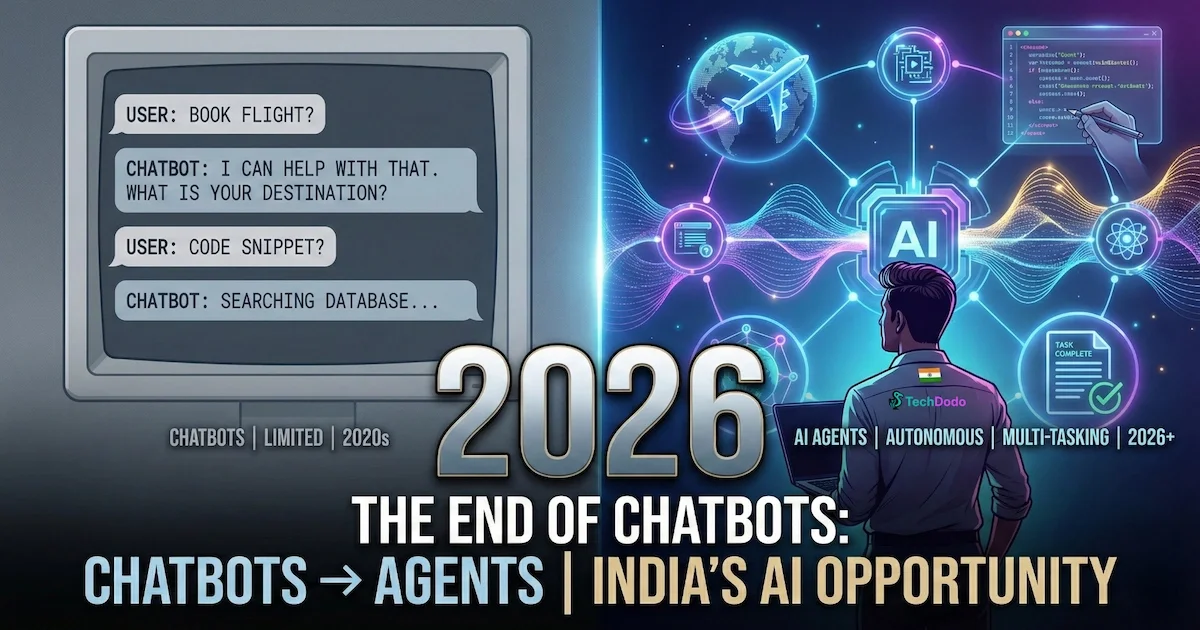
The chatbot era is over.
For three years, we've been talking to AI. Asking it questions. Getting answers. Watching it write poems, debug code, and explain quantum physics in the voice of a pirate. Entertaining? Sure. Revolutionary? Not quite.
Quick Answer: AI agents are autonomous systems that don't just respond — they act. In 2026, they'll book flights, write code, manage finances, and execute complex workflows independently. IBM and Salesforce expect 1 billion agents operational by year-end. 24% of Indian enterprises are already deploying them. The shift from "AI that talks" to "AI that does" is happening now.
Here's the thing. In 2026, AI won't just answer your questions. It'll book your flights, write your code, manage your customer support, and potentially handle tasks that took entire teams to execute. Stanford Computer Science Professor Jure Leskovec, speaking to CNBC, put it bluntly: we're about to enter "the era of autonomous agents."
And India, whether we're ready or not, is already in the thick of it.
What Are AI Agents, Exactly? (And Why Chatbots Are Now the Demo Version)
Let's clear the confusion first.
A chatbot — ChatGPT, Gemini, Claude in its basic form — is reactive. You ask, it answers. You prompt, it responds. It's like having a very smart friend who knows everything but won't lift a finger to actually do anything.
An AI agent is different. It doesn't wait for instructions at every step. You give it a goal: "Book me the cheapest flight to Goa next weekend." The agent then searches multiple airlines, compares prices, checks your calendar, considers your past preferences, and books the ticket. All while you're sipping chai.
The technical distinction matters. AI agents combine large language models with:
- Reasoning capabilities — breaking complex goals into subtasks
- Tool use — accessing APIs, databases, and external services
- Memory — learning from past interactions
- Autonomous execution — acting without human approval at each step
Microsoft's Chief Product Officer Aparna Chennapragada describes the evolution as moving from "AI answering questions to genuine collaboration." The shift is from assistant to colleague.
The Numbers That Should Wake You Up
Let's talk scale.
IBM and Salesforce expect one billion AI agents to be operational across the world by the end of 2026. That's not a typo. One billion autonomous systems making decisions, taking actions, and interacting with humans and other agents.
Gartner predicts 40% of enterprise applications will have task-specific AI agents by end of 2026. That's up from less than 5% today. Your CRM, your project management tool, your accounting software — all getting agent capabilities.
The global agentic AI market? Projected at $8.5 billion in 2026, potentially reaching $35-45 billion by 2030, according to Deloitte research.
But here's what nobody's talking about: India is actually ahead of the curve on this one.
India's Agentic AI Moment Is Already Here
The EY India C-suite GenAI survey tells a story that might surprise you.
24% of Indian enterprise leaders are already deploying agentic AI. Not piloting. Not experimenting. Deploying.
Nearly half (47%) of Indian enterprises now have multiple GenAI use cases live in production. Just 23% are still in pilot stage. The shift from "let's try this" to "let's scale this" happened faster than most analysts predicted.
And it gets more interesting. 58% of India's Global Capability Centres (GCCs) are currently investing in agentic AI, with another 29% planning to scale within the next year. That's 87% of GCCs actively moving on agents.
Metric | India Status |
Enterprises with multiple AI use cases live | 47% |
Leaders already deploying agentic AI | 24% |
GCCs investing in agentic AI | 58% |
Organizations expecting significant GenAI impact | 76% |
AI professionals in India | 1,20,000+ |
The IndiaAI Mission, backed by over ₹10,000 crore and 40,000 GPUs, is building the infrastructure for sovereign AI. Indian enterprises aren't just consuming global AI — they're building India-specific solutions.
Air India partnered with Salesforce for agentic customer service. State Bank of India is integrating autonomous conversational workflows. Cars24 deployed real-time voice intelligence using ElevenLabs' multilingual models. These aren't press releases — they're production deployments.
The Five Domains Where Agents Will Dominate in 2026
1. Customer Service (The Obvious One)
The IVRs are dead. Those press-1-for-billing, press-2-for-support systems? Dinosaurs.
Voice-native AI agents can now maintain context, reason across systems, and handle complete conversations without transferring you to a human. Salesforce leaders predict that by 2026, agents will be "embedded deeply enough in daily work that opting out will feel increasingly untenable."
For Indian companies, this is huge. Multilingual support — Hindi, Tamil, Telugu, Marathi — is no longer a nice-to-have. Solutions that don't understand local context are "simply not useful," according to GreyLabs AI founder Aman Goel.
2. Travel Booking (The Game-Changer)
Google is developing agentic tools for booking flights and hotels directly within AI Mode. The company is working with Booking.com, Expedia, Marriott, and other partners to make this happen.
But here's the catch: consumer trust remains limited. A Skift survey found only 2% of respondents would give AI full autonomy to book travel. The opportunity? Building agents that handle the research and logistics while keeping humans in the loop for final decisions.
Trip.com already launched TripGenie — an AI assistant that plans itineraries, books across flights and hotels, and rebooks automatically during disruptions.
3. Software Development (The Developer Advantage)
This is where Indian developers should pay close attention.
Claude Code and GitHub Copilot represent two philosophies of AI-assisted coding. Copilot is the accelerator — inline completions, fast suggestions, integrated into your IDE. Claude Code is the agentic collaborator — reading your entire codebase, proposing multi-file edits, executing terminal commands.
Claude Opus 4 currently leads SWE-bench at 72.5% and Terminal-bench at 43.2%. GitHub says Claude Sonnet 4 "soars in agentic scenarios" and powers their new coding agent.
The practical difference?
Task | GitHub Copilot | Claude Code |
Inline completions | ✅ Winner | Good |
Multi-file refactoring | Basic | ✅ Winner |
Codebase understanding | File-level | ✅ Repo-level |
Autonomous task completion | Limited | ✅ Strong |
Speed for simple tasks | ✅ Winner | Slower |
The smart move? Use both. Copilot for daily flow, Claude for planned refactors and migrations.
4. Enterprise Operations (The Quiet Revolution)
Behind the scenes, agents are handling supply chain optimization, compliance monitoring, fraud detection, and portfolio rebalancing. These aren't customer-facing — they're operational backbone systems.
According to the EY report, Indian enterprises are prioritizing GenAI investments in operations (63%), customer service (54%), and marketing (33%) over the next 12 months.
The continuous decision-making capability Leskovec describes — agents that "continually optimize, getting information and streamlining processes in real time" — is already happening in Indian GCCs.
5. Finance and Compliance (The High-Stakes Domain)
Fenmo AI, a Bengaluru startup, specializes in agentic AI for FinTech — automating invoice matching, reconciliation, and close management. Their solution integrates with existing ERPs without requiring new dashboards.
The finance domain is high-stakes, which means agents need governance guardrails. But the ROI is clear: tasks that took teams of accountants can now be handled by autonomous systems with human oversight.
The Job Question: Will AI Agents Replace You?
Let's address the elephant in the room.
The World Economic Forum's Future of Jobs Report projects 92 million jobs displaced by 2030, with 170 million new jobs created. A net gain of 78 million jobs globally.
But here's the nuance the headlines miss: these aren't direct exchanges. The jobs that disappear and the jobs that appear aren't in the same locations, with the same skills, for the same people.
In India, the EY report shows 64% of enterprises report selective workforce transformation in standardized tasks — administrative operations, customer success, telecalling, back-office processes. Rather than shrinking teams, AI is redirecting spend toward automation and efficiency.
The pattern emerging is "human-AI teams" or what some call "hybrid pods." One agent diagnoses, another remediates, a third validates, a fourth updates documentation. Humans provide strategic direction and handle exceptions.
Gnani.ai CEO Ganesh Gopalan notes that 2025 saw a "deep and rapid disruption in customer experience and customer-facing processes." The jobs that remain are in oversight, governance, and the irreducibly human tasks that require creativity, empathy, and complex judgment.
What Indian Developers Should Do Right Now
The opportunity is clear. The window is narrow.
Learn agent orchestration. Multi-agent systems — where specialized agents collaborate on complex tasks — are the next frontier. Google's A2A protocol, the Model Context Protocol (MCP), and frameworks like CrewAI are becoming essential skills.
Build with governance in mind. Forrester predicts an agentic AI deployment will cause a major public data breach in 2026. Organizations deploying agents without adequate safeguards face real consequences. The startups that win will be those that build trust and control into their architecture from day one.
Focus on India-specific problems. Multilingual voice AI, vernacular LLMs, and solutions that work on unreliable networks and low-compute devices are differentiated advantages. If your AI doesn't work in Hindi in a Tier-3 city, it's not solving for India.
Get practical experience. Claude Code is generally available. GitHub Copilot has a free tier. The agents are here — the question is whether you're building with them or waiting to be disrupted by them.
The Uncomfortable Truth About 2026
Here's what most coverage of AI agents gets wrong.
The shift isn't about replacing humans with machines. It's about redesigning how work itself happens. The enterprises that win won't be those that deploy the most agents — they'll be those that redesign processes around human-agent collaboration.
Anindya Das, CTO of AI cloud company Neysa, puts it directly: "Enterprises are now designing AI as critical infrastructure. That changes every decision around architecture, cost, security and ownership."
The companies still treating agents as "side projects" in 2026 will face growing challenges in attracting talent, meeting customer expectations, and sustaining legacy process models. By 2027, they'll be playing catch-up.
For Indian developers and startups, the timing is actually favorable. India has 1,20,000+ AI professionals, 185+ AI/ML GCC hubs, and a government actively backing indigenous AI infrastructure. The pieces are in place.
The question isn't whether AI agents will transform how work gets done. It's whether you'll be building them, working alongside them, or scrambling to adapt after everyone else already has.
The chatbot era was the demo. The agentic era is the product.
And it ships in 2026.
Common Questions About AI Agents 2026
What are AI agents and how are they different from chatbots?
AI agents are autonomous systems that plan, reason, and take independent action to complete goals. Unlike chatbots that respond to individual prompts, agents can book flights, write code across multiple files, and manage complex workflows without step-by-step human guidance.
Will AI agents replace jobs in India?
Selectively. The World Economic Forum predicts 92 million jobs displaced globally by 2030, but 170 million new jobs created. In India, 64% of enterprises report transformation in standardized tasks, but new roles are emerging in AI oversight, governance, and human-agent collaboration.
What are the best AI agents for coding in 2026?
Claude Code leads for repo-wide tasks and autonomous coding (72.5% on SWE-bench). GitHub Copilot wins for speed and inline completions. Most developers use both — Copilot for daily flow, Claude for complex refactors.
How are Indian companies using agentic AI?
Air India partnered with Salesforce for agentic customer service. SBI is integrating autonomous workflows. Cars24 deployed multilingual voice intelligence. 47% of Indian enterprises have multiple GenAI use cases in production, with 58% of GCCs investing in agentic AI.