The Clock Is Ticking on the Agentic AI Shift
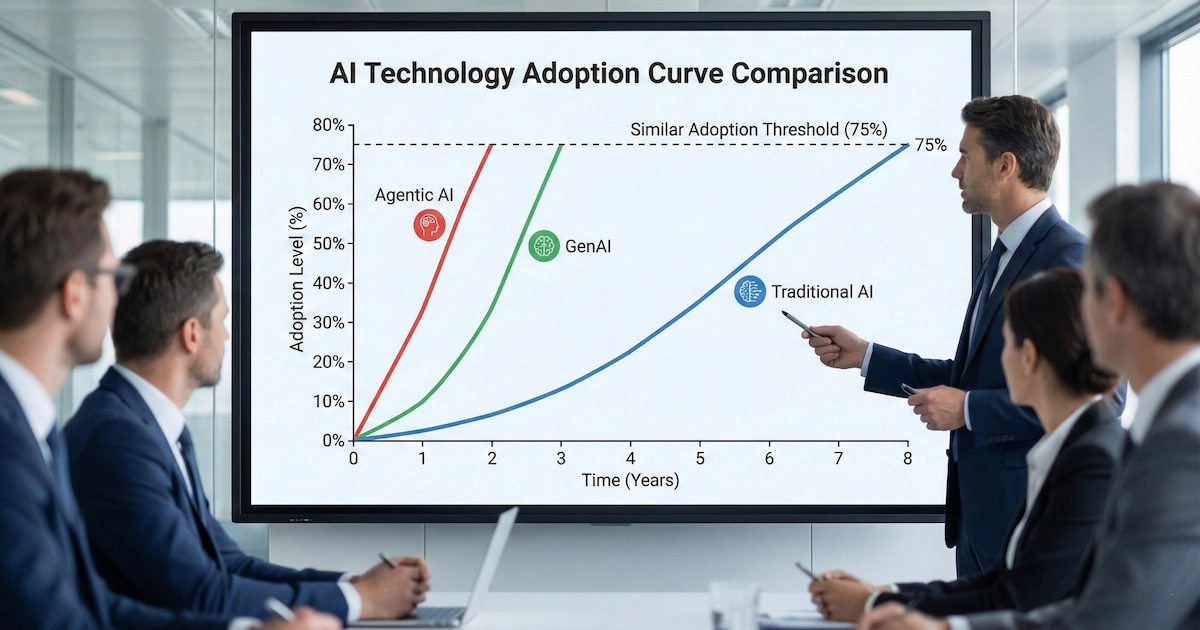
Something unusual happened in enterprise AI adoption over the past 24 months. Traditional AI took eight years to reach 72% adoption. Generative AI compressed that to three years. Agentic AI? According to MIT Sloan Management Review and Boston Consulting Group's November 2025 research, it has already hit 35% adoption in merely two years—with another 44% planning deployment soon.
This isn't incremental progress. This is a fundamental rewiring of how businesses operate.
Agentic AI systems differ from predecessors in one critical way: they don't wait for instructions. These systems perceive context, make decisions, and take actions autonomously. They plan multi-step workflows, learn from outcomes, and adapt—often coordinating with other AI agents to accomplish complex objectives.
For business leaders, this raises an uncomfortable question: How do you prepare for technology that fundamentally changes the relationship between human workers and automated systems?
Why 2026 Matters: The Convergence Point
Multiple forces are converging to make 2026 the inflection point for enterprise agentic AI.
Regulatory frameworks are crystallizing. The EU AI Act's rules for high-risk AI systems take effect in August 2026, requiring documented risk controls and human oversight checkpoints. In India, the newly released AI Governance Guidelines 2025 establish a "light-touch" regulatory framework ahead of the India-AI Impact Summit in February 2026—the first major AI summit hosted in the Global South.
Technology maturity is accelerating. Gartner predicts that by end of 2026, 40% of enterprise applications will include task-specific AI agents—up from less than 5% in 2025. IDC projects 40% of all Global 2000 job roles will involve working directly with AI agents.
The economic stakes are substantial. McKinsey estimates agentic AI could generate $450-650 billion in additional annual revenue by 2030 in advanced industries alone. The global market is projected to expand from $7.06 billion (2025) to $93.20 billion by 2032—a 44.6% CAGR.
Yet here's the sobering reality: while 62% of organizations experiment with agentic systems, only 23% have achieved enterprise-scale deployment. Deloitte's 2025 study found just 14% have production-ready solutions—and 35% have no formal strategy at all.
The Five Pillars of Agentic AI Readiness
Based on research from McKinsey, MIT Sloan, PwC, and Deloitte, successful preparation follows five interconnected dimensions.
Pillar 1: Data Foundation and Productization
Agentic AI requires enterprise data that most organizations haven't properly prepared. In Deloitte's 2025 survey, nearly half cited data searchability (48%) and reusability (47%) as primary barriers.
What to do now:
- Break down data silos. Agentic systems need information from across departments, cloud environments, and legacy systems. Fragmented data estates cripple agent effectiveness.
- Implement data lineage tracking. Under the EU AI Act, organizations must demonstrate exactly what datasets contributed to each output. This is a compliance requirement, not optional.
- Productize data assets. Treat internal data as products with clear ownership, quality standards, and accessibility rules.
India-specific: The AI Governance Guidelines recommend integrating AI with Digital Public Infrastructure (Aadhaar, UPI). Evaluate how your data architecture aligns with these national systems.
Pillar 2: Governance Architecture
Agentic AI presents challenges traditional IT frameworks weren't designed to handle. MIT Sloan researchers frame it bluntly: "How do we manage artificial colleagues that we own like equipment but must supervise like people?"
What to do now:
- Define agent autonomy levels. KPMG classifies agents as Automators (end-to-end workflows), Collaborators (working alongside humans), and Orchestrators (multi-agent coordination). Each requires different oversight.
- Establish decision boundaries. Agents need clear rules about independent action versus human escalation—technically enforced, not just documented.
- Build continuous monitoring. Governance must become "real time, data driven, and embedded." Deploy critic agents that challenge outputs and guardrail agents enforcing policy automatically.
Cross-functional requirement: Effective governance requires IT, HR, finance, legal, and operations collaboration. No single function can manage these systems alone.
Pillar 3: Technology Infrastructure
Agents built on different platforms need to work together, share information, and coordinate actions.
What to do now:
- Adopt "agentic AI mesh" architecture. McKinsey describes this as infrastructure integrating both custom-built and off-the-shelf agents into a coherent system.
- Implement multi-agent orchestration. Coordination layers that manage diverse agents while maintaining governance controls become essential.
- Embrace composable architecture. Gartner projects organizations with composable systems will outpace competitors by 80% in feature implementation speed by 2026.
Pillar 4: Workforce Transformation
KPMG's 2025 CEO Outlook found nearly three-quarters of global CEOs plan to invest 20% of their entire budget on AI—and they're not preparing for layoffs. They're building what KPMG calls the "superhuman employee": professionals augmented by AI.
What to do now:
- Identify emerging roles. Expect "Agent Bosses" (who govern AI agents), "Agent Evaluators" (who assess outcomes), and "Superhumans" (employees collaborating with agents as teammates).
- Invest in continuous reskilling. Kyndryl's 2025 report found 87% of leaders believe AI will reshape jobs within a year, but only 29% feel their workforce is ready.
- Address change management proactively. McKinsey identifies 41% of employees as apprehensive about AI's impact. Transparent communication turns skeptics into champions.
India opportunity: IDC notes three out of four EMEA employees expect job impacts by 2026. India's AI Governance Guidelines emphasize workforce development integration with national skilling initiatives.
Pillar 5: Strategic Process Redesign
Most organizations stumble here: they automate existing processes designed for humans rather than reimagining how work should function.
Deloitte's analysis is direct: "True value comes from redesigning operations, not just layering agents onto old workflows."
What to do now:
- Prioritize strategically. McKinsey's framework evaluates business impact, implementation feasibility, risk profile, time to value, and learning potential.
- Design agent-compatible processes. Traditional workflows assume human judgment at every turn. Agents need processes built for their capabilities.
- Launch lighthouse projects. High-impact transformations in core areas create visible wins building organizational momentum.
What Experts Disagree On
Timeline predictions vary. While sources point to 2026 as the inflection point, CIO Magazine warns agentic AI will be "more mixed than mainstream." Memory limitations remain unsolved.
Governance approaches differ regionally. India's "light-touch" model emphasizes innovation. The EU AI Act takes a prescriptive approach. The US lacks comprehensive federal legislation. Global organizations must navigate all three.
Build-versus-buy remains unsettled. The 2026 landscape includes Buy, Hybrid, and Build models—each with distinct compliance and capability trade-offs.
The Risk of Inaction
Regulatory exposure increases. Once EU AI Act enforcement begins August 2026, organizations deploying agents without proper governance face significant penalties.
Talent gaps widen. Global AI talent demand exceeds supply by more than 3:1. Delayed workforce transformation means competing for scarce skills against better-prepared competitors.
Technical debt accumulates. Layering agentic capabilities onto unreformed architecture creates compounding problems.
Your 90-Day Action Plan
Days 1-30: Conduct data readiness audit. Identify 2-3 candidate use cases. Establish cross-functional steering group.
Days 31-60: Document governance gaps. Begin workforce skills assessment. Evaluate architecture against mesh requirements.
Days 61-90: Select one lighthouse project. Implement use-case-specific governance. Establish outcome-focused metrics.
The organizations succeeding with agentic AI will treat this as business transformation, not technology deployment. The technology is ready. Regulations are forming. The question is whether your organization will be ready to meet them.
We'll update this guide as regulatory guidance emerges from the India-AI Impact Summit (February 2026) and EU AI Act enforcement details finalize.